About the Oak Artichoke Gall Wasp
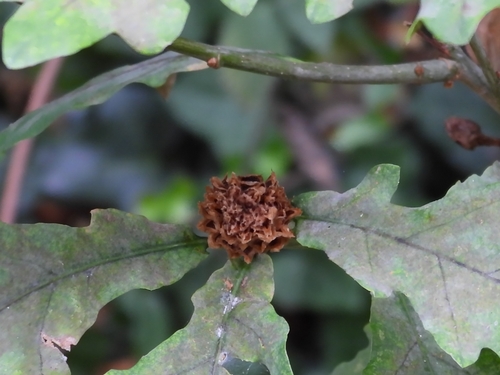
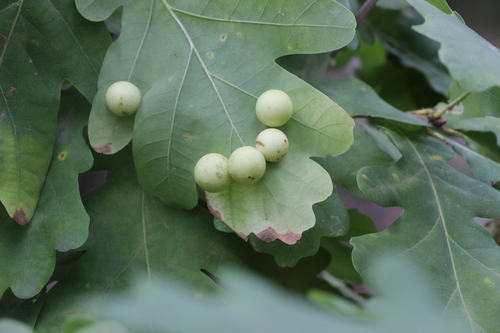
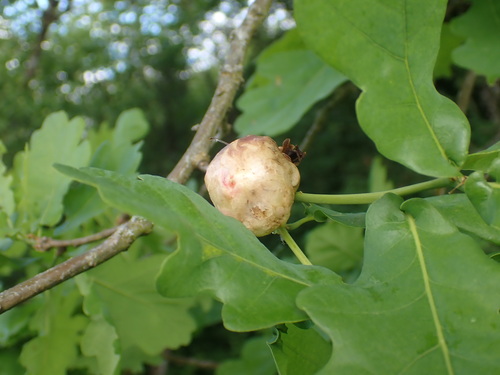
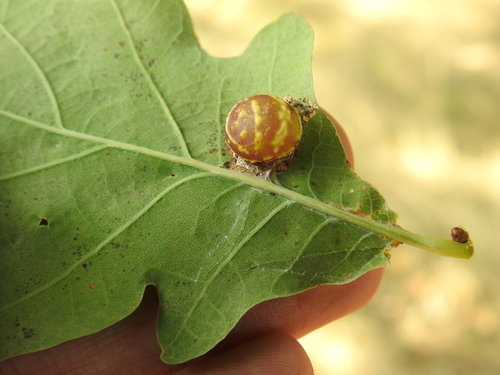
Andricus foecundatrix (formerly Andricus fecundator) is a parthenogenetic gall wasp which lays a single egg within a leaf bud, using its ovipositor, to produce a gall known as an oak artichoke gall, oak hop gall, larch-cone gall or hop strobile. The gall develops as a chemically induced distortion of leaf axillary or terminal buds on pedunculate oak (Quercus robur) or sessile oak (Quercus petraea) trees. The larva lives inside a smaller hard casing inside the artichoke and this is released in autumn. The asexual wasp emerges in spring and lays her eggs in the oak catkins. These develop into small oval galls which produce the sexual generation of wasps. A yew artichoke gall caused by the fly Taxomyia taxi also exists, but is unrelated to the oak-borne species. Previous names or synonyms for the species A. fecundator are A. fecundatrix, A. pilosus, A. foecundatrix (see below), A. gemmarum, A. gemmae, A. gemmaequercus, A. gemmaecinaraeformis and A. quercusgemmae.
The scientific name is now once again Andricus foecundatrix. Young galls exhibit a tuft of long hairs protruding from the centre of the 'artichoke', the remainder being overlapping scales. The hairs are attached to... Wikipedia →