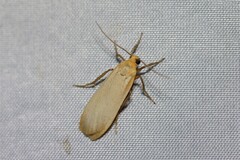
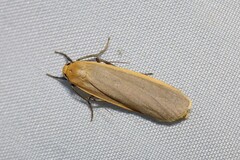
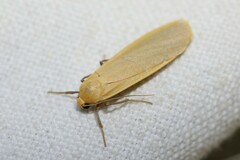
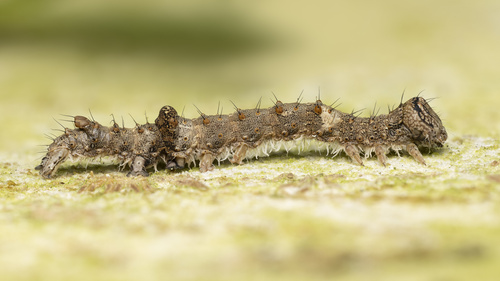
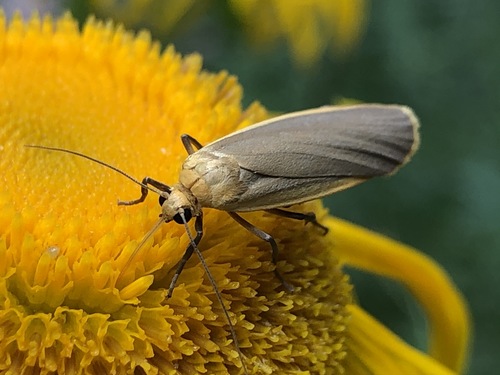
Buff Footman
Daily sighting probability <5% · Rare
at Munich

In 3 days ~10% in a week ~20%

7 Verified sightings at Munich
163 In all 5 parks From 2019 to 2026
July Best month
☀️🌙 Day & Night When it's spotted

About the Buff Footman

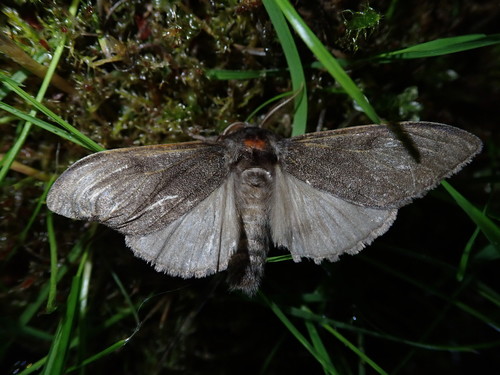
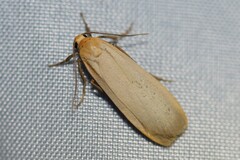
Katha depressa, the buff footman, is a moth of the family Erebidae found in Asia and Europe. It was first described by Eugenius Johann Christoph Esper in 1787. The length of the forewings is 15–17 mm. Both wings dark brown grey, with the costa of the forewing and the fringes light bright yellow, especially in the female. The ground colour is often more or less lightened with ochreous, sometimes almost clay-colour (ochreola Hbn.), or nearly whitish (helveola Ochs.) or of an indefinite intermediate shade (luteola Hbn.). In pavescens Butl. from Hokkaido (Island of Yezo), the wings are dirty greyish yellow; the hindwing lighter.

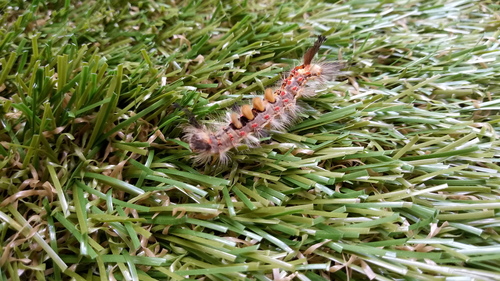
Katha deplana deplana Katha deplana pavescens (Butler, 1877) (Russia: Middle Amur, Primorye, Sakhalin, Kunashir; Korea; Japan) Larvae are a dirty lead-grey colour, bearing a yellow dorsal stripe with dark edges and three raised black transverse spots anteriorly, posteriorly and in the centre, and black markings laterally. The larvae feed on lichen and algae, especially on conifer trees, but also on oak (Quercus species) and heathers (Calluna species). Until June, on lichens on trees. Pupa... Wikipedia →
Global Distribution

Parks Where Found

# Park Country Daily sighting probability
1 Bavarian Forest National Park 🇩🇪 Germany
~10%
2 Snowdonia National Park 🇬🇧 United Kingdom
~10%
3 Pyrénées National Park 🇫🇷 France
~10%
4 Cévennes National Park 🇫🇷 France
~10%
5 Wadden Sea National Park 🇩🇪 Germany
<5%

Cities Where Found

# City Country Daily sighting probability
1 Porto 🇵🇹 Portugal
~20%
2 London 🇬🇧 United Kingdom
~10%
3 Liverpool 🇬🇧 United Kingdom
<5%
4 Munich 🇩🇪 Germany
<5%

Before you go

What are the chances of seeing a Buff Footman in Munich?

Rare

Under 5% of wildlife watchers report a Buff Footman sighting in Munich on a given day, based on 7 verified sightings from GBIF citizen-science data. It is the 392nd most-seen of the 521 insects we can rate there. Over three days the chance rises to about 10%, and over a week to about 20%, if each day is a fresh chance.

When is the best time to see a Buff Footman in Munich?

July

In that month about 10% of wildlife watchers report a Buff Footman in Munich on a given day, against under 5% in August to June, the lowest months. That is one of Munich's wettest months, with about 140 mm of rain against 60 mm in February.

What time of day is best to see a Buff Footman?

Between 10 pm and 1 am

Across all the parks we cover, that three-hour window holds the most Buff Footman sightings with a recorded time, and about 6 in 10 of them come between 6 pm and 6 am: it is seen both by day and at night.

Is Munich the best place to see a Buff Footman?

4th of 4

Of the 4 cities where we can rate Buff Footman sightings, Munich ranks 4th at under 5%. The best odds are in Porto (Portugal, about 20%), London (United Kingdom, about 10%) and Liverpool (United Kingdom, under 5%).

Which relatives of the Buff Footman live in Munich?

Same family: Erebidae

The closest relatives of the Buff Footman that you can see in Munich (family Erebidae, Underwing, Tiger, Tussock, and Allied Moths) are Burnet Companion (about 10%), Rusty Tussock Moth (about 10%) and Four-Spotted Footman (about 10%), with each one's daily chance of a sighting.

Where does the Buff Footman sighting chance come from?

GBIF citizen-science records

It is estimated from how often the Buff Footman is recorded against all the insects logged in Munich (7 verified sightings), calibrated against known sighting rates. Figures are rounded to the nearest 10% because citizen-science data supports honest approximations, not decimals, and months with records from fewer than five people show "—". How it works.

← Back to Munich