Chunam Tree Frog

Chunam Tree Frog

Polypedates maculatus

Silhouette: Jose Carlos Arenas-Monroy · PhyloPic

LCLeast ConcernNTVUENCR
Daily sighting probability ~10% · With luck
at Mysuru

In 3 days ~30% in a week ~60%

5 Verified sightings at Mysuru
98 In all 4 parks From 2019 to 2026
May Best month
🌅 Crepuscular When it's spotted

About the Chunam Tree Frog

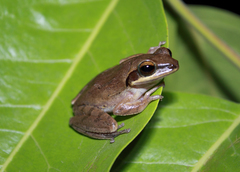
Polypedates maculatus, the Indian tree frog, or Chunam tree frog, is a common species of tree frog found in South Asia. It was described by John Edward Gray in 1830. Although now considered as a separate species again, for a time, the Himalayan tree frog was considered as a subspecies of the Indian tree frog (as P. m. himalayensis). Polypedates leucomystax, a very similar species, was formerly included in P. maculatus.

These frogs measure about 7–8 cm in body length. They are mostly brownish, yellowish, greyish, or whitish above, with darker spots or markings, rarely with an hourglass-shaped figure on the back of the head and the front of the back. The loreal and temporal regions are dark; there is a light line on the upper lip. The hind side of the thighs has round, yellow spots, which are usually separated by a dark-brown or purplish network. The skin is smooth above, and granulated on the belly and under the thighs; a fold extends from the eye to the shoulder. Males have internal vocal sacs.

The vomerine teeth are arranged in two more or less oblique series between the choanae or commencing close to the inner front edge of the latter. The skin of head is free;... Wikipedia →

Global Distribution

Parks Where Found

# Park Country Daily sighting probability
1 Wilpattu National Park 🇱🇰 Sri Lanka
~50%
2 Yala National Park 🇱🇰 Sri Lanka
~40%
3 Minneriya National Park 🇱🇰 Sri Lanka
~30%
4 Udawalawe National Park 🇱🇰 Sri Lanka
~30%

Cities Where Found

# City Country Daily sighting probability
1 Ponnani 🇮🇳 India
~40%
2 Thrissur 🇮🇳 India
~30%
3 Raipur 🇮🇳 India
~30%
4 Jabalpur 🇮🇳 India
~30%
5 Chennai 🇮🇳 India
~30%
6 Kollam 🇮🇳 India
~30%
7 Kozhikode 🇮🇳 India
~20%
8 Dehradun 🇮🇳 India
~20%
9 Colombo [Sri Jayawardenepura Kotte] 🇱🇰 Sri Lanka
~20%
10 Bengaluru 🇮🇳 India
~10%

Before you go

What are the chances of seeing a Chunam Tree Frog in Mysuru?

With luck

About 10% of wildlife watchers report a Chunam Tree Frog sighting in Mysuru on a given day, based on 5 verified sightings from GBIF citizen-science data. Over three days the chance rises to about 30%, and over a week to about 60%, if each day is a fresh chance.

When is the best time to see a Chunam Tree Frog in Mysuru?

May

In that month about 30% of wildlife watchers report a Chunam Tree Frog in Mysuru on a given day, against under 5% in June–August and October–February, the lowest months. That is one of Mysuru's wettest months, with about 120 mm of rain against almost none in January.

What time of day is best to see a Chunam Tree Frog?

Between 7 and 10 pm

Across all the parks we cover, that three-hour window holds the most Chunam Tree Frog sightings with a recorded time, and about 7 in 10 of them come between 6 pm and 6 am: it is most active around dawn and dusk.

Is Mysuru the best place to see a Chunam Tree Frog?

11th of 15

Of the 15 cities where we can rate Chunam Tree Frog sightings, Mysuru ranks 11th at about 10%. The best odds are in Ponnani (India, about 40%), Thrissur (India, about 30%) and Raipur (India, about 30%).

Which relatives of the Chunam Tree Frog live in Mysuru?

Same order: Anura

The closest relatives of the Chunam Tree Frog that you can see in Mysuru (order Anura, Frogs and Toads) are Common Indian Toad (about 30%) and Sri Lankan Bullfrog (about 10%), with each one's daily chance of a sighting.

Where does the Chunam Tree Frog sighting chance come from?

GBIF citizen-science records

It is estimated from how often the Chunam Tree Frog is recorded against all the amphibians logged in Mysuru (5 verified sightings), calibrated against known sighting rates. Figures are rounded to the nearest 10% because citizen-science data supports honest approximations, not decimals, and months with records from fewer than five people show "—". How it works.

← Back to Mysuru
