Gray-streaked Flycatcher

Gray-streaked Flycatcher

Muscicapa griseisticta

Silhouette: Ekytza · PhyloPic

LCLeast ConcernNTVUENCR
Daily sighting probability <5% · Rare
at Naha

In 3 days ~10% in a week ~20%

11 Verified sightings at Naha
179 In all 6 parks From 2019 to 2026
October Best month
☀️ Diurnal When it's spotted

About the Gray-streaked Flycatcher

The grey-streaked flycatcher or grey-spotted flycatcher (Muscicapa griseisticta) is a small passerine bird breeding in the eastern Palearctic belonging to the genus Muscicapa in the Old World flycatcher family Muscicapidae. The species was first described by Robert Swinhoe in 1861.

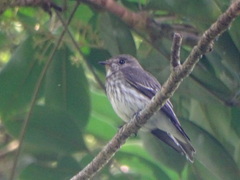
It is a slender, long-winged bird with a length of 13 to 15 cm. It is mainly grey brown above and white below. The breast and flanks are heavily streaked with grey. There is a narrow white bar on the wing and a pale patch between the bill and eye. The bill and feet are black. The eye is large and there is a white eye-ring. The adult male and female are alike but juvenile birds differ in having white spots and dark scaling on the upperparts.

It breeds in the vast coniferous forests in north-east China, North Korea and south-east Siberia including Sakhalin and Kamchatka. In spring and autumn it migrates through eastern and southern China, South Korea, Japan and Taiwan. In winter it occurs in forests, forest edges and open country with scattered trees in Borneo, the Philippines, Palau, eastern Indonesia and New Guinea. It is a vagrant to Singapore, Vietnam, Alaska and Australia.

It perches in the open, waiting for passing insects, then flies out up to 20 metres to catch them before returning to its perch and eating them. Wikipedia →

Sounds

Song0:20

China · 2026

© Peter Boesman · XC1147643 · CC BY-NC-ND 4.0

Call0:24

China · 2021

© Geoff Carey · XC742098 · CC BY-NC-SA 4.0

Song0:37

China · 2012

© Frank Lambert · XC114225 · CC BY-NC-ND 4.0

Global Distribution

Parks Where Found

# Park Country Daily sighting probability
1 Tangkoko Nature Reserve 🇮🇩 Indonesia
~10%
2 Raja Ampat 🇮🇩 Indonesia
<5%
3 Danum Valley Conservation Area 🇲🇾 Malaysia
<5%
4 Sepilok 🇲🇾 Malaysia
<5%
5 Taroko National Park 🇹🇼 Taiwan
<5%
6 Kinabalu Park 🇲🇾 Malaysia
<5%

Cities Where Found

# City Country Daily sighting probability
1 Jinhua 🇨🇳 China
~10%
2 Manila 🇵🇭 Philippines
~10%
3 Cebu City 🇵🇭 Philippines
~10%
4 Hangzhou 🇨🇳 China
~10%
5 Ningbo 🇨🇳 China
~10%
6 Fuzhou 🇨🇳 China
~10%
7 Nanjing 🇨🇳 China
<5%
8 Suzhou 🇨🇳 China
<5%
9 Davao City 🇵🇭 Philippines
<5%
10 Shanghai 🇨🇳 China
<5%

Before you go

What are the chances of seeing a Gray-streaked Flycatcher in Naha?

Rare

Under 5% of wildlife watchers report a Gray-streaked Flycatcher sighting in Naha on a given day, based on 11 verified sightings from GBIF citizen-science data. It is the 69th most-seen of the 81 birds we can rate there. Over three days the chance rises to about 10%, and over a week to about 20%, if each day is a fresh chance.

When is the best time to see a Gray-streaked Flycatcher in Naha?

October

In that month about 20% of wildlife watchers report a Gray-streaked Flycatcher in Naha on a given day, against under 5% in November to September, the lowest months.

What time of day is best to see a Gray-streaked Flycatcher?

Between 2 and 5 pm

Across all the parks we cover, that three-hour window holds the most Gray-streaked Flycatcher sightings with a recorded time, and about 9 in 10 of them come between 6 am and 6 pm: it is a daytime animal.

Is Naha the best place to see a Gray-streaked Flycatcher?

11th of 23

Of the 23 cities where we can rate Gray-streaked Flycatcher sightings, Naha ranks 11th at under 5%. The best odds are in Jinhua (China, about 10%), Manila (Philippines, about 10%) and Cebu City (Philippines, about 10%).

Where does the Gray-streaked Flycatcher sighting chance come from?

GBIF citizen-science records

It is estimated from how often the Gray-streaked Flycatcher is recorded against all the birds logged in Naha (11 verified sightings), calibrated against known sighting rates. Figures are rounded to the nearest 10% because citizen-science data supports honest approximations, not decimals, and months with records from fewer than five people show "—". How it works.

← Back to Naha