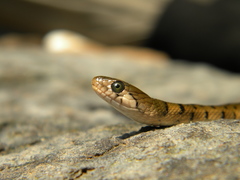
Chequered Keelback

Chequered Keelback

Fowlea piscator

Silhouette: Alex Slavenko · PhyloPic

LCLeast ConcernNTVUENCR
Daily sighting probability ~20% · Possible
at Nashik

In 3 days ~50% in a week ~80%

5 Verified sightings at Nashik
49 In all 6 parks From 2019 to 2026
November Best month
🌅 Crepuscular When it's spotted

About the Chequered Keelback

The checkered keelback (Fowlea piscator), also known commonly as the Asiatic water snake, is a common species in the subfamily Natricinae of the family Colubridae. The species is endemic to Asia. It is non-venomous. The eye of F. piscator is rather small and shorter than its distance from the nostril in the adult. Its rostral scale is visible from above. The internasal scales are much narrowed anteriorly and subtriangular, with the anterior angle truncated and as long as the prefrontal scales. The frontal scale is longer than its distance from the end of the snout, and as long as the parietals or a little shorter. The loreal is nearly as long as it is deep. There are one preocular and three (rarely four) post-oculars. Its temporals are 2+2 or 2+3. There are normally nine upper labials, with the fourth and fifth entering the eye; and five lower labials in contact with the anterior chin-shields, which are shorter than the posterior. The dorsal scales are arranged in 19 rows, strongly keeled, with outer rows smooth. The ventrals number 125–158, the anal is divided, and the subcaudals number 64–90. Coloration is very variable, consisting of dark spots arranged quincuncially... Wikipedia →

Global Distribution

Parks Where Found

# Park Country Daily sighting probability
1 Keoladeo National Park 🇮🇳 India
~30%
2 Ranthambore National Park 🇮🇳 India
~20%
3 Chitwan National Park 🇳🇵 Nepal
~20%
4 Doi Inthanon National Park 🇹🇭 Thailand
~10%
5 Kaeng Krachan National Park 🇹🇭 Thailand
~10%
6 Khao Yai National Park 🇹🇭 Thailand
~10%

Cities Where Found

# City Country Daily sighting probability
1 Chattogram 🇧🇩 Bangladesh
~50%
2 Dhaka 🇧🇩 Bangladesh
~40%
3 Thrissur 🇮🇳 India
~40%
4 Thiruvananthapuram 🇮🇳 India
~30%
5 Lucknow 🇮🇳 India
~30%
6 Jabalpur 🇮🇳 India
~30%
7 Bengaluru 🇮🇳 India
~30%
8 Guwahati 🇮🇳 India
~30%
9 Kolkata 🇮🇳 India
~30%
10 Yangon 🇲🇲 Myanmar
~30%

Zoos & Centres Where Found

# Zoo / Centre Country
1 Nehru Zoological Park 🇮🇳 India In captivity
2 Chhatbir Zoo 🇮🇳 India In captivity

Closest Relatives at Nashik

No species of the same family or order lives in Nashik, so these are its closest relatives here: other reptiles.

Before you go

What are the chances of seeing a Chequered Keelback in Nashik?

Possible

About 20% of wildlife watchers report a Chequered Keelback sighting in Nashik on a given day, based on 5 verified sightings from GBIF citizen-science data. Over three days the chance rises to about 50%, and over a week to about 80%, if each day is a fresh chance.

When is the best time to see a Chequered Keelback in Nashik?

November

In that month about 50% of wildlife watchers report a Chequered Keelback in Nashik on a given day, against under 5% in March–June and August–September, the lowest months. That is one of Nashik's driest months, with about 20 mm of rain against 520 mm in July. January has too few records to rate.

What time of day is best to see a Chequered Keelback?

Between 3 and 6 pm

Across all the parks we cover, that three-hour window holds the most Chequered Keelback sightings with a recorded time, and about 7 in 10 of them come between 6 am and 6 pm: it is most active around dawn and dusk.

Is Nashik the best place to see a Chequered Keelback?

16th of 20

Of the 20 cities where we can rate Chequered Keelback sightings, Nashik ranks 16th at about 20%. The best odds are in Chattogram (Bangladesh, about 50%), Dhaka (Bangladesh, about 40%) and Thrissur (India, about 40%).

Where does the Chequered Keelback sighting chance come from?

GBIF citizen-science records

It is estimated from how often the Chequered Keelback is recorded against all the reptiles logged in Nashik (5 verified sightings), calibrated against known sighting rates. Figures are rounded to the nearest 10% because citizen-science data supports honest approximations, not decimals, and months with records from fewer than five people show "—". How it works.

← Back to Nashik