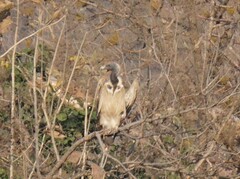
Indian Vulture

Indian Vulture

Gyps indicus

Silhouette: Shyamal · PhyloPic

LCNTVUENCRCritically Endangered
Daily sighting probability <5% · Rare
at Nashik

In 3 days <5% in a week ~10%

7 Verified sightings at Nashik
2,058 In all 10 parks From 2019 to 2026
September Best month
☀️ Diurnal When it's spotted

About the Indian Vulture

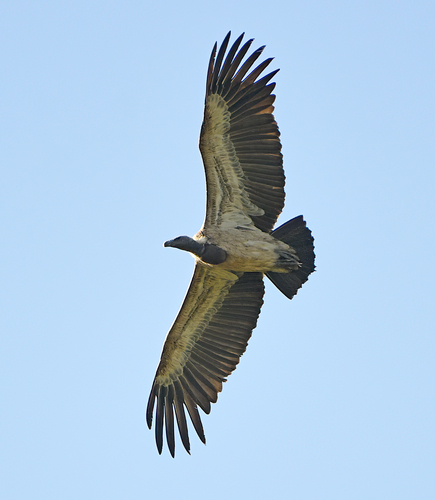
The Indian vulture or long-billed vulture (Gyps indicus) is a bird of prey native to the Indian subcontinent. It is an Old World vulture belonging to the family of Accipitridae. It is a medium-sized vulture with a small, semi-bald head with little feathers, long beak, and wide dark colored wings. It breeds mainly on small cliffs and hilly crags in central India and south India.

The Indian vulture is a keystone species that has been listed as Critically Endangered on the IUCN Red List since 2002, as the population has severely declined during the Indian vulture crisis. It is estimated that there are 5,000-15,000 mature individuals in the wild. The main cause of the decline was identified as kidney failure caused by the drug diclofenac, which was commonly given to cattle to reduce joint pain. It is thought that diclofenac poisoned vultures that ate the flesh of dead cattle. Diclofenac bans were enacted in India, Pakistan and Nepal in 2006.

The bird shares its habitat with other vulture species in the same genus (particularly the slender-billed vulture (Gyps tenuirostris) and white-rumped vulture (Gyps bengalensis)) in some parts of its range. The Indian vulture is placed... Wikipedia →

Sounds

Call1:21

India · 2016

© Oscar Campbell · XC351085 · CC BY-NC-SA 4.0

Global Distribution

Parks Where Found

# Park Country Daily sighting probability
1 Bandhavgarh National Park 🇮🇳 India
~30%
2 Ranthambore National Park 🇮🇳 India
~20%
3 Satpura National Park 🇮🇳 India
~10%
4 Kanha National Park 🇮🇳 India
~10%
5 Gir National Park 🇮🇳 India
~10%
6 Mudumalai National Park 🇮🇳 India
<5%
7 Chitwan National Park 🇳🇵 Nepal
<5%
8 Nagarhole National Park 🇮🇳 India
<5%
9 Keoladeo National Park 🇮🇳 India
<5%
10 Bandipur National Park 🇮🇳 India
<5%

Cities Where Found

# City Country Daily sighting probability
1 Gwalior 🇮🇳 India
~20%
2 Bhopal 🇮🇳 India
<5%
3 Nashik 🇮🇳 India
<5%

Before you go

What are the chances of seeing an Indian Vulture in Nashik?

Rare

Under 5% of wildlife watchers report an Indian Vulture sighting in Nashik on a given day, based on 7 verified sightings from GBIF citizen-science data. It is the 128th most-seen of the 141 birds we can rate there. Over three days the chance rises to under 5%, and over a week to about 10%, if each day is a fresh chance.

When is the best time to see an Indian Vulture in Nashik?

September

In that month about 10% of wildlife watchers report an Indian Vulture in Nashik on a given day, against under 5% in October to August, the lowest months. That is one of Nashik's wettest months, with about 280 mm of rain against almost none in January.

What time of day is best to see an Indian Vulture?

Between 8 and 11 am

Across all the parks we cover, that three-hour window holds the most Indian Vulture sightings with a recorded time, and about 9 in 10 of them come between 6 am and 6 pm: it is a daytime animal.

Is Nashik the best place to see an Indian Vulture?

3rd of 3

Of the 3 cities where we can rate Indian Vulture sightings, Nashik ranks 3rd at under 5%. The best odds are in Gwalior (India, about 20%) and Bhopal (India, under 5%).

Which relatives of the Indian Vulture live in Nashik?

Same family: Accipitridae

The closest relatives of the Indian Vulture that you can see in Nashik (family Accipitridae, Hawks, Eagles, and Kites) are Black Kite (about 40%), Black-winged Kite (about 10%) and Oriental Honey-buzzard (about 10%), with each one's daily chance of a sighting.

Where does the Indian Vulture sighting chance come from?

GBIF citizen-science records

It is estimated from how often the Indian Vulture is recorded against all the birds logged in Nashik (7 verified sightings), calibrated against known sighting rates. Figures are rounded to the nearest 10% because citizen-science data supports honest approximations, not decimals, and months with records from fewer than five people show "—". How it works.
← Back to Nashik