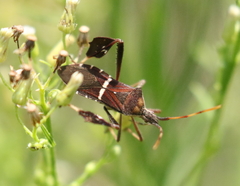
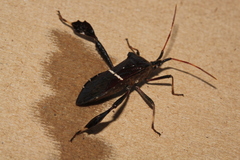
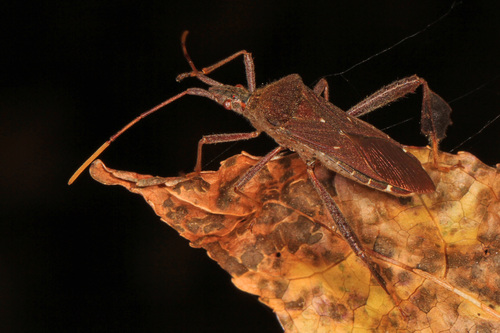
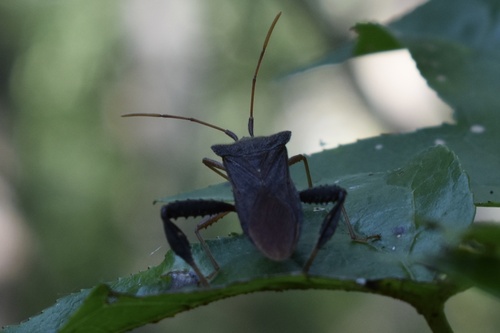
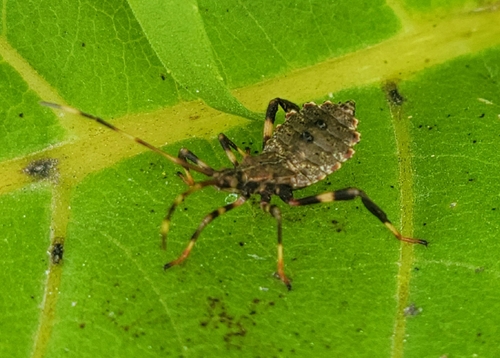
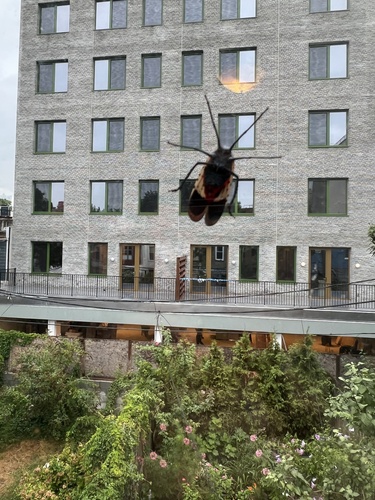
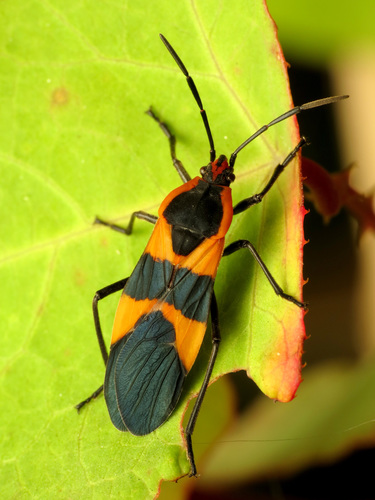
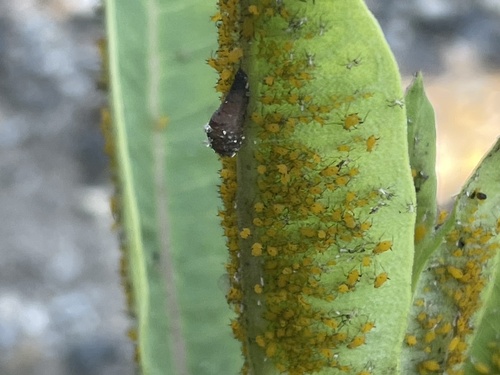
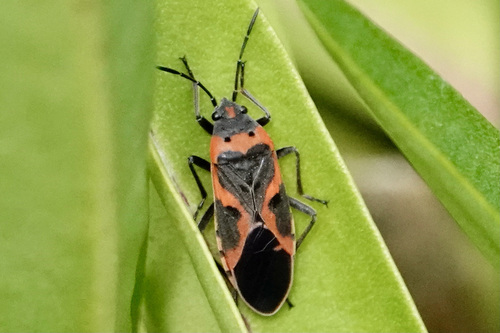
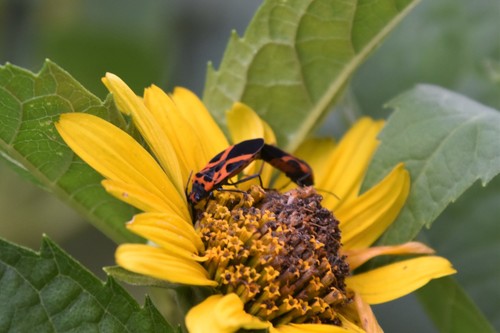
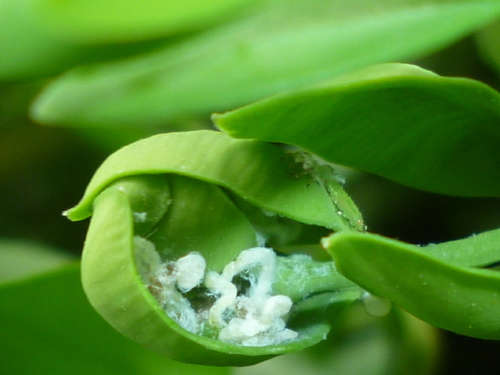
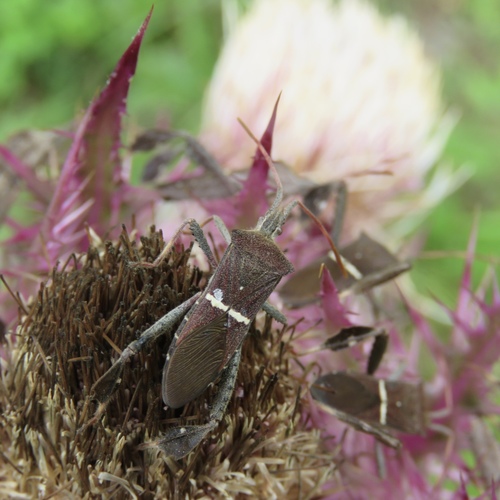
Eastern Leaf-Footed Bug

Eastern Leaf-Footed Bug

Leptoglossus phyllopus

Daily sighting probability <5% · Rare
at New York City

In 3 days ~10% in a week ~20%

26 Verified sightings at New York City
129 In all 6 parks From 2019 to 2026
September Best month
☀️ Diurnal When it's spotted

About the Eastern Leaf-Footed Bug

Leptoglossus phyllopus or eastern leaf-footed bug is a species of leaf-footed bugs in the same genus as the western conifer seed bug (L. occidentalis). The eastern leaf-footed bug is found throughout the southern United States, from Florida to California, through Mexico, and as far south as Costa Rica.

These bugs are a common garden insect which may damage a wide variety of crops including cotton, peaches and tomatoes, and seeds such as beans, black-eyed peas and sorghum. Like other bugs L. phyllopus suck juices from plants by puncturing them with their sucking mouth parts, making them resistant to ingested pesticides. A toxin is injected into the plant when piercing its skin, causing discoloration and hard spots on fruits. The adult bugs are highly resistant to pesticides; however, they are vulnerable in their bright orange nymph stage. Trap crops can be used to lure them away from desired plants and to encourage predator populations, and in small garden plots handpicking, the use of trap crops, and bug traps baited with methyl (E, Z)-2,4-decadienoate can be effective controls.

Acetosyringone is produced by the male leaffooted bug and used in its communication system. Leptoglossus phyllopus emits a foul odor when it is handled Wikipedia →
Global Distribution

Parks Where Found

# Park Country Daily sighting probability
1 Big Cypress National Preserve 🇺🇸 United States
~10%
2 Everglades National Park 🇺🇸 United States
~10%
3 Merritt Island National Wildlife Refuge 🇺🇸 United States
~10%
4 Great Smoky Mountains National Park 🇺🇸 United States
~10%
5 Big Bend National Park 🇺🇸 United States
~10%
6 Cumbres de Monterrey National Park 🇲🇽 Mexico
<5%

Cities Where Found

# City Country Daily sighting probability
1 Dallas 🇺🇸 United States
~10%
2 Austin 🇺🇸 United States
~10%
3 Houston 🇺🇸 United States
~10%
4 San Antonio 🇺🇸 United States
~10%
5 Miami 🇺🇸 United States
~10%
6 Orlando 🇺🇸 United States
<5%
7 Washington 🇺🇸 United States
<5%
8 Monterrey 🇲🇽 México
<5%
9 Baltimore 🇺🇸 United States
<5%
10 New York City 🇺🇸 United States
<5%

Before you go

What are the chances of seeing an Eastern Leaf-Footed Bug in New York City?

Rare

Under 5% of wildlife watchers report an Eastern Leaf-Footed Bug sighting in New York City on a given day, based on 26 verified sightings from GBIF citizen-science data. It is the 587th most-seen of the 1623 insects we can rate there. Over three days the chance rises to about 10%, and over a week to about 20%, if each day is a fresh chance.

When is the best time to see an Eastern Leaf-Footed Bug in New York City?

Any time of year

In every month with enough records, under 5% of wildlife watchers report an Eastern Leaf-Footed Bug in New York City on a given day, so our monthly data shows no clear season.

What time of day is best to see an Eastern Leaf-Footed Bug?

Between noon and 3 pm

Across all the parks we cover, that three-hour window holds the most Eastern Leaf-Footed Bug sightings with a recorded time, and about 9 in 10 of them come between 6 am and 6 pm: it is a daytime animal.

Is New York City the best place to see an Eastern Leaf-Footed Bug?

10th of 11

Of the 11 cities where we can rate Eastern Leaf-Footed Bug sightings, New York City ranks 10th at under 5%. The best odds are in Dallas (United States, about 10%), Austin (United States, about 10%) and Houston (United States, about 10%).

Where does the Eastern Leaf-Footed Bug sighting chance come from?

GBIF citizen-science records

It is estimated from how often the Eastern Leaf-Footed Bug is recorded against all the insects logged in New York City (26 verified sightings), calibrated against known sighting rates. Figures are rounded to the nearest 10% because citizen-science data supports honest approximations, not decimals, and months with records from fewer than five people show "—". How it works.

← Back to New York City