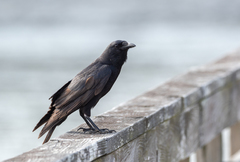
Fish Crow

Fish Crow

Corvus ossifragus

Silhouette: Peileppe · PhyloPic

LCLeast ConcernNTVUENCR
Daily sighting probability ~60% · Likely
at Orlando

In 3 days ~90% in a week >90%

9,108 Verified sightings at Orlando
5,609 In all 7 parks From 2019 to 2026
March Best month
☀️ Diurnal When it's spotted

About the Fish Crow

The fish crow (Corvus ossifragus) is a species of crow associated with wetland habitats in the eastern and southeastern United States. The fish crow was given its binomial name by the Scottish ornithologist Alexander Wilson in 1812, in the fifth volume of his American Ornithology. The binomial is from Latin; Corvus means "raven", while ossifragus means "bone-breaker". It is derived from os or ossis, meaning "bone", and frangere, meaning "to break". The English-language common name fish crow also derives from Wilson, who ascribed the name to the crow's aquatic diet, as described to him by local fishermen. He distinguished the fish crow from John Bartram's great seaside crow by the former's diminutive size when compared to the American crow.

The fish crow's taxonomic relation to other species of the Corvus genus is still poorly understood, but DNA sequencing indicates that it is most closely related to the Hispaniolan palm crow (C. palmarum) and the Jamaican crow (C. jamaicensis), with the three species forming a Nearctic clade. The Sinaloa crow (C. sinaloae) and Tamaulipas crow (C. imparatus) bear morphological similarities to and were once considered conspecific... Wikipedia →
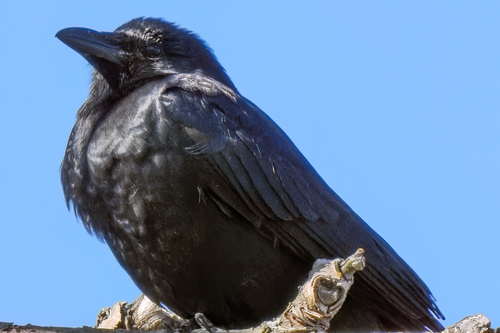
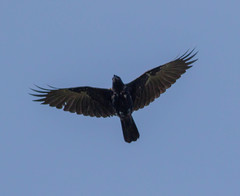
Sounds

Call0:17

United States · 2023

© Gregory Askew · XC822351 · CC BY-NC-SA 4.0

Flight call0:10

United States · 2016

© Albert Lastukhin & Max Lastukhin · XC325919 · CC BY-NC-SA 4.0

Call0:34

United States · 2021

© Kate StJohn · XC661002 · CC BY-NC-SA 4.0

Global Distribution

Parks Where Found

# Park Country Daily sighting probability
1 Merritt Island National Wildlife Refuge 🇺🇸 United States
~40%
2 Congaree National Park 🇺🇸 United States
~10%
3 Big Cypress National Preserve 🇺🇸 United States
~10%
4 Shenandoah National Park 🇺🇸 United States
~10%
5 Everglades National Park 🇺🇸 United States
<5%
6 Great Smoky Mountains National Park 🇺🇸 United States
<5%
7 Point Pelee National Park 🇨🇦 Canada
<5%

Cities Where Found

# City Country Daily sighting probability
1 Miami 🇺🇸 United States
~70%
2 Orlando 🇺🇸 United States
~60%
3 Washington 🇺🇸 United States
~50%
4 Baltimore 🇺🇸 United States
~40%
5 Philadelphia 🇺🇸 United States
~20%
6 New York City 🇺🇸 United States
~10%
7 Boston 🇺🇸 United States
<5%
8 Toronto 🇨🇦 Canada
<5%
9 Montreal 🇨🇦 Canada
<5%
10 Houston 🇺🇸 United States
<5%

Zoos & Centres Where Found

# Zoo / Centre Country
1 Ähtäri Zoo 🇫🇮 Finland In captivity

Before you go

What are the chances of seeing a Fish Crow in Orlando?

Likely

About 60% of wildlife watchers report a Fish Crow sighting in Orlando on a given day, based on 9,108 verified sightings from GBIF citizen-science data. It is the 9th most-seen of the 205 birds we can rate there. Over three days the chance rises to about 90%, and over a week to over 90%, if each day is a fresh chance.

When is the best time to see a Fish Crow in Orlando?

March to July

In those months about 70% of wildlife watchers report a Fish Crow in Orlando on a given day, against about 50% in September to November, the lowest months.

What time of day is best to see a Fish Crow?

Between 8 and 11 am

Across all the parks we cover, that three-hour window holds the most Fish Crow sightings with a recorded time, and nearly all of them come between 6 am and 6 pm: it is a daytime animal.

Is Orlando the best place to see a Fish Crow?

2nd of 10

Of the 10 cities where we can rate Fish Crow sightings, Orlando ranks 2nd at about 60%. The best odds are in Miami (United States, about 70%).

Where does the Fish Crow sighting chance come from?

GBIF citizen-science records

It is estimated from how often the Fish Crow is recorded against all the birds logged in Orlando (9,108 verified sightings), calibrated against known sighting rates. Figures are rounded to the nearest 10% because citizen-science data supports honest approximations, not decimals, and months with records from fewer than five people show "—". How it works.

← Back to Orlando