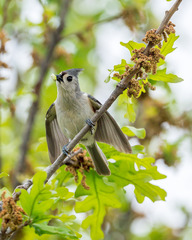
Tufted Titmouse

Tufted Titmouse

Baeolophus bicolor

Silhouette: Sheatherius · PhyloPic

LCLeast ConcernNTVUENCR
Daily sighting probability ~80% · Very likely
at Orlando

In 3 days >90%

12,122 Verified sightings at Orlando
12,502 In all 8 parks From 2019 to 2026
September Best month
☀️ Diurnal When it's spotted

About the Tufted Titmouse

The tufted titmouse (Baeolophus bicolor) is a small songbird native to eastern North America. The species belongs to the tit and chickadee family (Paridae). The black-crested titmouse, found from central and southern Texas southward, was originally included as a subspecies but now is considered a separate species, Baeolophus atricristatus.

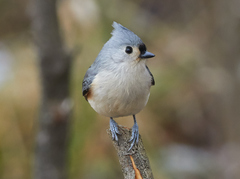
Measurements: Length: 14–16 cm (5.5–6.3 in) Weight: 18–26 g (0.63–0.92 oz) Wingspan: 20–26 cm (7.9–10.2 in) A small bird, the tufted titmouse has a white front and gray upper body outlined with rust-colored flanks. Other characteristics include its black forehead and the tufted gray crest on its head. In juveniles, the black forehead is greatly diminished such that it may be confused with the oak titmouse, although their ranges do not overlap. Males tend to be larger than females.

The song of the tufted titmouse is usually described as a whistled peter-peter-peter, although this song can vary in about 20 notable ways. The habitat of the tufted titmouse is deciduous and mixed woods, gardens, parks, and shrublands. Although it is nonmigratory and originally native to the Ohio and Mississippi River basins... Wikipedia →

Sounds

Call0:38

United States · 2026

© Rory Nefdt · XC1146764 · CC BY-NC-SA 4.0

Scold0:57

United States · 2023

© Richard E. Webster · XC827249 · CC BY-NC-SA 4.0

Song0:31

United States · 2023

© Jim Berry · XC793408 · CC BY-NC-SA 4.0

Global Distribution

Parks Where Found

# Park Country Daily sighting probability
1 Congaree National Park 🇺🇸 United States
~90%
2 Great Smoky Mountains National Park 🇺🇸 United States
~70%
3 Shenandoah National Park 🇺🇸 United States
~60%
4 Big Cypress National Preserve 🇺🇸 United States
~20%
5 Merritt Island National Wildlife Refuge 🇺🇸 United States
~10%
6 Acadia National Park 🇺🇸 United States
~10%
7 Everglades National Park 🇺🇸 United States
<5%
8 Point Pelee National Park 🇨🇦 Canada
<5%

Cities Where Found

# City Country Daily sighting probability
1 Orlando 🇺🇸 United States
~80%
2 Washington 🇺🇸 United States
~60%
3 Dallas 🇺🇸 United States
~50%
4 Boston 🇺🇸 United States
~40%
5 Baltimore 🇺🇸 United States
~40%
6 Houston 🇺🇸 United States
~40%
7 Philadelphia 🇺🇸 United States
~30%
8 Detroit 🇺🇸 United States
~30%
9 New York City 🇺🇸 United States
~20%
10 Austin 🇺🇸 United States
<5%

Before you go

What are the chances of seeing a Tufted Titmouse in Orlando?

Very likely

About 80% of wildlife watchers report a Tufted Titmouse sighting in Orlando on a given day, based on 12,122 verified sightings from GBIF citizen-science data. It is the 3rd most-seen of the 205 birds we can rate there. Over three days the chance rises to over 90%, if each day is a fresh chance.

When is the best time to see a Tufted Titmouse in Orlando?

April to October

In those months about 80% of wildlife watchers report a Tufted Titmouse in Orlando on a given day, against about 60% in December and January, the lowest months.

What time of day is best to see a Tufted Titmouse?

Between 7 and 10 am

Across all the parks we cover, that three-hour window holds the most Tufted Titmouse sightings with a recorded time, and about 9 in 10 of them come between 6 am and 6 pm: it is a daytime animal.

Is Orlando the best place to see a Tufted Titmouse?

Yes

Of the 14 cities where we can rate Tufted Titmouse sightings, Orlando has the highest daily chance: about 80%. Next come Washington (United States, about 60%) and Dallas (United States, about 50%).

Where does the Tufted Titmouse sighting chance come from?

GBIF citizen-science records

It is estimated from how often the Tufted Titmouse is recorded against all the birds logged in Orlando (12,122 verified sightings), calibrated against known sighting rates. Figures are rounded to the nearest 10% because citizen-science data supports honest approximations, not decimals, and months with records from fewer than five people show "—". How it works.

← Back to Orlando