Carnaby's Black Cockatoo

Carnaby's Black Cockatoo

Zanda latirostris

Daily sighting probability ~10% · With luck
at Perth

In 3 days ~30% in a week ~60%

1,258 Verified sightings at Perth
April Best month
☀️ Diurnal When it's spotted

About the Carnaby's Black Cockatoo

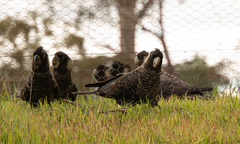
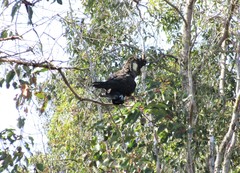
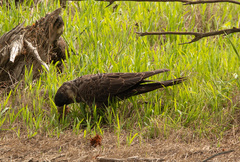
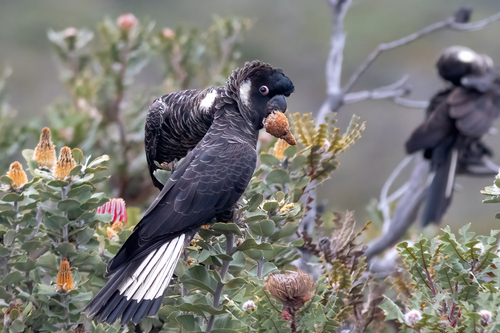
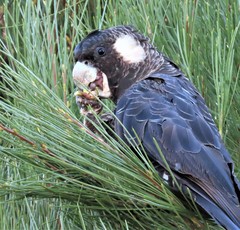
Carnaby's black cockatoo (Zanda latirostris), also known as the short-billed black cockatoo, is a large black cockatoo endemic to southwest Australia. It was described in 1948 by naturalist Ivan Carnaby. Measuring 53–58 cm (21–23 in) in length, it has a short crest on the top of its head. Its plumage is mostly greyish black, and it has prominent white cheek patches and a white tail band. The body feathers are edged with white giving a scalloped appearance. Adult males have a dark grey beak and pink eye-rings. Adult females have a bone-coloured beak, grey eye-rings and ear patches that are paler than those of the males.

This cockatoo usually lays a clutch of one to two eggs. It generally takes 28 to 29 days for the female to incubate the eggs, and the young fledge ten to eleven weeks after hatching. The young will stay with the family until the next breeding season, and sometimes even longer. The family leaves the nesting site after the young fledge until the following year. Carnaby's black cockatoo forms flocks when not breeding, with birds in drier habitats usually being more migratory than those in wetter ones. It flies with deep and slow wingbeats, generally high above trees. Seeds of plants of the families Proteaceae and, to a lesser extent, Myrtaceae form a large part of its diet.

Carnaby's black cockatoo nests in hollows situated high in trees with fairly large diameters, generally Eucalyptus. With much of its habitat lost to land clearing and development and threatened by further habitat destruction, Carnaby's black cockatoo is listed as an endangered species by the Federal and Western Australian governments. It is also classified as endangered by the International Union for Conservation of Nature (IUCN). Like most parrots, it is protected by CITES, an international agreement that makes trade, export, and import of listed wild-caught species illegal. Wikipedia →
Global Distribution

Parks Where Found

# Park Country Daily sighting probability

More parks will be added in future updates.

Cities Where Found

# City Country Daily sighting probability
1 Perth 🇦🇺 Australia
~10%

Zoos & Centres Where Found

# Zoo / Centre Country
1 Perth Zoo 🇦🇺 Australia In captivity
2 Paphos Zoo 🇨🇾 Cyprus In captivity
3 Greenough Wildlife & Bird Park 🇦🇺 Australia In captivity
4 Armadale Reptile Centre 🇦🇺 Australia In captivity

Before you go

What are the chances of seeing a Carnaby's Black Cockatoo in Perth?

With luck

About 10% of wildlife watchers report a Carnaby's Black Cockatoo sighting in Perth on a given day, based on 1,258 verified sightings from GBIF citizen-science data. It is the 61st most-seen of the 162 birds we can rate there. Over three days the chance rises to about 30%, and over a week to about 60%, if each day is a fresh chance.

When is the best time to see a Carnaby's Black Cockatoo in Perth?

March to May

In those months about 20% of wildlife watchers report a Carnaby's Black Cockatoo in Perth on a given day, against about 10% in June to February, the lowest months.

What time of day is best to see a Carnaby's Black Cockatoo?

Between 10 am and 1 pm

Across all the parks we cover, that three-hour window holds the most Carnaby's Black Cockatoo sightings with a recorded time, and about 9 in 10 of them come between 6 am and 6 pm: it is a daytime animal.

Where else can you see a Carnaby's Black Cockatoo?

Only Perth, in our data

Perth is the only city on Wallace's Line with enough records to rate Carnaby's Black Cockatoo sightings: about 10% of wildlife watchers there report one on a given day.

Which relatives of the Carnaby's Black Cockatoo live in Perth?

Same order: Psittaciformes

The closest relatives of the Carnaby's Black Cockatoo that you can see in Perth (order Psittaciformes, Parrots) are Coconut Lorikeet (about 80%), Galah (about 50%) and Little Corella (about 50%), with each one's daily chance of a sighting.

Where does the Carnaby's Black Cockatoo sighting chance come from?

GBIF citizen-science records

It is estimated from how often the Carnaby's Black Cockatoo is recorded against all the birds logged in Perth (1,258 verified sightings), calibrated against known sighting rates. Figures are rounded to the nearest 10% because citizen-science data supports honest approximations, not decimals, and months with records from fewer than five people show "—". How it works.

← Back to Perth