
Elegant Parrot

Elegant Parrot

Neophema elegans

Silhouette: Farelli (photo), John E. McCormack, Michael G. Harvey, Brant C. Faircloth, Nicholas G. Crawford, Travis C. Glenn, Robb T. Brumfield & T. Michael Keesey · PhyloPic

LCLeast ConcernNTVUENCR Endemic
Daily sighting probability <5% · Rare
at Perth

In 3 days <5%

6 Verified sightings at Perth
132 In 1 park From 2019 to 2026
September Best month
🌙 Nocturnal When it's spotted

About the Elegant Parrot

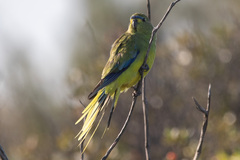
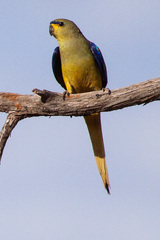
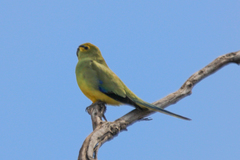
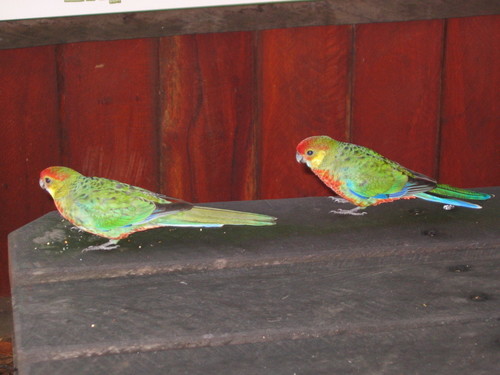
The elegant parrot (Neophema elegans) is a species of parrot in the family Psittaculidae. It is endemic to Australia. The elegant parrot was called carteri, bilgir, or koolyederong by Aboriginal peoples. Its English name came from the renowned ornithologist and artist John Gould in 1837, its specific name Latin for "elegant". It is one of six species of grass parrot in the genus Neophema, and within it a member of the subgenus Neonanodes. Its common name is elegant parrot, but it has also been called elegant parakeet, elegant grass parakeet, and grass parrot in the past.

The elegant parrot is 23 cm (9.1 in) long and predominantly golden olive in colour with a dark blue frontal band line above with lighter blue, while abdomen and vent are yellow. The female is a duller shade of olive all over and has a narrower blue frontal band. The wings are predominantly olive with outer flight feathers dark blue. The yellow-edged tail has shades of olive and blue. The bill and legs are grey and the eyes dark brown.

Juveniles are duller and lack the frontal bands. The elegant parrot is found in two disjunct regions, one across... Wikipedia →

Sounds

Call0:09

Australia · 2016

© Marc Anderson · XC334243 · CC BY-NC-ND 4.0

Call0:21

Australia · 2023

© Peter Boesman · XC859972 · CC BY-NC-ND 4.0

Recording0:18

Australia · 2025

© Tom Hunt · iNaturalist · CC BY-NC 4.0

Global Distribution

Parks Where Found

# Park Country Daily sighting probability
1 Flinders Ranges National Park 🇦🇺 Australia
~30%

More parks will be added in future updates.

Cities Where Found

# City Country Daily sighting probability
1 Perth 🇦🇺 Australia
<5%

Zoos & Centres Where Found

# Zoo / Centre Country
1 Adelaide Zoo 🇦🇺 Australia In captivity
2 Featherdale Sydney Wildlife Park 🇦🇺 Australia In captivity
3 Haus des Meeres 🇦🇹 Austria In captivity
4 Sealife Adventure, Southend-on-Sea 🇬🇧 United Kingdom In captivity
5 Bird Kingdom 🇨🇦 Canada In captivity

Before you go

What are the chances of seeing an Elegant Parrot in Perth?

Rare

Under 5% of wildlife watchers report an Elegant Parrot sighting in Perth on a given day, based on 6 verified sightings from GBIF citizen-science data. It is the 154th most-seen of the 162 birds we can rate there. Over three days the chance rises to under 5%, if each day is a fresh chance.

When is the best time to see an Elegant Parrot in Perth?

Any time of year

In every month with enough records, under 5% of wildlife watchers report an Elegant Parrot in Perth on a given day, so our monthly data shows no clear season.

What time of day is best to see an Elegant Parrot?

Between midnight and 3 am

Across all the parks we cover, that three-hour window holds the most Elegant Parrot sightings with a recorded time, and about 7 in 10 of them come between 6 pm and 6 am: it is mostly seen at night.

Where else can you see an Elegant Parrot?

Only Perth, in our data

Perth is the only city on Wallace's Line with enough records to rate Elegant Parrot sightings: under 5% of wildlife watchers there report one on a given day.

Which relatives of the Elegant Parrot live in Perth?

Same family: Psittacidae

The closest relatives of the Elegant Parrot that you can see in Perth (family Psittacidae, New World and African Parrots) are Coconut Lorikeet (about 80%), Galah (about 50%) and Little Corella (about 50%), with each one's daily chance of a sighting.

Where does the Elegant Parrot sighting chance come from?

GBIF citizen-science records

It is estimated from how often the Elegant Parrot is recorded against all the birds logged in Perth (6 verified sightings), calibrated against known sighting rates. Figures are rounded to the nearest 10% because citizen-science data supports honest approximations, not decimals, and months with records from fewer than five people show "—". How it works.

← Back to Perth