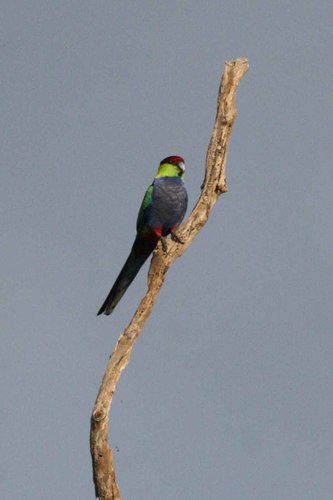
Red-capped Parrot

Red-capped Parrot

Purpureicephalus spurius

LCLeast ConcernNTVUENCR
Daily sighting probability <5% · Rare
at Perth

In 3 days ~10% in a week ~30%

376 Verified sightings at Perth
September Best month
☀️ Diurnal When it's spotted

About the Red-capped Parrot

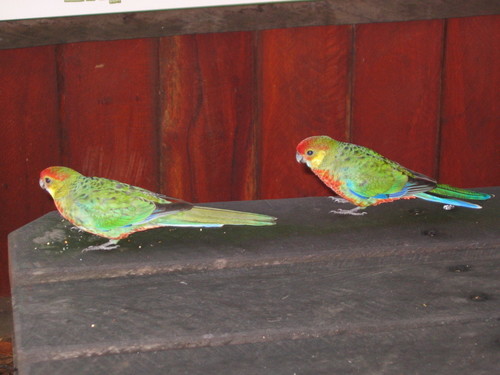
The red-capped parrot (Purpureicephalus spurius) is a species of broad-tailed parrot native to southwestern Australia. It was described by Heinrich Kuhl in 1820, with no subspecies recognised. It has long been classified in its own genus owing to its distinctive elongated beak, though genetic analysis shows that it lies within the lineage of the Psephotellus parrots and that its closest relative is the mulga parrot (Psephotellus varius). Not easily confused with other parrot species, it has a bright crimson crown, green-yellow cheeks, and a distinctive long bill. The wings, back, and long tail are dark green, and the underparts are purple-blue. The adult female is very similar though sometimes slightly duller than the male; her key distinguishing feature is a white stripe on the wing under-surface. Juveniles are predominantly green.

Found in woodland and open savannah country, the red-capped parrot is predominantly herbivorous, consuming seeds, particularly of eucalypts, as well as flowers and berries, but insects are occasionally eaten. Nesting takes place in tree hollows, generally of older large trees. Although the red-capped parrot has been shot as a pest and has been affected by land clearing, the population is growing and the species is considered of least-concern by the International Union for Conservation of Nature (IUCN). It has a reputation of being anxious and difficult to breed in captivity. Wikipedia →

Global Distribution

Parks Where Found

# Park Country Daily sighting probability

More parks will be added in future updates.

Cities Where Found

# City Country Daily sighting probability
1 Perth 🇦🇺 Australia
<5%

Zoos & Centres Where Found

# Zoo / Centre Country
1 Budapest Zoo & Botanical Garden 🇭🇺 Hungary In captivity
2 Loro Parque 🇪🇸 Spain In captivity
3 Featherdale Sydney Wildlife Park 🇦🇺 Australia In captivity

Before you go

What are the chances of seeing a Red-capped Parrot in Perth?

Rare

Under 5% of wildlife watchers report a Red-capped Parrot sighting in Perth on a given day, based on 376 verified sightings from GBIF citizen-science data. It is the 84th most-seen of the 162 birds we can rate there. Over three days the chance rises to about 10%, and over a week to about 30%, if each day is a fresh chance.

When is the best time to see a Red-capped Parrot in Perth?

February, May and July–September

In those months about 10% of wildlife watchers report a Red-capped Parrot in Perth on a given day, against under 5% in March–April, June and October–January, the lowest months. Those are among Perth's wettest months, with about 80 mm of rain a month against 10 mm in December.

What time of day is best to see a Red-capped Parrot?

Between 2 and 5 pm

Across all the parks we cover, that three-hour window holds the most Red-capped Parrot sightings with a recorded time, and nearly all of them come between 6 am and 6 pm: it is a daytime animal.

Where else can you see a Red-capped Parrot?

Only Perth, in our data

Perth is the only city on Wallace's Line with enough records to rate Red-capped Parrot sightings: under 5% of wildlife watchers there report one on a given day.

Which relatives of the Red-capped Parrot live in Perth?

Same family: Psittacidae

The closest relatives of the Red-capped Parrot that you can see in Perth (family Psittacidae, New World and African Parrots) are Coconut Lorikeet (about 80%), Galah (about 50%) and Little Corella (about 50%), with each one's daily chance of a sighting.

Where does the Red-capped Parrot sighting chance come from?

GBIF citizen-science records

It is estimated from how often the Red-capped Parrot is recorded against all the birds logged in Perth (376 verified sightings), calibrated against known sighting rates. Figures are rounded to the nearest 10% because citizen-science data supports honest approximations, not decimals, and months with records from fewer than five people show "—". How it works.

← Back to Perth