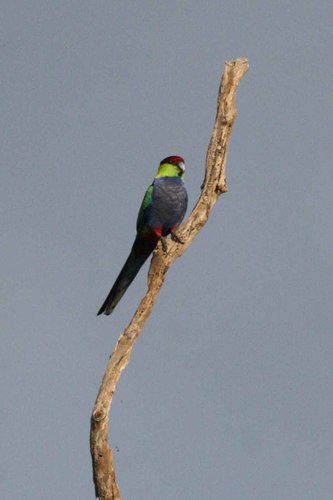
Western Rosella

Western Rosella

Platycercus icterotis

LCLeast ConcernNTVUENCR
Daily sighting probability <5% · Rare
at Perth

In 3 days <5%

8 Verified sightings at Perth
June Best month
☀️ Diurnal When it's spotted

About the Western Rosella

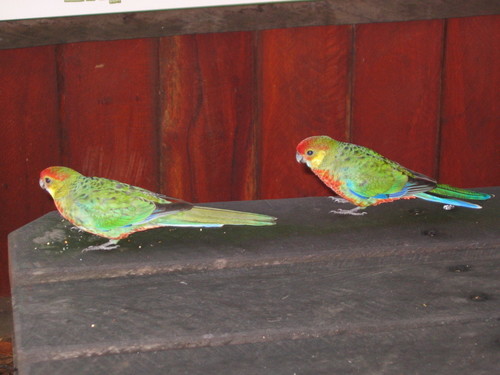
The western rosella (Platycercus icterotis), or moyadong, is a species of parrot endemic to southwestern Australia. The head and underparts are bright red, and the back is mottled black; a yellow patch at the cheek distinguishes it from others of the genus Platycercus. Adults of the species exhibit sexual dimorphism with the females duller overall; juveniles lack the striking colours of mature birds and the characteristic patterning is not as easily distinguished. Their communication call is a softly delivered pink-pink sound, and much of their behaviour is comparatively unobtrusive. Their habitat is in eucalypt forests and woodlands, where they often remain unobserved until they appear to feed on seeds at nearby cleared areas.

Individuals form mating pairs and generally remain in one locality, although they will venture out to join small groups at plentiful sources of food. The western rosella is predominantly herbivorous, its diet consisting mostly of seeds of grasses and other plants, although nectar and insect larvae are sometimes eaten. The damage attributed to the species at introduced fruit and grain crops saw them declared as a pest and permitted by the state to be killed or captured. They are more placid and sociable than rosellas of other Australian regions from which they are geographically isolated and have become internationally popular as an aviary bird. Their history in aviculture begins with two 1830 lithographs of live specimens in England by Edward Lear. Successful breeding in captivity began there during the early 20th century.

The population is classified as two subspecies, representing an inland group residing in the agricultural district and another nearer the coast in kwongan, tall forest and a variety of woodlands. The abrupt intersection of these groups' range, delineated by country of lower rainfall between Albany and Geraldton, is a zone of hybridisation between the two subspecies Platycercus icterotis icterotis and P. icterotis xanthogenys. The classification of the species relationship to sister taxa of Platycercus is less complex, due to their ecological and geographic isolation, and they are allied to a subgenus Platycercus (Violania). Wikipedia →
Global Distribution

Parks Where Found

# Park Country Daily sighting probability

More parks will be added in future updates.

Cities Where Found

# City Country Daily sighting probability
1 Perth 🇦🇺 Australia
<5%

Zoos & Centres Where Found

# Zoo / Centre Country
1 Kyabram Fauna Park 🇦🇺 Australia In captivity
2 Perth Zoo 🇦🇺 Australia In captivity
3 Flying High Bird Sanctuary 🇦🇺 Australia In captivity
4 Bloedel Conservatory 🇨🇦 Canada In captivity

Before you go

What are the chances of seeing a Western Rosella in Perth?

Rare

Under 5% of wildlife watchers report a Western Rosella sighting in Perth on a given day, based on 8 verified sightings from GBIF citizen-science data. It is the 154th most-seen of the 162 birds we can rate there. Over three days the chance rises to under 5%, if each day is a fresh chance.

When is the best time to see a Western Rosella in Perth?

Any time of year

In every month with enough records, under 5% of wildlife watchers report a Western Rosella in Perth on a given day, so our monthly data shows no clear season.

What time of day is best to see a Western Rosella?

Between 3 and 6 pm

Across all the parks we cover, that three-hour window holds the most Western Rosella sightings with a recorded time, and nearly all of them come between 6 am and 6 pm: it is a daytime animal.

Where else can you see a Western Rosella?

Only Perth, in our data

Perth is the only city on Wallace's Line with enough records to rate Western Rosella sightings: under 5% of wildlife watchers there report one on a given day.

Which relatives of the Western Rosella live in Perth?

Same family: Psittacidae

The closest relatives of the Western Rosella that you can see in Perth (family Psittacidae, New World and African Parrots) are Coconut Lorikeet (about 80%), Galah (about 50%) and Little Corella (about 50%), with each one's daily chance of a sighting.

Where does the Western Rosella sighting chance come from?

GBIF citizen-science records

It is estimated from how often the Western Rosella is recorded against all the birds logged in Perth (8 verified sightings), calibrated against known sighting rates. Figures are rounded to the nearest 10% because citizen-science data supports honest approximations, not decimals, and months with records from fewer than five people show "—". How it works.

← Back to Perth