Australian Ringneck

Australian Ringneck

Barnardius zonarius

Silhouette: Farelli (photo), John E. McCormack, Michael G. Harvey, Brant C. Faircloth, Nicholas G. Crawford, Travis C. Glenn, Robb T. Brumfield & T. Michael Keesey · PhyloPic

LCLeast ConcernNTVUENCR Endemic
Daily sighting probability ~20% · Possible
at Perth

In 3 days ~40% in a week ~80%

1,546 Verified sightings at Perth
1,991 In all 5 parks From 2019 to 2026
September Best month
☀️ Diurnal When it's spotted

About the Australian Ringneck

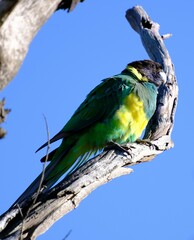
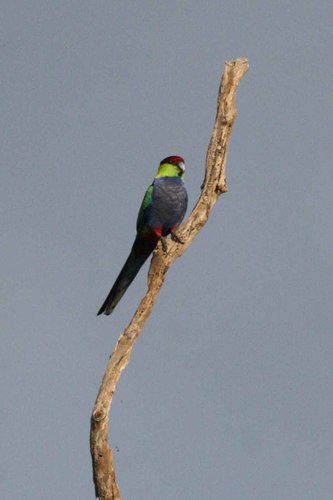
The Australian ringneck (Barnardius zonarius) is a parrot native to Australia. Except for extreme tropical and highland areas, the species has adapted to all conditions. Treatments of genus Barnardius have previously recognised two species, the Port Lincoln parrot (Barnardius zonarius) and the mallee ringneck (Barnardius barnardi), but due to these readily interbreeding at the contact zone they are usually regarded as a single species B. zonarius with subspecific descriptions. Currently, four subspecies are recognised, each with a distinct range.

In Western Australia, the ringneck competes for nesting space with the rainbow lorikeet, an introduced species. To protect the ringneck, culls of the lorikeet are sanctioned by authorities in this region. Overall, though, the ringneck is not a threatened species.

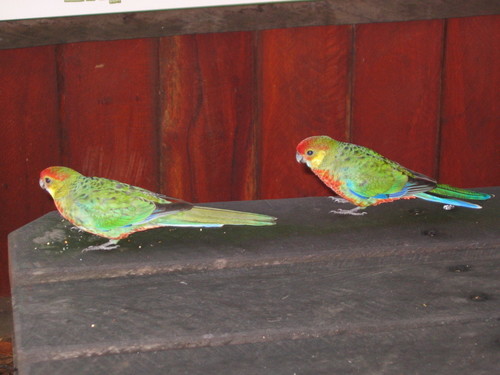
The subspecies of the Australian ringneck differ considerably in colouration. It is a medium size species around 33 cm (13 in) long. The basic colour is green, and all four subspecies have the characteristic yellow ring around the hindneck; wings and tail are a mixture of green and blue. Wikipedia →

Sounds

Call0:43

Australia · 2025

© Peter Boesman · XC1066387 · CC BY-NC-ND 4.0

Flight call0:16

Australia · 2023

© Raymond Bosman · XC808246 · CC BY-NC-SA 4.0

Duet0:37

Australia · 2017

© Marc Anderson · XC382726 · CC BY-NC-ND 4.0

Global Distribution

Parks Where Found

# Park Country Daily sighting probability
1 Flinders Ranges National Park 🇦🇺 Australia
~90%
2 Hattah-Kulkyne National Park 🇦🇺 Australia
~70%
3 Cape Range 🇦🇺 Australia
~30%
4 Ningaloo Marine Park 🇦🇺 Australia
~20%
5 Uluru-Kata Tjuta National Park 🇦🇺 Australia
~10%

Cities Where Found

# City Country Daily sighting probability
1 Perth 🇦🇺 Australia
~20%
2 Melbourne 🇦🇺 Australia
<5%

Zoos & Centres Where Found

# Zoo / Centre Country
1 Safari Madrid 🇪🇸 Spain In captivity
2 Kyabram Fauna Park 🇦🇺 Australia In captivity
3 Silesian Zoological Garden 🇵🇱 Poland In captivity
4 Budapest Zoo & Botanical Garden 🇭🇺 Hungary In captivity
5 Auckland Zoo 🇳🇿 New Zealand In captivity
6 Loro Parque 🇪🇸 Spain In captivity
7 Wagga Zoo 🇦🇺 Australia In captivity
8 Castellar Zoo 🇪🇸 Spain In captivity
9 Parque Loro Sexi 🇪🇸 Spain In captivity
10 Flying High Bird Sanctuary 🇦🇺 Australia In captivity
11 Tropical World 🇮🇪 Ireland In captivity
12 Acuario de Almuñécar 🇪🇸 Spain In captivity
13 Caversham Wildlife Park 🇦🇺 Australia In captivity

Before you go

What are the chances of seeing an Australian Ringneck in Perth?

Possible

About 20% of wildlife watchers report an Australian Ringneck sighting in Perth on a given day, based on 1,546 verified sightings from GBIF citizen-science data. It is the 48th most-seen of the 162 birds we can rate there. Over three days the chance rises to about 40%, and over a week to about 80%, if each day is a fresh chance.

When is the best time to see an Australian Ringneck in Perth?

September

In that month about 30% of wildlife watchers report an Australian Ringneck in Perth on a given day, against about 10% in November and December, the lowest months.

What time of day is best to see an Australian Ringneck?

Between 2 and 5 pm

Across all the parks we cover, that three-hour window holds the most Australian Ringneck sightings with a recorded time, and nearly all of them come between 6 am and 6 pm: it is a daytime animal.

Is Perth the best place to see an Australian Ringneck?

Yes

Of the 2 cities where we can rate Australian Ringneck sightings, Perth has the highest daily chance: about 20%. Next come Melbourne (Australia, under 5%).

Which relatives of the Australian Ringneck live in Perth?

Same family: Psittacidae

The closest relatives of the Australian Ringneck that you can see in Perth (family Psittacidae, New World and African Parrots) are Coconut Lorikeet (about 80%), Galah (about 50%) and Little Corella (about 50%), with each one's daily chance of a sighting.

Where does the Australian Ringneck sighting chance come from?

GBIF citizen-science records

It is estimated from how often the Australian Ringneck is recorded against all the birds logged in Perth (1,546 verified sightings), calibrated against known sighting rates. Figures are rounded to the nearest 10% because citizen-science data supports honest approximations, not decimals, and months with records from fewer than five people show "—". How it works.

← Back to Perth