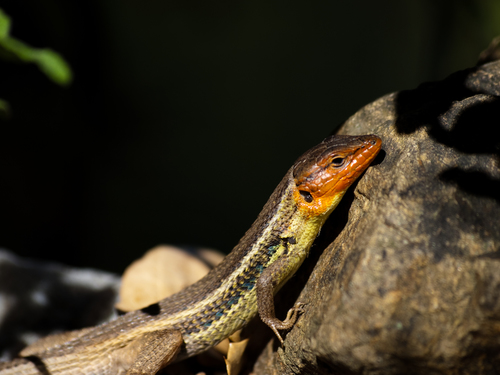
Ladder Snake

Ladder Snake

Zamenis scalaris

Silhouette: Beth Reinke · PhyloPic

LCLeast ConcernNTVUENCR
Daily sighting probability ~10% · With luck
at Porto

In 3 days ~20% in a week ~50%

24 Verified sightings at Porto
63 In all 5 parks From 2019 to 2026
May Best month
☀️🌙 Day & Night When it's spotted

About the Ladder Snake

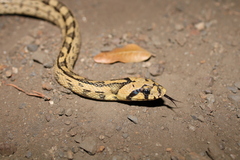
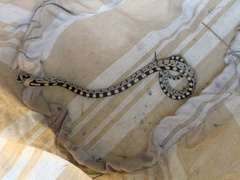
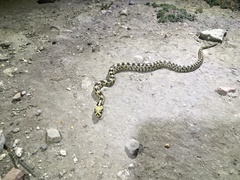
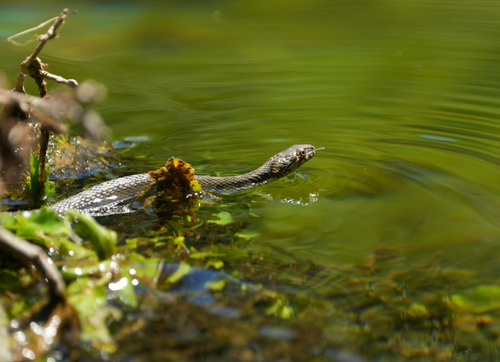
The ladder snake (Zamenis scalaris) is a species of non-venomous snake in the subfamily Colubrinae of the family Colubridae. The species is native to southwestern Europe. The geographic range of the ladder snake includes Portugal, Spain, southern France and just into Italy, also Menorca and the Iles d'Hyères off Provence, but it is absent from northern Iberia including much of the Pyrenees, Galicia (although the species is found on Ons Island, in the Atlantic Islands of Galicia National Park), Cantabria and the Basque Country. The population on Menorca may stem from an introduction by humans.

The ladder snake enjoys scrub bushy cover, including orchards, vineyards, hedges and overgrown dry-stone walls; it is common in the maquis. Habitats with stones and boulders and low shade are preferred. Although known at altitudes over 2,000 metres (6,600 ft), this is a species which prefers altitudes from sea level to 700 metres (2,300 ft).

The ladder snake is a medium-sized snake which reaches a maximum total length (tail included) of around 160 cm (63 in) but which averages 120 cm (47 in) in total length. It has a pointed snout. As an adult... Wikipedia →

Global Distribution

Parks Where Found

# Park Country Daily sighting probability
1 Sierra Nevada National Park 🇪🇸 Spain
~20%
2 Sierra de Guadarrama National Park 🇪🇸 Spain
~10%
3 Monfragüe National Park 🇪🇸 Spain
~10%
4 Doñana National Park 🇪🇸 Spain
~10%
5 Cévennes National Park 🇫🇷 France
~10%

Cities Where Found

# City Country Daily sighting probability
1 Madrid 🇪🇸 Spain
~10%
2 Porto 🇵🇹 Portugal
~10%
3 Barcelona 🇪🇸 Spain
~10%
4 Lisbon 🇵🇹 Portugal
~10%

Zoos & Centres Where Found

# Zoo / Centre Country
1 Barcelona Zoo 🇪🇸 Spain In captivity
2 Paris Zoological Park 🇫🇷 France In captivity
3 Aquarium du palais de la Porte Dorée 🇫🇷 France In captivity
4 Aquarama Barcelona 🇪🇸 Spain In captivity
5 Reserva Zoológica Oasys MiniHollywood 🇪🇸 Spain In captivity
6 Alpenzoo Innsbruck 🇦🇹 Austria In captivity
7 South Carolina Aquarium 🇺🇸 United States In captivity
8 Public marine aquarium of Trieste 🇮🇹 Italy In captivity
9 Reptilandia 🇺🇸 United States In captivity

Before you go

What are the chances of seeing a Ladder Snake in Porto?

With luck

About 10% of wildlife watchers report a Ladder Snake sighting in Porto on a given day, based on 24 verified sightings from GBIF citizen-science data. It is the 7th most-seen of the 16 reptiles we can rate there. Over three days the chance rises to about 20%, and over a week to about 50%, if each day is a fresh chance.

When is the best time to see a Ladder Snake in Porto?

May

In that month about 20% of wildlife watchers report a Ladder Snake in Porto on a given day, against under 5% in February, September and December, the lowest months.

What time of day is best to see a Ladder Snake?

Between 8 and 11 pm

Across all the parks we cover, that three-hour window holds the most Ladder Snake sightings with a recorded time, and about half of them come between 6 am and 6 pm: it is seen both by day and at night.

Is Porto the best place to see a Ladder Snake?

Among the best

Of the 4 cities where we can rate Ladder Snake sightings, Porto ranks 2nd at about 10%, level with the leaders once rounded. The best odds are in Madrid (Spain, about 10%).

Which relatives of the Ladder Snake live in Porto?

Same family: Colubridae

The closest relatives of the Ladder Snake that you can see in Porto (family Colubridae, Colubrid Snakes) are Iberian Grass Snake (about 10%) and Horseshoe Whip Snake (about 10%), with each one's daily chance of a sighting.

Where does the Ladder Snake sighting chance come from?

GBIF citizen-science records

It is estimated from how often the Ladder Snake is recorded against all the reptiles logged in Porto (24 verified sightings), calibrated against known sighting rates. Figures are rounded to the nearest 10% because citizen-science data supports honest approximations, not decimals, and months with records from fewer than five people show "—". How it works.

← Back to Porto