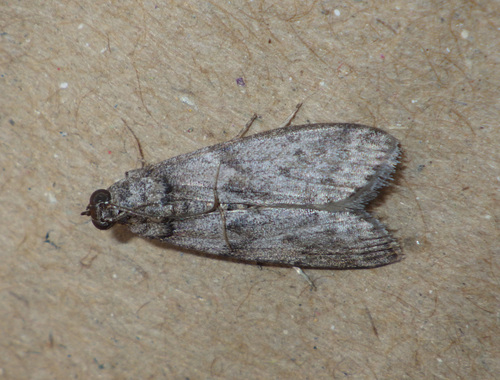
Rosy-Striped Knot-Horn

Rosy-Striped Knot-Horn

Oncocera semirubella

Daily sighting probability <5% · Rare
at Porto

In 3 days ~10% in a week ~20%

7 Verified sightings at Porto
177 In all 4 parks From 2019 to 2026
August Best month
☀️🌙 Day & Night When it's spotted

About the Rosy-Striped Knot-Horn

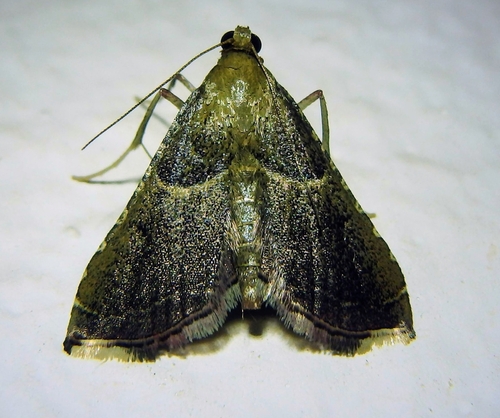
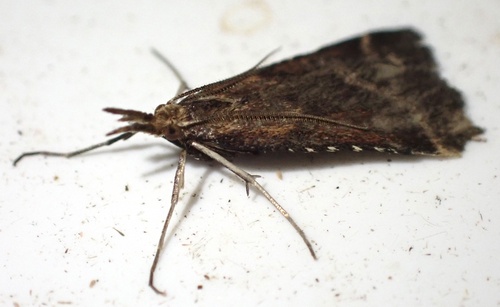
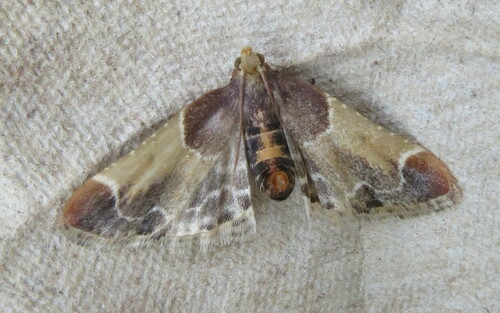
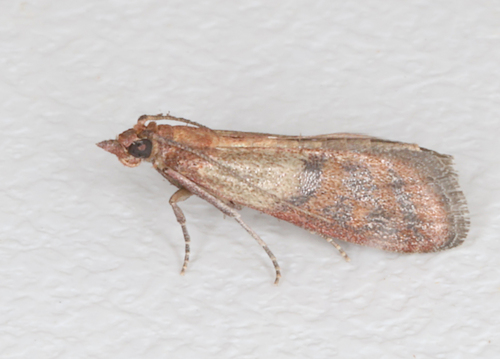
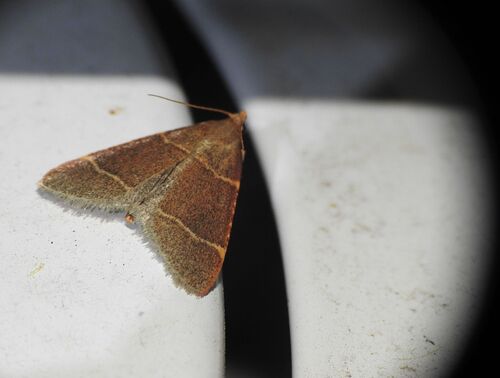
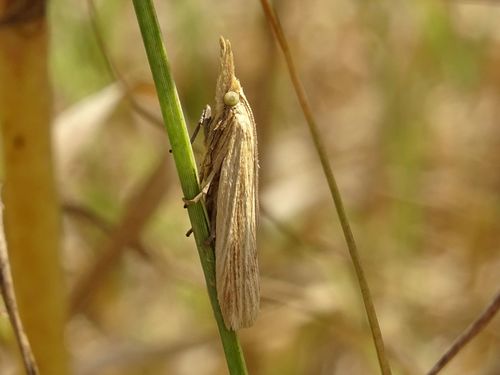
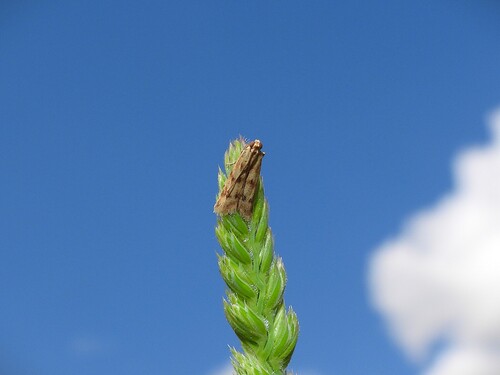
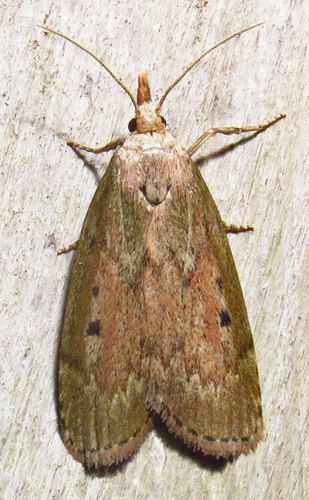
Oncocera semirubella, the rosy-striped knot-horn, is a small moth of the family Pyralidae. It is found in European regions, including the British Isles, and East Asia (e.g. China, Japan, South Korea and Taiwan). The wingspan is 26–30 mm. The forewings are light crimson or pink, sometimes much mixed with grey or dark grey, a whitish, greyish-ochreous, or grey costal streak; a broad ochreous-yellowish dorsal suffusion. Hindwings grey, slightly rosy-tinged.

The larva is bronzy-blackish, with ten indistinct greenish lines; a whitish lateral spot on 3, including a black dot; head and plate of 2 black : amongst web on Lotus. The adult moth flies in one generation by the end of June to August.[1] It is easily disturbed on short grassland, flies from dusk onwards, and is attracted to light and sugar.

The larvae feed on bird's-foot trefoil (Lotus corniculatus), white clover, Ononis species, horseshoe vetch and Medicago species. ^The flight season refers to Belgium and the Netherlands; this may vary in other parts of its range.

Media related to Oncocera semirubella at Wikimedia Commons waarneming... Wikipedia →

Global Distribution

Parks Where Found

# Park Country Daily sighting probability
1 Bavarian Forest National Park 🇩🇪 Germany
~10%
2 Wadden Sea National Park 🇩🇪 Germany
~10%
3 Cévennes National Park 🇫🇷 France
~10%
4 Pyrénées National Park 🇫🇷 France
~10%

Cities Where Found

# City Country Daily sighting probability
1 Kharkiv 🇺🇦 Ukraine
~10%
2 Vienna 🇦🇹 Austria
~10%
3 Munich 🇩🇪 Germany
~10%
4 Paris 🇫🇷 France
~10%
5 Milan 🇮🇹 Italy
~10%
6 Prague 🇨🇿 Czechia
~10%
7 Budapest 🇭🇺 Hungary
~10%
8 Berlin 🇩🇪 Germany
~10%
9 Tokyo 🇯🇵 Japan
<5%
10 Essen 🇩🇪 Germany
<5%

Before you go

What are the chances of seeing a Rosy-Striped Knot-Horn in Porto?

Rare

Under 5% of wildlife watchers report a Rosy-Striped Knot-Horn sighting in Porto on a given day, based on 7 verified sightings from GBIF citizen-science data. It is the 395th most-seen of the 498 insects we can rate there. Over three days the chance rises to about 10%, and over a week to about 20%, if each day is a fresh chance.

When is the best time to see a Rosy-Striped Knot-Horn in Porto?

August and September

In those months about 10% of wildlife watchers report a Rosy-Striped Knot-Horn in Porto on a given day, against under 5% in October to July, the lowest months. Those are among Porto's driest months, with about 35 mm of rain a month against 140 mm in January.

What time of day is best to see a Rosy-Striped Knot-Horn?

Between 10 pm and 1 am

Across all the parks we cover, that three-hour window holds the most Rosy-Striped Knot-Horn sightings with a recorded time, and about 7 in 10 of them come between 6 pm and 6 am: it is seen both by day and at night.

Is Porto the best place to see a Rosy-Striped Knot-Horn?

12th of 17

Of the 17 cities where we can rate Rosy-Striped Knot-Horn sightings, Porto ranks 12th at under 5%. The best odds are in Kharkiv (Ukraine, about 10%), Vienna (Austria, about 10%) and Munich (Germany, about 10%).

Which relatives of the Rosy-Striped Knot-Horn live in Porto?

Same family: Pyralidae

The closest relatives of the Rosy-Striped Knot-Horn that you can see in Porto (family Pyralidae, Pyralid Snout Moths) are Rosy Tabby (about 10%), Long-Legged Tabby (about 10%) and Meal Moth (about 10%), with each one's daily chance of a sighting.

Where does the Rosy-Striped Knot-Horn sighting chance come from?

GBIF citizen-science records

It is estimated from how often the Rosy-Striped Knot-Horn is recorded against all the insects logged in Porto (7 verified sightings), calibrated against known sighting rates. Figures are rounded to the nearest 10% because citizen-science data supports honest approximations, not decimals, and months with records from fewer than five people show "—". How it works.

← Back to Porto