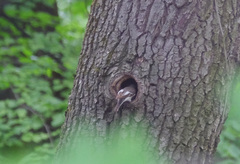
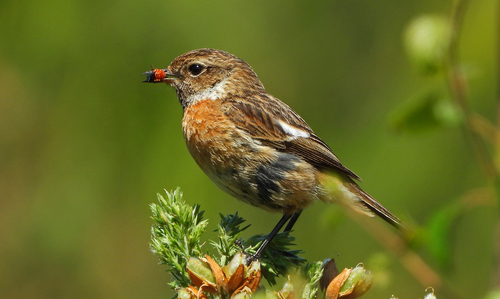
Collared Flycatcher

Collared Flycatcher

Ficedula albicollis

Silhouette: hedera.baltica · PhyloPic

LCLeast ConcernNTVUENCR
Daily sighting probability <5% · Rare
at Prague

In 3 days <5% in a week ~10%

42 Verified sightings at Prague
641 In all 5 parks From 2019 to 2026
May Best month
☀️ Diurnal When it's spotted

About the Collared Flycatcher

The collared flycatcher (Ficedula albicollis) is a small passerine bird in the Old World flycatcher family, one of the four species of Western Palearctic black-and-white flycatchers. It breeds in southeast Europe (isolated populations are present in the islands of Gotland and Öland in the Baltic Sea, Sweden) and Eastern France to the Balkan Peninsula and Ukraine and is migratory, wintering in Sub-Saharan Africa. It is a rare vagrant in western Europe.

This is a 12–13.5 cm long bird. The breeding male is mainly black above and white below, with a white collar, large white wing patch, black tail (although some males have white tail sides) and a large white forehead patch. It has a pale rump. The bill is black and has the broad but pointed shape typical of aerial insectivores. As well as taking insects in flight, this species hunts caterpillars amongst the oak foliage, and will take berries.

Non-breeding males, females and juveniles have the black replaced by a pale brown, and may be very difficult to distinguish from other Ficedula flycatchers, particularly the European pied flycatcher (F. hypoleuca) and the semicollared flycatcher (F. semitorquata), with which this species hybridizes to a limited extent.

F. albicollis vis-a-vis F. hypoleuca are speciating from each other by reinforcement, as evidenced by differences between colouration in sympatry versus allopatry. This is evidence for speciation by reinforcement. They are birds of deciduous woodlands, parks and gardens, with a preference for old trees with cavities in which it nests. They build an open nest in a tree hole, or man-made nest-boxes. Normally 5-7 eggs are laid. The song is slow strained whistles, quite unlike the pied flycatcher. Pied flycatchers can mimic the song of the collared flycatcher in sympatric populations.

The genus name is from Latin and refers to a small fig-eating bird (ficus, "fig") supposed to change into the blackcap in winter. The specific albicollis is from Latin albus, white, and collum, "neck". The collared flycatcher is used as a model species in both ecology and genetics and it was one of the first birds that had its full genome sequenced. Repeated spectrometric data taken from male collared flycatchers has revealed that plumage reflectance should be measured during courtship, the primary period of sexual signalling, with spectral traits declining over the breeding season.

In a natural population of F. albicollis inbreeding appeared to be rare, but when it did occur it had severe negative consequences for fitness characteristics such as hatching success rate. Wikipedia →

Sounds

Song0:42

Sweden · 2025

© Ulf Elman · XC1006289 · CC BY-NC-ND 4.0

Call0:42

Poland · 2024

© Jarek Matusiak · XC901805 · CC BY-NC-ND 4.0

Alarm call0:15

Sweden · 2015

© Mikael Litsgård · XC288094 · CC BY-NC-SA 4.0

Global Distribution

Parks Where Found

# Park Country Daily sighting probability
1 Białowieża National Park 🇵🇱 Poland
~40%
2 Plitvice Lakes National Park 🇭🇷 Croatia
~30%
3 Fertő-Hanság National Park 🇭🇺 Hungary
<5%
4 Kafue National Park 🇿🇲 Zambia
<5%
5 Kiskunság National Park 🇭🇺 Hungary
<5%

Cities Where Found

# City Country Daily sighting probability
1 Rostov-on-Don 🇷🇺 Russia
~10%
2 Kyiv 🇺🇦 Ukraine
~10%
3 Jerusalem 🇮🇱 Israel
~10%
4 Ankara 🇹🇷 Turkey
~10%
5 Kharkiv 🇺🇦 Ukraine
~10%
6 Sofia 🇧🇬 Bulgaria
~10%
7 Istanbul 🇹🇷 Turkey
<5%
8 Bucharest 🇷🇴 Romania
<5%
9 Athens 🇬🇷 Greece
<5%
10 Izmir 🇹🇷 Turkey
<5%

Before you go

What are the chances of seeing a Collared Flycatcher in Prague?

Rare

Under 5% of wildlife watchers report a Collared Flycatcher sighting in Prague on a given day, based on 42 verified sightings from GBIF citizen-science data. It is the 109th most-seen of the 145 birds we can rate there. Over three days the chance rises to under 5%, and over a week to about 10%, if each day is a fresh chance.

When is the best time to see a Collared Flycatcher in Prague?

May

In that month about 10% of wildlife watchers report a Collared Flycatcher in Prague on a given day, against under 5% in June to April, the lowest months.

What time of day is best to see a Collared Flycatcher?

Between 7 and 10 am

Across all the parks we cover, that three-hour window holds the most Collared Flycatcher sightings with a recorded time, and about 9 in 10 of them come between 6 am and 6 pm: it is a daytime animal.

Is Prague the best place to see a Collared Flycatcher?

17th of 20

Of the 20 cities where we can rate Collared Flycatcher sightings, Prague ranks 17th at under 5%. The best odds are in Rostov-on-Don (Russia, about 10%), Kyiv (Ukraine, about 10%) and Jerusalem (Israel, about 10%).

Where does the Collared Flycatcher sighting chance come from?

GBIF citizen-science records

It is estimated from how often the Collared Flycatcher is recorded against all the birds logged in Prague (42 verified sightings), calibrated against known sighting rates. Figures are rounded to the nearest 10% because citizen-science data supports honest approximations, not decimals, and months with records from fewer than five people show "—". How it works.

← Back to Prague