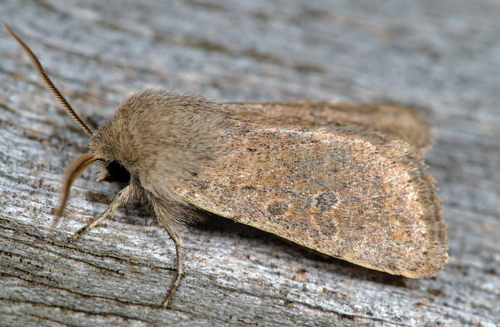
Flame Shoulder Moth

Flame Shoulder Moth

Ochropleura plecta

Daily sighting probability <5% · Rare
at Prague

In 3 days ~10% in a week ~30%

13 Verified sightings at Prague
319 In all 5 parks From 2019 to 2026
August Best month
🌅 Crepuscular When it's spotted

About the Flame Shoulder Moth

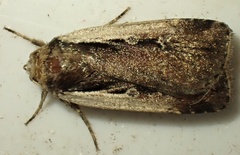
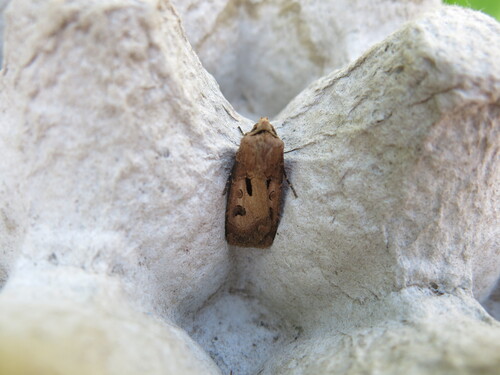
The flame shoulder (Ochropleura plecta) is a moth of the family Noctuidae. The species was first described by Carl Linnaeus in 1761. It is distributed throughout the Palearctic from Ireland in the west to Siberia then Korea and Japan in the east.

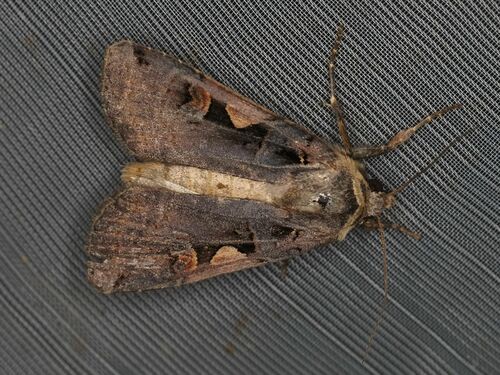
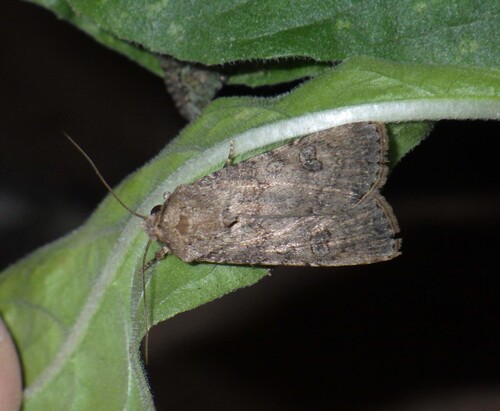
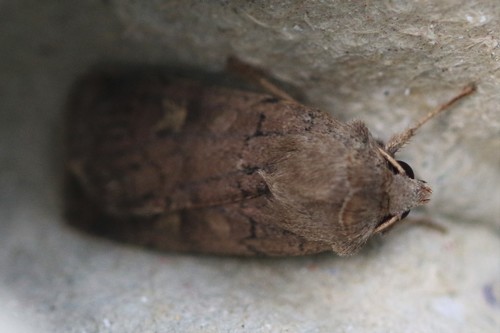
The forewings of this species are reddish brown with a black streak interrupted by white stigmata and a creamy-yellow streak along the costa which gives the species its common name. The hindwings are pure white. The wingspan is 28–34 mm. Forewing red brown suffused with purple; costal streak broadly cream colour to outer line, sometimes red speckled; cell and a basal streak below median vein blackish or deep red; orbicular and reniform stigmata with bright pale rings and grey centres, the latter followed by a small black blotch; lines rarely visible; hindwing whitish; patagia red-brown; dorsum greyish fuscous, sometimes with basal half cream coloured, sometimes wholly cream coloured. The ab. unimacula Stgr. [now ssp.] from Spain has the orbicular stigma obsolete; — in ab. anderssoni Lampa from Scandinavia the forewing is blackish purple; in ab. glaucimacula Graes. from Amurland the stigmata are smaller... Wikipedia →

Global Distribution

Parks Where Found

# Park Country Daily sighting probability
1 Snowdonia National Park 🇬🇧 United Kingdom
~20%
2 Wadden Sea National Park 🇩🇪 Germany
~10%
3 Pyrénées National Park 🇫🇷 France
~10%
4 Bavarian Forest National Park 🇩🇪 Germany
~10%
5 Cairngorms National Park 🇬🇧 United Kingdom
~10%

Cities Where Found

# City Country Daily sighting probability
1 Liverpool 🇬🇧 United Kingdom
~40%
2 Porto 🇵🇹 Portugal
~10%
3 Manchester 🇬🇧 United Kingdom
~10%
4 London 🇬🇧 United Kingdom
~10%
5 Birmingham 🇬🇧 United Kingdom
~10%
6 Essen 🇩🇪 Germany
~10%
7 Turin 🇮🇹 Italy
~10%
8 Kyiv 🇺🇦 Ukraine
~10%
9 Berlin 🇩🇪 Germany
<5%
10 Hamburg 🇩🇪 Germany
<5%

Before you go

What are the chances of seeing a Flame Shoulder Moth in Prague?

Rare

Under 5% of wildlife watchers report a Flame Shoulder Moth sighting in Prague on a given day, based on 13 verified sightings from GBIF citizen-science data. It is the 358th most-seen of the 724 insects we can rate there. Over three days the chance rises to about 10%, and over a week to about 30%, if each day is a fresh chance.

When is the best time to see a Flame Shoulder Moth in Prague?

June and August

In those months about 10% of wildlife watchers report a Flame Shoulder Moth in Prague on a given day, against under 5% in July and September–May, the lowest months. Those are among Prague's wettest months, with about 80 mm of rain a month against 30 mm in February.

What time of day is best to see a Flame Shoulder Moth?

Between 6 and 9 am

Across all the parks we cover, that three-hour window holds the most Flame Shoulder Moth sightings with a recorded time, and about 6 in 10 of them come between 6 am and 6 pm: it is most active around dawn and dusk.

Is Prague the best place to see a Flame Shoulder Moth?

11th of 14

Of the 14 cities where we can rate Flame Shoulder Moth sightings, Prague ranks 11th at under 5%. The best odds are in Liverpool (United Kingdom, about 40%), Porto (Portugal, about 10%) and Manchester (United Kingdom, about 10%).

Which relatives of the Flame Shoulder Moth live in Prague?

Same family: Noctuidae

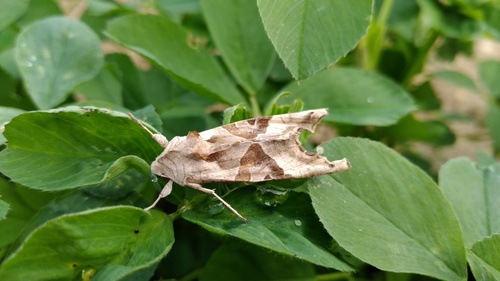
The closest relatives of the Flame Shoulder Moth that you can see in Prague (family Noctuidae, Cutworm Moths and Allies) are Silver Υ (about 10%), Large Yellow Underwing (about 10%) and Knot Grass Moth (about 10%), with each one's daily chance of a sighting.

Where does the Flame Shoulder Moth sighting chance come from?

GBIF citizen-science records

It is estimated from how often the Flame Shoulder Moth is recorded against all the insects logged in Prague (13 verified sightings), calibrated against known sighting rates. Figures are rounded to the nearest 10% because citizen-science data supports honest approximations, not decimals, and months with records from fewer than five people show "—". How it works.
← Back to Prague