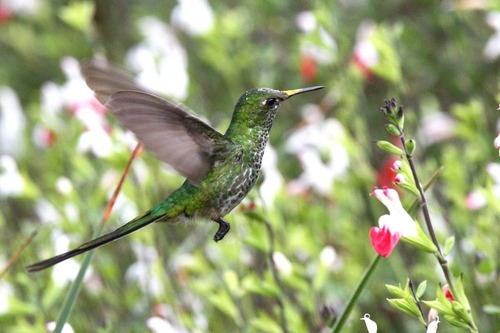
Sword-billed Hummingbird

Sword-billed Hummingbird

Ensifera ensifera

Silhouette: Ernst Haeckel (vectorized by T. Michael Keesey) · PhyloPic

LCLeast ConcernNTVUENCR
Daily sighting probability ~10% · With luck
at Quito

In 3 days ~20% in a week ~40%

103 Verified sightings at Quito
478 In all 2 parks From 2019 to 2026
June Best month
☀️ Diurnal When it's spotted

About the Sword-billed Hummingbird

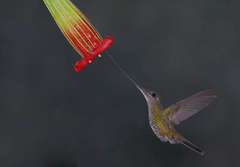
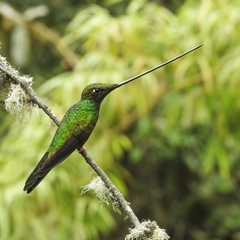
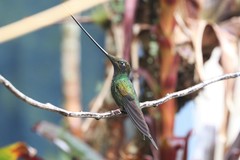
The sword-billed hummingbird (Ensifera ensifera), also known as the swordbill, is a neotropical species of hummingbird from the Andean regions of South America. It is the only member in the genus Ensifera. Among the largest species of hummingbird, it is characterized by its unusually long bill, being the only bird to have a beak longer than the rest of its body, excluding the tail. It uses its bill to drink nectar from flowers with long corollas and has coevolved with the species Passiflora mixta. While most hummingbirds preen using their bills, the sword-billed hummingbird uses its feet to scratch and preen due to its bill being so long.

The sword-billed hummingbird is a trap-line feeder and feeds on nectar, especially from Passiflora mixta and other passionflowers. It also hawks for insects. It breeds from February to March and builds cup nests using moss. The sword-billed hummingbird is listed as being of least concern by the International Union for Conservation of Nature (IUCN) on the IUCN Red List, but is threatened by climate change and deforestation.

The sword-billed hummingbird was first described as Ornismya ensifera by Auguste Boissonneau in... Wikipedia →

Sounds

Call0:27

Ecuador · 1998

© Mitch Lysinger · XC260507 · CC BY-NC-SA 4.0

Wing sound whilst feeding0:27

Colombia · 2022

© Frank Lambert · XC1044437 · CC BY-NC-ND 4.0

Flight call0:19

Colombia · 2020

© Jerome Fischer · XC583112 · CC BY-NC-SA 4.0

Global Distribution

Parks Where Found

# Park Country Daily sighting probability
1 Los Nevados National Natural Park 🇨🇴 Colombia
~10%
2 Chingaza National Natural Park 🇨🇴 Colombia
<5%

Cities Where Found

# City Country Daily sighting probability
1 Quito 🇪🇨 Ecuador
~10%
2 Bogota 🇨🇴 Colombia
<5%

Before you go

What are the chances of seeing a Sword-billed Hummingbird in Quito?

With luck

About 10% of wildlife watchers report a Sword-billed Hummingbird sighting in Quito on a given day, based on 103 verified sightings from GBIF citizen-science data. It is the 57th most-seen of the 167 birds we can rate there. Over three days the chance rises to about 20%, and over a week to about 40%, if each day is a fresh chance.

When is the best time to see a Sword-billed Hummingbird in Quito?

June

In that month about 20% of wildlife watchers report a Sword-billed Hummingbird in Quito on a given day, against under 5% in May, July–August and October–December, the lowest months. That is one of Quito's driest months, with about 60 mm of rain against 180 mm in April.

What time of day is best to see a Sword-billed Hummingbird?

Between 8 and 11 am

Across all the parks we cover, that three-hour window holds the most Sword-billed Hummingbird sightings with a recorded time, and about 9 in 10 of them come between 6 am and 6 pm: it is a daytime animal.

Is Quito the best place to see a Sword-billed Hummingbird?

Yes

Of the 2 cities where we can rate Sword-billed Hummingbird sightings, Quito has the highest daily chance: about 10%. Next come Bogota (Colombia, under 5%).

Where does the Sword-billed Hummingbird sighting chance come from?

GBIF citizen-science records

It is estimated from how often the Sword-billed Hummingbird is recorded against all the birds logged in Quito (103 verified sightings), calibrated against known sighting rates. Figures are rounded to the nearest 10% because citizen-science data supports honest approximations, not decimals, and months with records from fewer than five people show "—". How it works.

← Back to Quito