
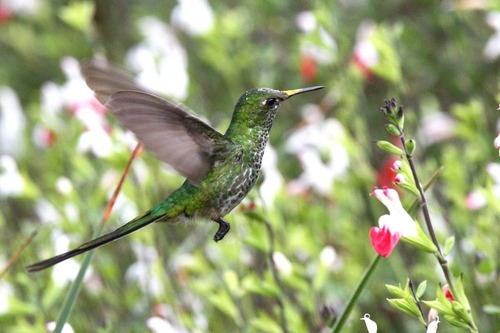
Sparkling Violetear

Sparkling Violetear

Colibri coruscans

Silhouette: Ferran Sayol · PhyloPic

LCLeast ConcernNTVUENCR
Daily sighting probability >90% · Very likely
at Quito
2,909 Verified sightings at Quito
2,439 In all 8 parks From 2019 to 2026
August Best month
☀️ Diurnal When it's spotted

About the Sparkling Violetear

The sparkling violetear (Colibri coruscans) is a species of hummingbird widespread in highlands of northern and western South America, including a large part of the Andes (from Argentina and northwards), the Venezuelan Coastal Range, and the Tepuis. It occurs in a wide range of semi-open habitats, even in gardens and parks within major cities such as Quito, and is often the most common species of hummingbird in its range. It is highly vocal and territorial.

Other subspecies have been proposed to be separated from those two but that treatment has not been widely accepted. The sparkling violetear is the largest violetear at 13 to 14 cm (5 to 5.5 in) long. Male birds weigh 5.8 to 8.5 g (0.20 to 0.30 oz) and females 6 to 7.5 g (0.21 to 0.26 oz). The nominate male's upperparts are metallic bluish green, the chin bluish violet, the belly blue, and the rest of the underparts green. Long erectile bluish violet plumes cover the ears. The tail is metallic green with a steely blue band near the end. Females are similar but smaller, and often have a white... Wikipedia →

Sounds

Song1:00

Ecuador · 2025

© Manuel Sánchez-Nivicela · XC1144807 · CC BY-NC-ND 4.0

Call0:27

Venezuela · 2024

© JAYRSON ARAUJO DE OLIVEIRA · XC939457 · CC BY-NC-SA 4.0

Flight call0:04

Ecuador · 2023

© rudy gelis · XC822927 · CC BY-NC-SA 4.0

Global Distribution

Parks Where Found

# Park Country Daily sighting probability
1 Los Nevados National Natural Park 🇨🇴 Colombia
~30%
2 Chingaza National Natural Park 🇨🇴 Colombia
~20%
3 Podocarpus National Park 🇪🇨 Ecuador
~20%
4 Farallones de Cali National Natural Park 🇨🇴 Colombia
~10%
5 Amboró National Park 🇧🇴 Bolivia
~10%
6 Lauca National Park 🇨🇱 Chile
~10%
7 Henri Pittier National Park 🇻🇪 Venezuela
<5%
8 Manu National Park 🇵🇪 Peru
<5%

Cities Where Found

# City Country Daily sighting probability
1 Quito 🇪🇨 Ecuador
>90%
2 Bogota 🇨🇴 Colombia
~90%
3 La Paz 🇧🇴 Bolivia
~60%
4 Cochabamba 🇧🇴 Bolivia
~30%
5 Mendoza 🇦🇷 Argentina
~10%
6 Medellín 🇨🇴 Colombia
<5%
7 Caracas 🇻🇪 Venezuela
<5%

Zoos & Centres Where Found

# Zoo / Centre Country
1 Walsrode World Bird Park 🇩🇪 Germany In captivity
2 Oasi Naturalistica di Sant'Alessio 🇮🇹 Italy In captivity
3 Butterfly World 🇺🇸 United States In captivity

Before you go

What are the chances of seeing a Sparkling Violetear in Quito?

Very likely

Over 90% of wildlife watchers report a Sparkling Violetear sighting in Quito on a given day, based on 2,909 verified sightings from GBIF citizen-science data. It is the 2nd most-seen of the 167 birds we can rate there.

When is the best time to see a Sparkling Violetear in Quito?

May, August and October–March

In those months over 90% of wildlife watchers report a Sparkling Violetear in Quito on a given day, against about 90% in April, June–July and September, the lowest months.

What time of day is best to see a Sparkling Violetear?

Between 9 am and noon

Across all the parks we cover, that three-hour window holds the most Sparkling Violetear sightings with a recorded time, and about 9 in 10 of them come between 6 am and 6 pm: it is a daytime animal.

Is Quito the best place to see a Sparkling Violetear?

Yes

Of the 7 cities where we can rate Sparkling Violetear sightings, Quito has the highest daily chance: over 90%. Next come Bogota (Colombia, about 90%) and La Paz (Bolivia, about 60%).

Where does the Sparkling Violetear sighting chance come from?

GBIF citizen-science records

It is estimated from how often the Sparkling Violetear is recorded against all the birds logged in Quito (2,909 verified sightings), calibrated against known sighting rates. Figures are rounded to the nearest 10% because citizen-science data supports honest approximations, not decimals, and months with records from fewer than five people show "—". How it works.

← Back to Quito