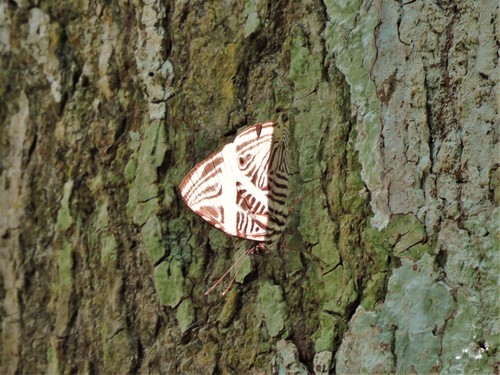
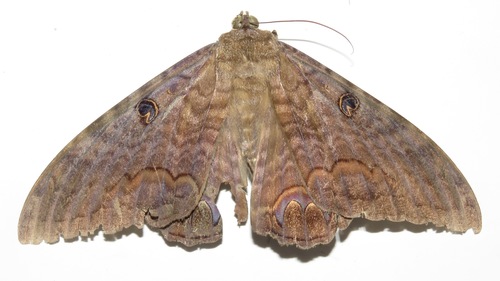
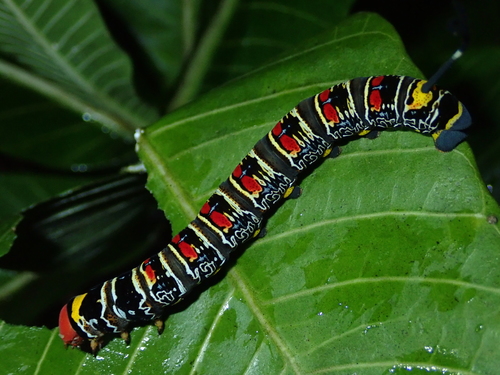
Citheronia laocoon

Citheronia laocoon

Citheronia laocoon

Daily sighting probability ~10% · With luck
at Rio de Janeiro

In 3 days ~40% in a week ~60%

53 Verified sightings at Rio de Janeiro
11 In 1 park From 2019 to 2026
April Best month
☀️ Diurnal When it's spotted

About the Citheronia laocoon

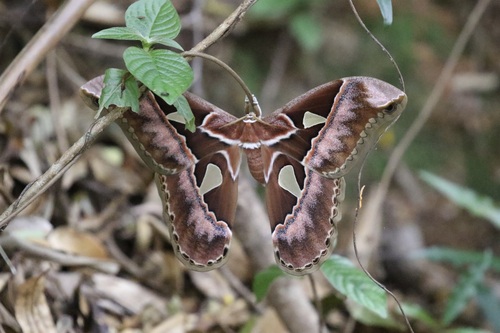
Citheronia laocoon is a species of moth in the family Saturniidae. It is found from the Guianas south to northern Argentina. The moths are relatively large, with a 130-mm wingspan. They do not have a prominent discal spot, neither on fore or hindwing. Females are yellowish black, with orange-red venation. Males look similar, however they are smaller at 110-115-mm wingspan on average. The venation is more vivid and pronounced, however. Their hindwings are highly variable, ranging from yellow with a brown band to mostly red with yellow patches and brown stripes.

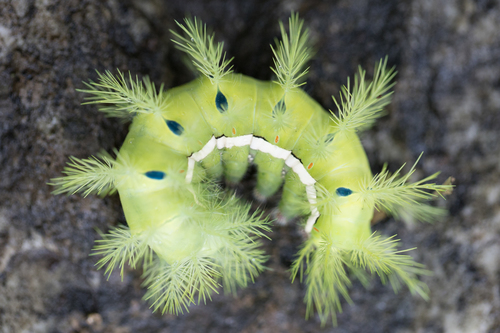
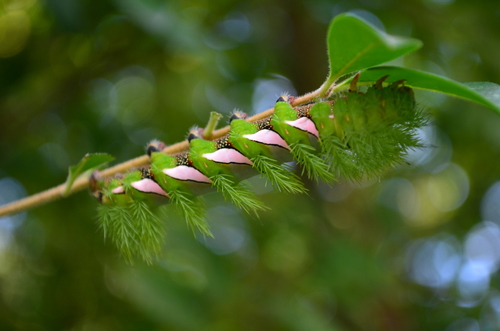
Their abdomen are yellow, with a red dorsal side and sometimes have red flecks on the side. Caterpillars are quite large, as with many others in the Citheronia genus, and are prominently green, with long prolegs that sport black 'racing stripes' and red 'horns' along each segment of their body. They also have an alternating pattern of a black stripe on each segment, that terminates at the spiracle (arthropods). Their dorsal side is darker green than their ventral side.

This species is not heavily dimorphic. The main difference between the two sexes in the antennae and size. As with all... Wikipedia →
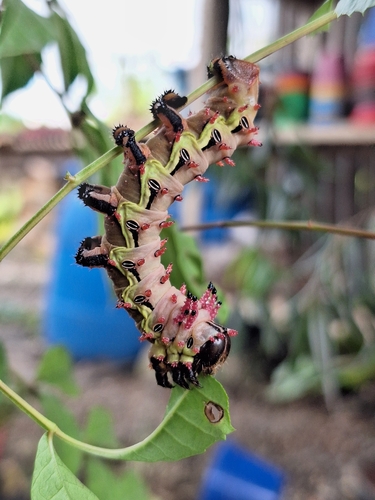
Global Distribution

Parks Where Found

# Park Country Daily sighting probability
1 Tijuca National Park 🇧🇷 Brazil
~10%

More parks will be added in future updates.

Cities Where Found

# City Country Daily sighting probability
1 Niterói 🇧🇷 Brazil
~20%
2 Rio de Janeiro 🇧🇷 Brazil
~10%
3 Vitória 🇧🇷 Brazil
~10%
4 Santos 🇧🇷 Brazil
~10%
5 Brasilia 🇧🇷 Brazil
~10%
6 Campinas 🇧🇷 Brazil
~10%
7 Belo Horizonte 🇧🇷 Brazil
~10%
8 São Paulo 🇧🇷 Brazil
<5%

Before you go

What are the chances of seeing a Citheronia laocoon in Rio de Janeiro?

With luck

About 10% of wildlife watchers report a Citheronia laocoon sighting in Rio de Janeiro on a given day, based on 53 verified sightings from GBIF citizen-science data. It is the 6th most-seen of the 169 insects we can rate there. Over three days the chance rises to about 40%, and over a week to about 60%, if each day is a fresh chance.

When is the best time to see a Citheronia laocoon in Rio de Janeiro?

April

In that month about 30% of wildlife watchers report a Citheronia laocoon in Rio de Janeiro on a given day, against about 10% in January–March and May–October, the lowest months.

What time of day is best to see a Citheronia laocoon?

Between 10 am and 1 pm

Across all the parks we cover, that three-hour window holds the most Citheronia laocoon sightings with a recorded time, and nearly all of them come between 6 am and 6 pm: it is a daytime animal.

Is Rio de Janeiro the best place to see a Citheronia laocoon?

2nd of 8

Of the 8 cities where we can rate Citheronia laocoon sightings, Rio de Janeiro ranks 2nd at about 10%. The best odds are in Niterói (Brazil, about 20%).

Which relatives of the Citheronia laocoon live in Rio de Janeiro?

Same family: Saturniidae

The closest relatives of the Citheronia laocoon that you can see in Rio de Janeiro (family Saturniidae, Emperor and Giant Silk Moths) are Automeris naranja (about 10%), Rothschildia speculifer (about 10%) and Automeris illustris (about 10%), with each one's daily chance of a sighting.

Where does the Citheronia laocoon sighting chance come from?

GBIF citizen-science records

It is estimated from how often the Citheronia laocoon is recorded against all the insects logged in Rio de Janeiro (53 verified sightings), calibrated against known sighting rates. Figures are rounded to the nearest 10% because citizen-science data supports honest approximations, not decimals, and months with records from fewer than five people show "—". How it works.

← Back to Rio de Janeiro