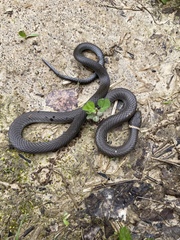
Ringneck Snake

Ringneck Snake

Diadophis punctatus

Silhouette: Alex Slavenko · PhyloPic

LCLeast ConcernNTVUENCR
Daily sighting probability <5% · Rare
at Sacramento

In 3 days ~10% in a week ~30%

11 Verified sightings at Sacramento
638 In all 14 parks From 2019 to 2026
March Best month
☀️🌙 Day & Night When it's spotted

About the Ringneck Snake

Diadophis punctatus, commonly known as the ring-necked snake or ringneck snake, is a small, harmless species of colubrid snake found throughout much of the United States, as well as south in Central Mexico and as far north as Nova Scotia, Canada. Ring-necked snakes are generally fossorial and somewhat secretive, by nature, and, as a nocturnal species, are rarely seen during the daytime. These snakes are believed to be fairly abundant throughout most of their range, though no scientific evaluation supports this hypothesis. Scientific research is lacking for the species, despite their apparently common status, and more in-depth investigations are greatly needed. It is the only species within the genus Diadophis and, currently, 14 subspecies are identified, though many herpetologists question the morphologically based classifications.

The ring-necked snake is perhaps best known for its unique defensive posture: when threatened, it curls its tail into a tight coil, partially rolls onto its back, and shows its bright red-orange underside and ventral surface. In nature, vivid coloration on an animal generally serves as a warning to others that it is not afraid of delivering a dose of venom, or that it is poisonous if eaten; this "false warning" coloration is a form of mimicry, a survival adaptation in which a non-venomous species (i.e., the ring-necked snake) has evolved brighter coloration, similar to truly venomous species, and used it to their advantage. Another example is seen in certain milksnakes and kingsnakes (Lampropeltis sp.) which have red, yellow, white or black stripes, an adaptation meant to confuse predators by visually mimicking the venomous coral snakes (Elapidae) which share much of their range. Wikipedia →

Global Distribution

Parks Where Found

# Park Country Daily sighting probability
1 Shenandoah National Park 🇺🇸 United States
~40%
2 Great Smoky Mountains National Park 🇺🇸 United States
~30%
3 Acadia National Park 🇺🇸 United States
~30%
4 Congaree National Park 🇺🇸 United States
~20%
5 Big Cypress National Preserve 🇺🇸 United States
~20%
6 Guadalupe Mountains National Park 🇺🇸 United States
~20%
7 Cape Breton Highlands National Park 🇨🇦 Canada
~20%
8 Everglades National Park 🇺🇸 United States
~10%
9 Redwood National Park 🇺🇸 United States
~10%
10 Merritt Island National Wildlife Refuge 🇺🇸 United States
~10%
11 Zion National Park 🇺🇸 United States
~10%
12 Big Bend National Park 🇺🇸 United States
~10%
13 Saguaro National Park 🇺🇸 United States
~10%
14 Yosemite National Park 🇺🇸 United States
~10%

Cities Where Found

# City Country Daily sighting probability
1 Miami 🇺🇸 United States
~10%
2 Orlando 🇺🇸 United States
~10%
3 Baltimore 🇺🇸 United States
~10%
4 Washington 🇺🇸 United States
~10%
5 San Francisco 🇺🇸 United States
~10%
6 Sacramento 🇺🇸 United States
<5%
7 Mexico City 🇲🇽 México
<5%
8 Philadelphia 🇺🇸 United States
<5%
9 Los Angeles 🇺🇸 United States
<5%
10 New York City 🇺🇸 United States
<5%

Zoos & Centres Where Found

# Zoo / Centre Country
1 Kansas City Zoo 🇺🇸 United States In captivity
2 Sobela Ocean Aquarium 🇺🇸 United States In captivity

Before you go

What are the chances of seeing a Ringneck Snake in Sacramento?

Rare

Under 5% of wildlife watchers report a Ringneck Snake sighting in Sacramento on a given day, based on 11 verified sightings from GBIF citizen-science data. It is the 12th most-seen of the 14 reptiles we can rate there. Over three days the chance rises to about 10%, and over a week to about 30%, if each day is a fresh chance.

When is the best time to see a Ringneck Snake in Sacramento?

March, May and November

In those months about 10% of wildlife watchers report a Ringneck Snake in Sacramento on a given day, against under 5% in April, June–October and December–February, the lowest months.

What time of day is best to see a Ringneck Snake?

Between 10 am and 1 pm

Across all the parks we cover, that three-hour window holds the most Ringneck Snake sightings with a recorded time, and about 7 in 10 of them come between 6 am and 6 pm: it is seen both by day and at night.

Is Sacramento the best place to see a Ringneck Snake?

6th of 12

Of the 12 cities where we can rate Ringneck Snake sightings, Sacramento ranks 6th at under 5%. The best odds are in Miami (United States, about 10%), Orlando (United States, about 10%) and Baltimore (United States, about 10%).

Which relatives of the Ringneck Snake live in Sacramento?

Same family: Colubridae

The closest relatives of the Ringneck Snake that you can see in Sacramento (family Colubridae, Colubrid Snakes) are Sharp-tailed Snake (about 10%), Gopher Snake (about 10%) and California King Snake (about 10%), with each one's daily chance of a sighting.

Where does the Ringneck Snake sighting chance come from?

GBIF citizen-science records

It is estimated from how often the Ringneck Snake is recorded against all the reptiles logged in Sacramento (11 verified sightings), calibrated against known sighting rates. Figures are rounded to the nearest 10% because citizen-science data supports honest approximations, not decimals, and months with records from fewer than five people show "—". How it works.

← Back to Sacramento