About the Evergreen Bagworm Moth
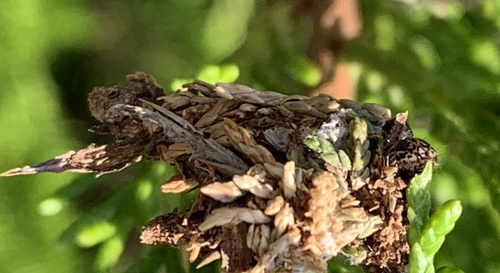
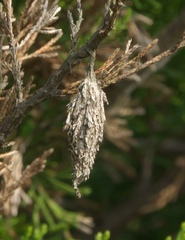
The evergreen bagworm (Thyridopteryx ephemeraeformis), commonly known as bagworm, eastern bagworm, common bagworm, common basket worm, or North American bagworm, is a moth that spins its cocoon in its larval life, decorating it with bits of plant material from the trees on which it feeds.
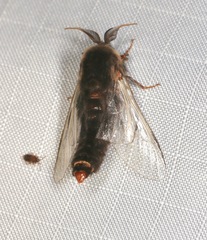
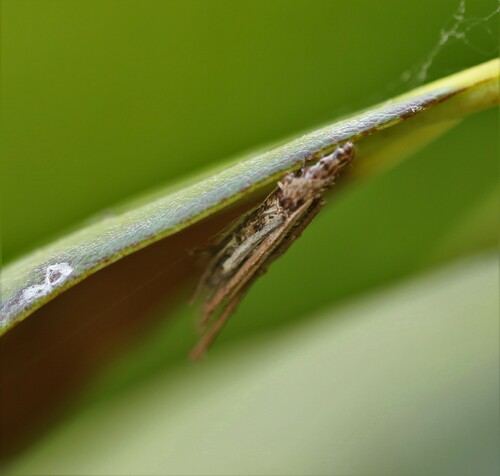
The evergreen bagworm's case grows to over 6 cm, tapered and open on both ends. Newborn larvae are blackish and turn brown to tan as they grow, mottled with black. The heads and thorax develop a yellow tint as they grow to a total length of 24 to 32 mm. Adult males resemble bees, having a 25 mm wingspan with transparent wings (thuris window + pterux wing) and black furry bodies. Adult females are maggot-like with yellowish-white soft bodies 19 to 23 mm long and small tufts of hair near the end of the abdomen. The cream-colored eggs are 0.75 mm in diameter.
The evergreen bagworm thrives in the eastern United States as far west as Nebraska, north into New England, and bordering the Gulf of Mexico south throughout Texas. It has been found in other countries, such as South Africa, Croatia, and in the north-east of Iran. Large populations in forested areas are rare. With scarce predators in urban areas, evergreen bagworms often thrive in urban habitats. When disturbed, the larva retracts its head into its case and closes the front opening. Mature larvae may remain in the host tree or drag their case nearby before attaching themselves for the pupa stage.
The diet of larvae consists of leaves and buds of trees. Arborvitae and red cedar are favored host trees. Cypress, juniper, pine, spruce, apple, birch, black locust, elm, maple, poplar, oak, sycamore, willow, and over 100 other species can also be eaten.
Bagworms are commonly parasitized by ichneumonid wasps, notably Itoplectis conquisitor. Predators include vespid wasps and hornets. Woodpeckers and sapsuckers can feed on the larvae from their cases. Eggs hatch from early April to early June (earlier in the south), and larvae emerge from the carcass of their mother in her case. Newborn larvae emerge from the bottom of the hanging case and drop down on a strand of silk. The wind often blows the larva to nearby plants, beginning its new case from silk and fecal material before adding leaves and twigs from its host. When mature in mid-August, the larva wraps silk around a branch, hangs from it, and pupates head down. The silk is so strong that it can strangle and kill the branch it hangs from over several years as the branch grows. Adult males transform into moths in four weeks to seek out females for mating. Wikipedia →