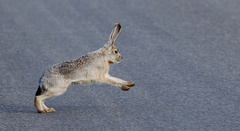
Black-tailed Jackrabbit

Black-tailed Jackrabbit

Lepus californicus

Silhouette: Jan A. Venter, Herbert H. T. Prins, David A. Balfour & Rob Slotow (vectorized by T. Michael Keesey) · PhyloPic

LCLeast ConcernNTVUENCR
Daily sighting probability <5% · Rare
at San Diego

In 3 days ~10% in a week ~20%

27 Verified sightings at San Diego
730 In all 10 parks From 2019 to 2026
May Best month
🌅 Crepuscular When it's spotted

About the Black-tailed Jackrabbit

The black-tailed jackrabbit (Lepus californicus), also known as the American desert hare, is a common hare of the western United States and Mexico, where it is found at elevations from sea level up to 10,000 ft (3,000 m). Reaching a length around 2 ft (61 cm), and a weight from 3 to 6 lb (1.4 to 2.7 kg), the black-tailed jackrabbit is one of the largest North American hares. Black-tailed jackrabbits occupy mixed shrub-grassland terrains. Their breeding depends on the location; it typically peaks in spring, but may continue all year round in warm climates. Young are born fully furred with eyes open; they are well camouflaged and are mobile within minutes of birth, thus females do not protect or even stay with the young except during nursing. The average litter size is around four, but may be as low as two and as high as seven in warm regions.

The black-tailed jackrabbit does not migrate or hibernate during winter and uses the same habitat of 0.4–1.2 mi2 (1.0–3.1 km2) year-round. Its diet is composed of various shrubs, small trees, grasses, and forbs. Shrubs generally comprise the bulk of fall and winter diets, while grasses and forbs are used in spring and early summer, but the pattern and plant species vary with climate. The black-tailed jackrabbit is an important prey species for raptors and carnivorous mammals, such as eagles, hawks, owls, coyotes, foxes, and wild cats. The hares host many ectoparasites including fleas, ticks, lice, and mites; for this reason, hunters often avoid collecting them. Wikipedia →

Global Distribution

Parks Where Found

# Park Country Daily sighting probability
1 Joshua Tree National Park 🇺🇸 United States
~40%
2 El Vizcaíno Biosphere Reserve 🇲🇽 Mexico
~30%
3 Saguaro National Park 🇺🇸 United States
~30%
4 Death Valley National Park 🇺🇸 United States
~30%
5 Bahía de Loreto National Park 🇲🇽 Mexico
~30%
6 Cabo Pulmo National Park 🇲🇽 Mexico
~20%
7 Zion National Park 🇺🇸 United States
~10%
8 Big Bend National Park 🇺🇸 United States
~10%
9 Padre Island National Seashore 🇺🇸 United States
~10%
10 Grand Canyon National Park 🇺🇸 United States
~10%

Cities Where Found

# City Country Daily sighting probability
1 Sacramento 🇺🇸 United States
~20%
2 San Francisco 🇺🇸 United States
~10%
3 Las Vegas 🇺🇸 United States
~10%
4 Mesa 🇺🇸 United States
~10%
5 Phoenix 🇺🇸 United States
~10%
6 San Diego 🇺🇸 United States
<5%

Before you go

What are the chances of seeing a Black-tailed Jackrabbit in San Diego?

Rare

Under 5% of wildlife watchers report a Black-tailed Jackrabbit sighting in San Diego on a given day, based on 27 verified sightings from GBIF citizen-science data. It is the 18th most-seen of the 26 mammals we can rate there. Over three days the chance rises to about 10%, and over a week to about 20%, if each day is a fresh chance.

When is the best time to see a Black-tailed Jackrabbit in San Diego?

Any time of year

In every month with enough records, under 5% of wildlife watchers report a Black-tailed Jackrabbit in San Diego on a given day, so our monthly data shows no clear season.

What time of day is best to see a Black-tailed Jackrabbit?

Between 6 and 9 pm

Across all the parks we cover, that three-hour window holds the most Black-tailed Jackrabbit sightings with a recorded time, and about 6 in 10 of them come between 6 am and 6 pm: it is most active around dawn and dusk.

Is San Diego the best place to see a Black-tailed Jackrabbit?

6th of 6

Of the 6 cities where we can rate Black-tailed Jackrabbit sightings, San Diego ranks 6th at under 5%. The best odds are in Sacramento (United States, about 20%), San Francisco (United States, about 10%) and Las Vegas (United States, about 10%).

Where does the Black-tailed Jackrabbit sighting chance come from?

GBIF citizen-science records

It is estimated from how often the Black-tailed Jackrabbit is recorded against all the mammals logged in San Diego (27 verified sightings), calibrated against known sighting rates. Figures are rounded to the nearest 10% because citizen-science data supports honest approximations, not decimals, and months with records from fewer than five people show "—". How it works.

← Back to San Diego