Allen's Hummingbird

Allen's Hummingbird

Selasphorus sasin

Silhouette: Ferran Sayol · PhyloPic

LCLeast ConcernNTVUENCR
Daily sighting probability ~10% · With luck
at San Francisco

In 3 days ~20% in a week ~40%

7,186 Verified sightings at San Francisco
1,806 In all 2 parks From 2019 to 2026
May Best month
☀️ Diurnal When it's spotted

About the Allen's Hummingbird

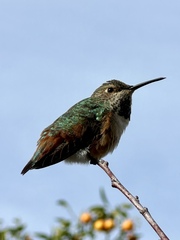
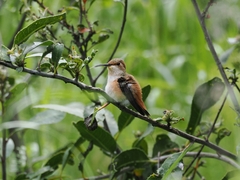
Allen's hummingbird (Selasphorus sasin) is a species of hummingbird that breeds in the western United States. It is one of seven species in the genus Selasphorus. Allen's hummingbird is a small bird, with mature adults reaching only 3 to 3.5 in (76 to 89 mm) in length and weighing approximately 2 to 4 grams in weight. They are known for their vibrant colors and energetic behaviors, making them a popular subject for birdwatchers and nature enthusiasts. The male has a green back and forehead, with rust-colored (rufous) flanks, rump, and tail. The male's throat is an iridescent orange-red. The male hummingbirds make use of their elaborate colors to impress the females, which is crucial for mating season. The female and immature Allen's hummingbirds are similarly colored, but lack the iridescent throat patch, instead having a series of speckles on their throats. Females are mostly green, featuring rufous color only on the tail, which also has white tips. Immature Allen's hummingbirds are so similar to the female rufous hummingbird, the two are almost indistinguishable in the field.

The lack of a notch in the second rectrix is considered an important field mark to distinguish... Wikipedia →

Sounds

Flight display0:28

United States · 2022

© Paul Marvin · XC698001 · CC BY-NC-SA 4.0

Alarm call0:04

United States · 2020

© Steve Hampton · XC595857 · CC BY-NC-SA 4.0

Call1:26

United States · 2015

© Frank Lambert · XC408476 · CC BY-NC-ND 4.0

Global Distribution

Parks Where Found

# Park Country Daily sighting probability
1 Channel Islands National Park 🇺🇸 United States
~30%
2 Redwood National Park 🇺🇸 United States
~10%

Cities Where Found

# City Country Daily sighting probability
1 Los Angeles 🇺🇸 United States
~60%
2 San Diego 🇺🇸 United States
~50%
3 Tijuana 🇲🇽 México
~20%
4 San Francisco 🇺🇸 United States
~10%
5 Philadelphia 🇺🇸 United States
<5%
6 Houston 🇺🇸 United States
<5%
7 San Antonio 🇺🇸 United States
<5%

Zoos & Centres Where Found

# Zoo / Centre Country
1 Living Desert Zoo and Gardens 🇺🇸 United States In captivity
2 Arizona-Sonora Desert Museum 🇺🇸 United States In captivity

Before you go

What are the chances of seeing an Allen's Hummingbird in San Francisco?

With luck

About 10% of wildlife watchers report an Allen's Hummingbird sighting in San Francisco on a given day, based on 7,186 verified sightings from GBIF citizen-science data. It is the 108th most-seen of the 375 birds we can rate there. Over three days the chance rises to about 20%, and over a week to about 40%, if each day is a fresh chance.

When is the best time to see an Allen's Hummingbird in San Francisco?

April to June

In those months about 20% of wildlife watchers report an Allen's Hummingbird in San Francisco on a given day, against under 5% in August to January, the lowest months. Those are among San Francisco's driest months, with about 20 mm of rain a month against 110 mm in December.

What time of day is best to see an Allen's Hummingbird?

Between 7 and 10 am

Across all the parks we cover, that three-hour window holds the most Allen's Hummingbird sightings with a recorded time, and about 9 in 10 of them come between 6 am and 6 pm: it is a daytime animal.

Is San Francisco the best place to see an Allen's Hummingbird?

4th of 7

Of the 7 cities where we can rate Allen's Hummingbird sightings, San Francisco ranks 4th at about 10%. The best odds are in Los Angeles (United States, about 60%), San Diego (United States, about 50%) and Tijuana (México, about 20%).

Where does the Allen's Hummingbird sighting chance come from?

GBIF citizen-science records

It is estimated from how often the Allen's Hummingbird is recorded against all the birds logged in San Francisco (7,186 verified sightings), calibrated against known sighting rates. Figures are rounded to the nearest 10% because citizen-science data supports honest approximations, not decimals, and months with records from fewer than five people show "—". How it works.

← Back to San Francisco