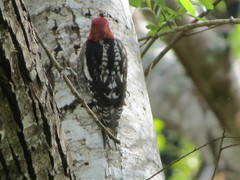
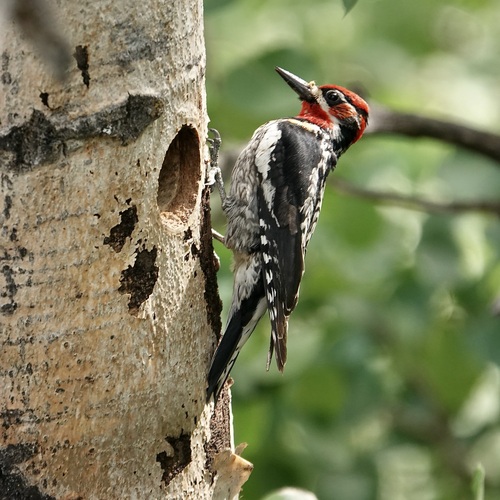
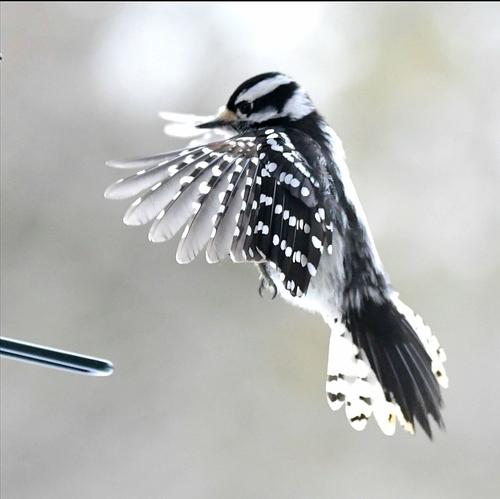
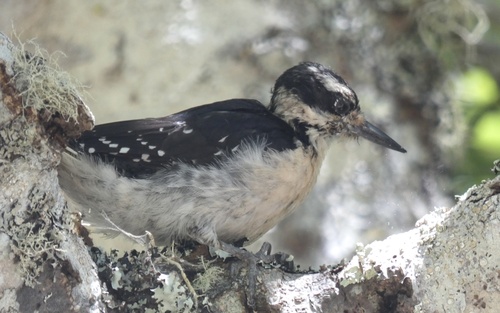

Red-breasted Sapsucker

Red-breasted Sapsucker

Sphyrapicus ruber

Silhouette: Nancy Wyman (photo), John E. McCormack, Michael G. Harvey, Brant C. Faircloth, Nicholas G. Crawford, Travis C. Glenn, Robb T. Brumfield & T. Michael Keesey · PhyloPic

LCLeast ConcernNTVUENCR
Daily sighting probability <5% · Rare
at San Francisco

In 3 days ~10% in a week ~20%

2,501 Verified sightings at San Francisco
2,480 In all 9 parks From 2019 to 2026
October Best month
☀️ Diurnal When it's spotted

About the Red-breasted Sapsucker

The red-breasted sapsucker (Sphyrapicus ruber) is a medium-sized woodpecker of the forests of the west coast of North America. The red-breasted sapsucker was formally described in 1788 by German naturalist Johann Friedrich Gmelin in his revised and expanded edition of Carl Linnaeus's Systema Naturae. He placed it with the woodpeckers in the genus Picus and coined the binomial name Picus ruber. The specific epithet is Latin meaning "red". Gmelin based his description on the "red-breasted woodpecker" that had been described in 1782 by the English ornithologist John Latham in his A General Synopsis of Birds. Latham mistakenly believed that his specimen had come from Cayenne in French Guiana. The type locality has been designated as Nootka Sound in the Canadian province of British Columbia. The red-breasted sapsucker is now one of four species placed in the genus Sphyrapicus that was introduced in 1858 by the American naturalist Spencer Baird.

The red-breasted sapsucker, the red-naped sapsucker (Sphyrapicus nuchalis), and the yellow-bellied sapsucker (Sphyrapicus varius) were formerly treated as a single species, the yellow-bellied sapsucker. The red-breasted and red-naped... Wikipedia →

Sounds

Begging call0:23

United States · 2022

© Bobby Wilcox · XC738560 · CC BY-NC-SA 4.0

Call0:36

Canada · 1992

© Peter Ward and Ken Hall · XC613145 · CC BY-NC-SA 4.0

Song0:10

United States · 2015

© Frank Lambert · XC408661 · CC BY-NC-ND 4.0

Global Distribution

Parks Where Found

# Park Country Daily sighting probability
1 Yosemite National Park 🇺🇸 United States
~20%
2 Sequoia and Kings Canyon National Parks 🇺🇸 United States
~10%
3 Great Bear Rainforest 🇨🇦 Canada
~10%
4 Olympic National Park 🇺🇸 United States
~10%
5 Redwood National Park 🇺🇸 United States
<5%
6 Pacific Rim National Park Reserve 🇨🇦 Canada
<5%
7 Death Valley National Park 🇺🇸 United States
<5%
8 Joshua Tree National Park 🇺🇸 United States
<5%
9 Channel Islands National Park 🇺🇸 United States
<5%

Cities Where Found

# City Country Daily sighting probability
1 Portland 🇺🇸 United States
~10%
2 Sacramento 🇺🇸 United States
<5%
3 Seattle 🇺🇸 United States
<5%
4 Vancouver 🇨🇦 Canada
<5%
5 San Francisco 🇺🇸 United States
<5%
6 Los Angeles 🇺🇸 United States
<5%
7 San Diego 🇺🇸 United States
<5%
8 Phoenix 🇺🇸 United States
<5%

Before you go

What are the chances of seeing a Red-breasted Sapsucker in San Francisco?

Rare

Under 5% of wildlife watchers report a Red-breasted Sapsucker sighting in San Francisco on a given day, based on 2,501 verified sightings from GBIF citizen-science data. It is the 158th most-seen of the 375 birds we can rate there. Over three days the chance rises to about 10%, and over a week to about 20%, if each day is a fresh chance.

When is the best time to see a Red-breasted Sapsucker in San Francisco?

February, October and December

In those months about 10% of wildlife watchers report a Red-breasted Sapsucker in San Francisco on a given day, against under 5% in January, March–September and November, the lowest months. Those are among San Francisco's wettest months, with about 75 mm of rain a month against almost none in July.

What time of day is best to see a Red-breasted Sapsucker?

Between 9 am and noon

Across all the parks we cover, that three-hour window holds the most Red-breasted Sapsucker sightings with a recorded time, and nearly all of them come between 6 am and 6 pm: it is a daytime animal.

Is San Francisco the best place to see a Red-breasted Sapsucker?

5th of 8

Of the 8 cities where we can rate Red-breasted Sapsucker sightings, San Francisco ranks 5th at under 5%. The best odds are in Portland (United States, about 10%), Sacramento (United States, under 5%) and Seattle (United States, under 5%).

Where does the Red-breasted Sapsucker sighting chance come from?

GBIF citizen-science records

It is estimated from how often the Red-breasted Sapsucker is recorded against all the birds logged in San Francisco (2,501 verified sightings), calibrated against known sighting rates. Figures are rounded to the nearest 10% because citizen-science data supports honest approximations, not decimals, and months with records from fewer than five people show "—". How it works.

← Back to San Francisco