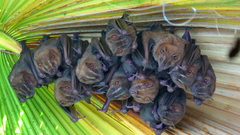
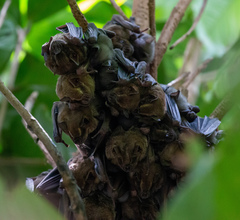
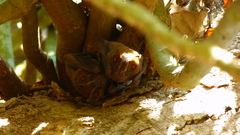
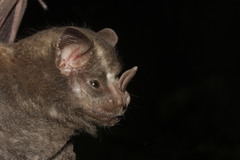
Great Fruit-eating Bat

Great Fruit-eating Bat

Artibeus lituratus

Silhouette: Jorge D. Carballo-Morales, based on a photo by Mario Barroso · PhyloPic

LCLeast ConcernNTVUENCR
Daily sighting probability ~10% · With luck
at San José

In 3 days ~20% in a week ~40%

11 Verified sightings at San José
25 In all 3 parks From 2019 to 2026
April Best month
☀️🌙 Day & Night When it's spotted

About the Great Fruit-eating Bat

The great fruit-eating bat (Artibeus lituratus) is a bat species found from Mexico to Brazil and Argentina, as well as in Antigua and Barbuda, Barbados, Grenada, Martinique, Saint Lucia, Saint Vincent and the Grenadines and Trinidad and Tobago.

They weigh 10.5 grams (0.37 oz) at birth and grow to 65 grams (2.3 oz) as adults. The heart of A. lituratus contains unique membranous structures not seen in any other mammal. The functions of these differences are still being studied, but may possibly aid in keeping the heart in the correct position while upside down, flight assistance, and energy reservation.

In Panama, it has been found that some Artibeus lituratus fly with 18-23g fruits of Dipteryx panamensis (Fabaceae), which is a third of the animal's body weight, up to hundreds of meters from the parent tree. Reproductive damage within A. lituratus has been linked with the insecticide deltamethrin. Wikipedia →
Sounds

Recording0:28

Mexico · 2020

© phoenixchaman · iNaturalist · CC BY-NC 4.0

Global Distribution

Parks Where Found

# Park Country Daily sighting probability
1 Corcovado National Park 🇨🇷 Costa Rica
~10%
2 Soberanía National Park 🇵🇦 Panama
~10%
3 La Amistad International Park (Panama) 🇵🇦 Panama
<5%

Cities Where Found

# City Country Daily sighting probability
1 Cali 🇨🇴 Colombia
~10%
2 Belo Horizonte 🇧🇷 Brazil
~10%
3 San José 🇨🇷 Costa Rica
~10%
4 Rio de Janeiro 🇧🇷 Brazil
~10%

Before you go

What are the chances of seeing a Great Fruit-eating Bat in San José?

With luck

About 10% of wildlife watchers report a Great Fruit-eating Bat sighting in San José on a given day, based on 11 verified sightings from GBIF citizen-science data. It is the 8th most-seen of the 15 mammals we can rate there. Over three days the chance rises to about 20%, and over a week to about 40%, if each day is a fresh chance.

When is the best time to see a Great Fruit-eating Bat in San José?

April

In that month about 20% of wildlife watchers report a Great Fruit-eating Bat in San José on a given day, against under 5% in February–March, June–September and November, the lowest months. That is one of San José's driest months, with about 75 mm of rain against 300 mm in October.

What time of day is best to see a Great Fruit-eating Bat?

Between 7 and 10 pm

Across all the parks we cover, that three-hour window holds the most Great Fruit-eating Bat sightings with a recorded time, and about half of them come between 6 am and 6 pm: it is seen both by day and at night.

Is San José the best place to see a Great Fruit-eating Bat?

Among the best

Of the 4 cities where we can rate Great Fruit-eating Bat sightings, San José ranks 3rd at about 10%, level with the leaders once rounded. The best odds are in Cali (Colombia, about 10%) and Belo Horizonte (Brazil, about 10%).

Where does the Great Fruit-eating Bat sighting chance come from?

GBIF citizen-science records

It is estimated from how often the Great Fruit-eating Bat is recorded against all the mammals logged in San José (11 verified sightings), calibrated against known sighting rates. Figures are rounded to the nearest 10% because citizen-science data supports honest approximations, not decimals, and months with records from fewer than five people show "—". How it works.

← Back to San José