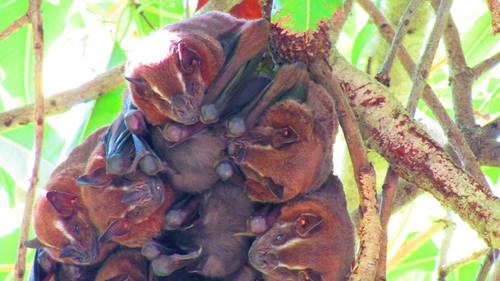
Common Opossum

Common Opossum

Didelphis marsupialis

Silhouette: Sarah Werning · PhyloPic

LCLeast ConcernNTVUENCR
Daily sighting probability ~10% · With luck
at San José

In 3 days ~40% in a week ~70%

48 Verified sightings at San José
171 In all 15 parks From 2019 to 2026
May Best month
☀️🌙 Day & Night When it's spotted

About the Common Opossum

The common opossum (Didelphis marsupialis), also called the northern black-eared opossum, is a species of marsupial living from the northeast of Mexico to Bolivia (reaching the coast of the South Pacific Ocean to the central coast of Peru), including Trinidad and Tobago as well as the Windward Islands in the Caribbean, where it is referred to as the manicou. The common opossum prefers forests, but can also be found in fields and cities.

The common opossum is found in tropical and subtropical forest, both primary and secondary, at altitudes of up to 2,200 m (7,200 ft). They use a wide range of nest sites. Most commonly, they will create one in the hollow of a tree; However, they will also dig a burrow or nest in any dark location if nothing else is suitable (which often gets them in trouble with humans). Opossums enjoy denning underground, but do not spend as much time underground during the dry season.

The common opossum is similar in size to a house cat. The fur of the opossum is actually yellow in the under-fur, but is hidden by the longer black guard-hairs that cover it, while the tail, fingers, and face are lighter with the tail being... Wikipedia →

Sounds

Recording0:06

El Salvador · 2024

© Rodríguez Viky · iNaturalist · CC BY-NC 4.0

Global Distribution

Parks Where Found

# Park Country Daily sighting probability
1 Lago de Yojoa 🇭🇳 Honduras
~30%
2 Masaya Volcano National Park 🇳🇮 Nicaragua
~20%
3 Cerro Azul Meámbar National Park 🇭🇳 Honduras
~20%
4 Soberanía National Park 🇵🇦 Panama
~20%
5 Biotopo Cerro Cahuí 🇬🇹 Guatemala
~20%
6 Piedras Blancas National Park 🇨🇷 Costa Rica
~10%
7 Palo Verde National Park 🇨🇷 Costa Rica
~10%
8 Tambopata National Reserve 🇵🇪 Peru
~10%
9 Manu National Park 🇵🇪 Peru
~10%
10 Cahuita National Park 🇨🇷 Costa Rica
~10%
11 Tortuguero National Park 🇨🇷 Costa Rica
~10%
12 La Amistad International Park (Panama) 🇵🇦 Panama
~10%
13 Parque Natural Metropolitano 🇵🇦 Panama
~10%
14 Braulio Carrillo National Park 🇨🇷 Costa Rica
~10%
15 Monteverde Cloud Forest Reserve 🇨🇷 Costa Rica
~10%

Cities Where Found

# City Country Daily sighting probability
1 San Pedro Sula 🇭🇳 Honduras
~30%
2 Manaus 🇧🇷 Brazil
~20%
3 Cali 🇨🇴 Colombia
~20%
4 Guayaquil 🇪🇨 Ecuador
~20%
5 Medellín 🇨🇴 Colombia
~20%
6 Guatemala City 🇬🇹 Guatemala
~20%
7 Caracas 🇻🇪 Venezuela
~20%
8 San José 🇨🇷 Costa Rica
~10%
9 Managua 🇳🇮 Nicaragua
~10%
10 Panama City 🇵🇦 Panama
~10%

Zoos & Centres Where Found

# Zoo / Centre Country
1 Parque Municipal Summit 🇵🇦 Panama In captivity

Before you go

What are the chances of seeing a Common Opossum in San José?

With luck

About 10% of wildlife watchers report a Common Opossum sighting in San José on a given day, based on 48 verified sightings from GBIF citizen-science data. It is the 5th most-seen of the 15 mammals we can rate there. Over three days the chance rises to about 40%, and over a week to about 70%, if each day is a fresh chance.

When is the best time to see a Common Opossum in San José?

February, April–May, July and September–October

In those months about 20% of wildlife watchers report a Common Opossum in San José on a given day, against under 5% in August, the lowest month.

What time of day is best to see a Common Opossum?

Between 8 and 11 pm

Across all the parks we cover, that three-hour window holds the most Common Opossum sightings with a recorded time, and about half of them come between 6 pm and 6 am: it is seen both by day and at night.

Is San José the best place to see a Common Opossum?

8th of 11

Of the 11 cities where we can rate Common Opossum sightings, San José ranks 8th at about 10%. The best odds are in San Pedro Sula (Honduras, about 30%), Manaus (Brazil, about 20%) and Cali (Colombia, about 20%).

Where does the Common Opossum sighting chance come from?

GBIF citizen-science records

It is estimated from how often the Common Opossum is recorded against all the mammals logged in San José (48 verified sightings), calibrated against known sighting rates. Figures are rounded to the nearest 10% because citizen-science data supports honest approximations, not decimals, and months with records from fewer than five people show "—". How it works.

← Back to San José