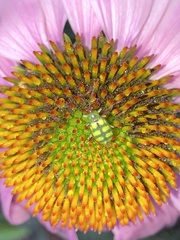
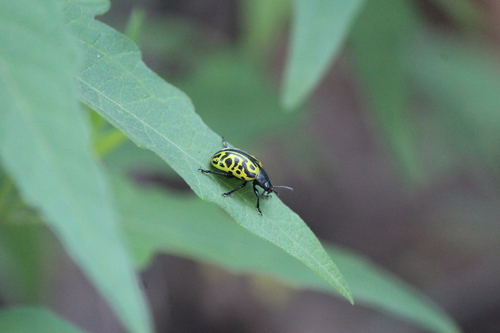
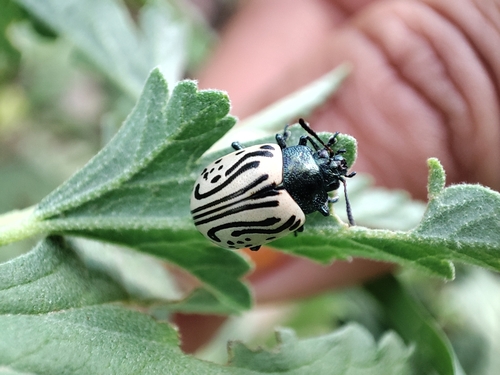

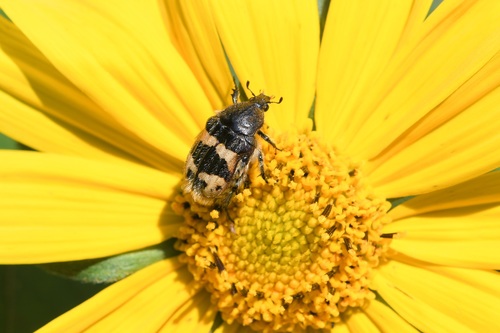

Banded Cucumber Beetle

Banded Cucumber Beetle

Diabrotica balteata

Daily sighting probability ~10% · With luck
at San Luis Potosí

In 3 days ~20% in a week ~40%

5 Verified sightings at San Luis Potosí
8 In 1 park From 2019 to 2026
November Best month
🌙 Nocturnal When it's spotted

About the Banded Cucumber Beetle

Diabrotica balteata is a species of cucumber beetle in the family Chrysomelidae known commonly as the banded cucumber beetle. It occurs in the Americas, where its distribution extends from the United States to Colombia and Venezuela in South America. It is also present in Cuba. It is a pest of a variety of agricultural crops.

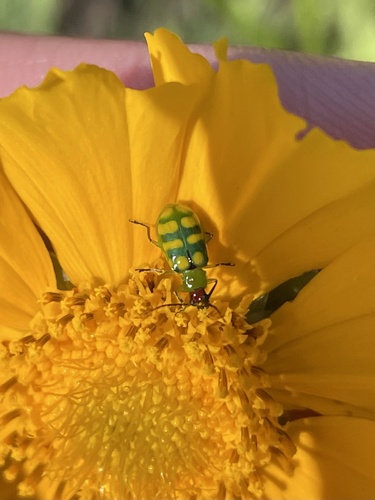
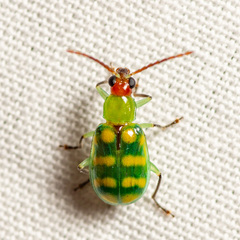
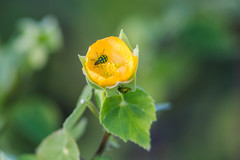
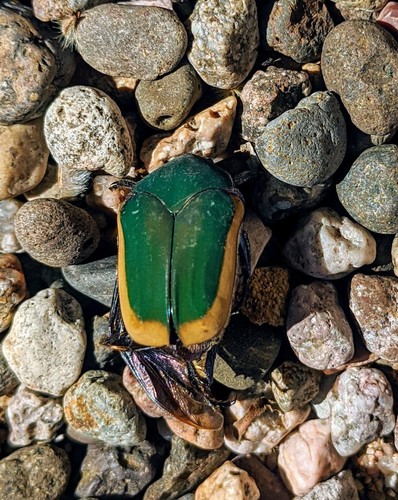
This beetle is 5 to 6 millimeters long. It has a red head and black thorax. The elytra are yellow, marked with three transverse bands in shades of green or blue-green and a narrower longitudinal green line down the center. The pattern of banding is variable and nearly absent in some individuals. The color of the elytra is influenced by the types of plants the beetle eats. The larva is also variable and has three instars. The new larva is white and about 2.3 millimeters long. It may turn yellow as it consumes plant material. The later-instar larva may reach nearly 9 millimeters.

The adult mates at about six days of age. The female begins producing eggs about 16 days later. She lays a cluster of eggs every few days for two to eight weeks, producing up to 15 clusters, for a maximum of 850 eggs. A cluster has up to 100 oval yellow eggs... Wikipedia →

Global Distribution

Parks Where Found

# Park Country Daily sighting probability
1 Everglades National Park 🇺🇸 United States
<5%

More parks will be added in future updates.

Cities Where Found

# City Country Daily sighting probability
1 San Pedro Sula 🇭🇳 Honduras
~10%
2 Puebla 🇲🇽 México
~10%
3 San Luis Potosí 🇲🇽 México
~10%
4 Torreón 🇲🇽 México
~10%
5 Houston 🇺🇸 United States
<5%
6 Monterrey 🇲🇽 México
<5%
7 Los Angeles 🇺🇸 United States
<5%
8 Austin 🇺🇸 United States
<5%
9 Miami 🇺🇸 United States
<5%

Before you go

What are the chances of seeing a Banded Cucumber Beetle in San Luis Potosí?

With luck

About 10% of wildlife watchers report a Banded Cucumber Beetle sighting in San Luis Potosí on a given day, based on 5 verified sightings from GBIF citizen-science data. It is the 79th most-seen of the 91 insects we can rate there. Over three days the chance rises to about 20%, and over a week to about 40%, if each day is a fresh chance.

When is the best time to see a Banded Cucumber Beetle in San Luis Potosí?

November

In that month about 20% of wildlife watchers report a Banded Cucumber Beetle in San Luis Potosí on a given day, against under 5% in August–October and December–May, the lowest months. That is one of San Luis Potosí's driest months, with about 15 mm of rain against 110 mm in July.

What time of day is best to see a Banded Cucumber Beetle?

Between 9 pm and midnight

Across all the parks we cover, that three-hour window holds the most Banded Cucumber Beetle sightings with a recorded time, and about 8 in 10 of them come between 6 pm and 6 am: it is mostly seen at night.

Is San Luis Potosí the best place to see a Banded Cucumber Beetle?

Among the best

Of the 9 cities where we can rate Banded Cucumber Beetle sightings, San Luis Potosí ranks 3rd at about 10%, level with the leaders once rounded. The best odds are in San Pedro Sula (Honduras, about 10%) and Puebla (México, about 10%).

Which relatives of the Banded Cucumber Beetle live in San Luis Potosí?

Same family: Chrysomelidae

The closest relatives of the Banded Cucumber Beetle that you can see in San Luis Potosí (family Chrysomelidae, Leaf Beetles) are Calligrapha mexicana (about 10%) and Calligrapha dislocata (about 10%), with each one's daily chance of a sighting.

Where does the Banded Cucumber Beetle sighting chance come from?

GBIF citizen-science records

It is estimated from how often the Banded Cucumber Beetle is recorded against all the insects logged in San Luis Potosí (5 verified sightings), calibrated against known sighting rates. Figures are rounded to the nearest 10% because citizen-science data supports honest approximations, not decimals, and months with records from fewer than five people show "—". How it works.

← Back to San Luis Potosí