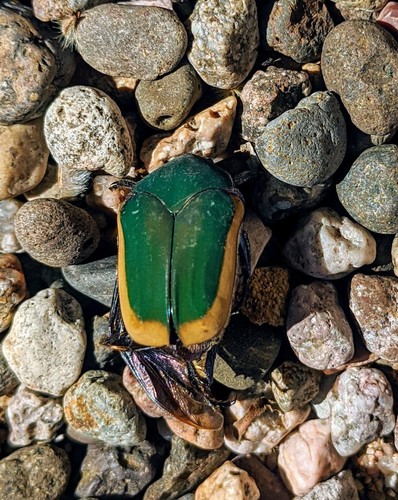

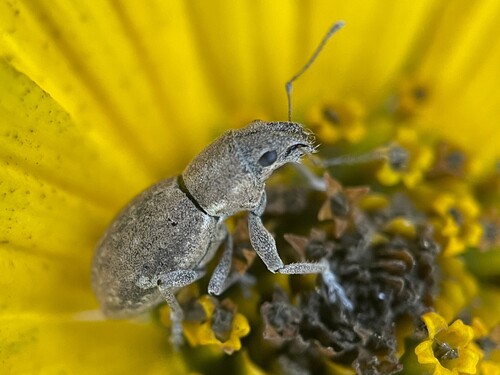
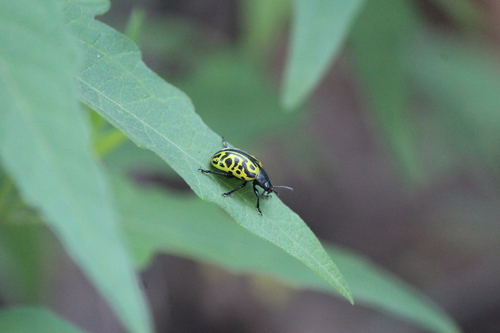
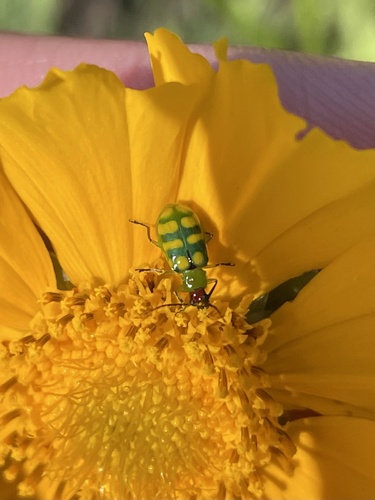
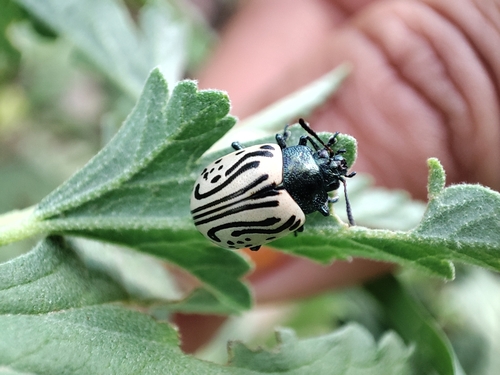

Figeater Beetle

Figeater Beetle

Cotinis mutabilis

Daily sighting probability ~10% · With luck
at San Luis Potosí

In 3 days ~30% in a week ~50%

13 Verified sightings at San Luis Potosí
78 In all 6 parks From 2019 to 2026
July Best month
☀️ Diurnal When it's spotted

About the Figeater Beetle

The figeater beetle (also green fruit beetle or fig beetle, Cotinis mutabilis) is a member of the scarab beetle family in the subfamily Cetoniinae, comprising a group of beetles commonly called flower chafers, since many of them feed on pollen, nectar, or petals. Its habitat covers primarily the southwestern United States (including California) and Mexico, extending south to northern South America. Within the figeater beetle's cuticle, twisted fibers are arranged in stacked layers. When light hits those layers, it bends and creates a distinct iridescent color. Figeater beetles are often mistaken for green June beetles (Cotinis nitida) and occasionally Japanese beetles (Popillia japonica), which occur in the Eastern US. C. mutabilis are also named by the synonym C. texana.

After mating, eggs are laid in decaying matter or compost piles, which provide sustenance for the emerging larvae. Oviposition takes place over an extended period of about three months, beginning in early August and continuing until the end of October. Eggs measure approximately 1.8 mm wide and 2.3 mm long and have a whitish color. In laboratory conditions with optimal temperatures, eggs hatch within... Wikipedia →

Global Distribution

Parks Where Found

# Park Country Daily sighting probability
1 Masaya Volcano National Park 🇳🇮 Nicaragua
~30%
2 Zion National Park 🇺🇸 United States
~10%
3 Cañón del Sumidero National Park 🇲🇽 Mexico
~10%
4 Channel Islands National Park 🇺🇸 United States
~10%
5 Saguaro National Park 🇺🇸 United States
~10%
6 Cumbres de Monterrey National Park 🇲🇽 Mexico
~10%

Cities Where Found

# City Country Daily sighting probability
1 Tijuana 🇲🇽 México
~30%
2 Managua 🇳🇮 Nicaragua
~20%
3 Los Angeles 🇺🇸 United States
~20%
4 San Diego 🇺🇸 United States
~20%
5 Mexico City 🇲🇽 México
~20%
6 León 🇲🇽 México
~20%
7 Mesa 🇺🇸 United States
~10%
8 Puebla 🇲🇽 México
~10%
9 Ciudad Juárez 🇲🇽 México
~10%
10 Las Vegas 🇺🇸 United States
~10%

Before you go

What are the chances of seeing a Figeater Beetle in San Luis Potosí?

With luck

About 10% of wildlife watchers report a Figeater Beetle sighting in San Luis Potosí on a given day, based on 13 verified sightings from GBIF citizen-science data. It is the 32nd most-seen of the 91 insects we can rate there. Over three days the chance rises to about 30%, and over a week to about 50%, if each day is a fresh chance.

When is the best time to see a Figeater Beetle in San Luis Potosí?

June and July

In those months about 20% of wildlife watchers report a Figeater Beetle in San Luis Potosí on a given day, against under 5% in December to May, the lowest months. Those are among San Luis Potosí's wettest months, with about 95 mm of rain a month against 5 mm in April.

What time of day is best to see a Figeater Beetle?

Between 9 am and noon

Across all the parks we cover, that three-hour window holds the most Figeater Beetle sightings with a recorded time, and about 8 in 10 of them come between 6 am and 6 pm: it is a daytime animal.

Is San Luis Potosí the best place to see a Figeater Beetle?

13th of 17

Of the 17 cities where we can rate Figeater Beetle sightings, San Luis Potosí ranks 13th at about 10%. The best odds are in Tijuana (México, about 30%), Managua (Nicaragua, about 20%) and Los Angeles (United States, about 20%).

Where does the Figeater Beetle sighting chance come from?

GBIF citizen-science records

It is estimated from how often the Figeater Beetle is recorded against all the insects logged in San Luis Potosí (13 verified sightings), calibrated against known sighting rates. Figures are rounded to the nearest 10% because citizen-science data supports honest approximations, not decimals, and months with records from fewer than five people show "—". How it works.

← Back to San Luis Potosí