Black Stink Bug

Black Stink Bug

Proxys punctulatus

Daily sighting probability ~10% · With luck
at San Pedro Sula

In 3 days ~30% in a week ~60%

6 Verified sightings at San Pedro Sula
12 In all 2 parks From 2019 to 2026
September Best month
☀️ Diurnal When it's spotted

About the Black Stink Bug

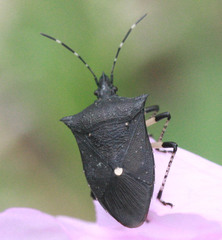
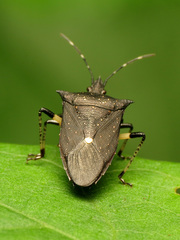
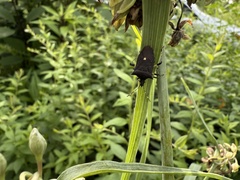
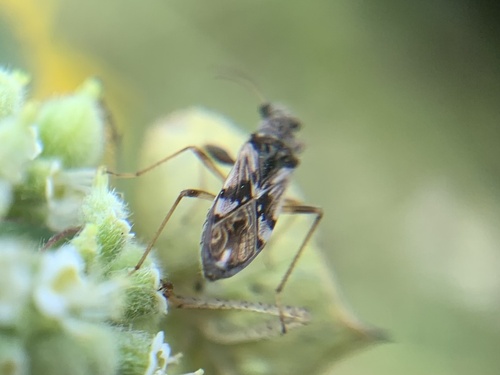
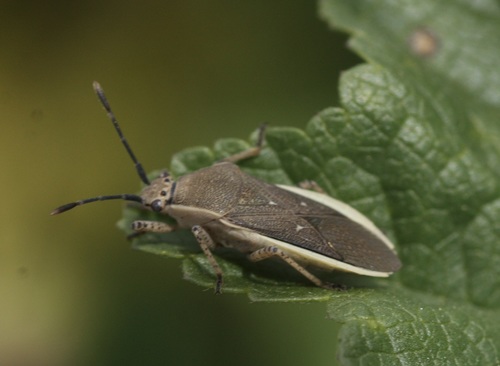
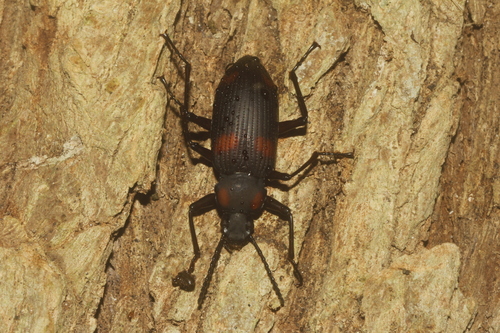
Proxys punctulatus, the black stink bug, is a species of stink bug in the family Pentatomidae. It is found in the Caribbean Sea, Central America, and North America. The adult of P. punctulatus is 11-13 mm long and has a mostly black body with a yellow spot at the apex of the scutellum. There are six legs which are black and cream in colour. The head as well as the humeral angles of the pronotum are pointed.

The life cycle of this species has been studied in Union County, Illinois. Adults overwinter in leaf litter near their host plants. They become active in June and reproduce. Eggs are usually laid singly. These eggs hatch into nymphs which go through five instars. A laboratory experiment, rearing P. punctulatus on Tradescantia subaspera under constant temperature and light, found that on average egg incubation takes 9.04 days while the five nymphal instars take 5.06, 7.15, 7.56, 9.32, and 15.93 days.

Proxys punctulatus is omnivorous, feeding on both plant juices and on insect larvae. It has been found on blackberry, spiderwort, cotton, soybean and citrus plants. Feeding results in disfigured leaves and discolored areas on stems, but this... Wikipedia →

Global Distribution

Parks Where Found

# Park Country Daily sighting probability
1 Masaya Volcano National Park 🇳🇮 Nicaragua
~10%
2 Great Smoky Mountains National Park 🇺🇸 United States
<5%

Cities Where Found

# City Country Daily sighting probability
1 San Pedro Sula 🇭🇳 Honduras
~10%
2 Orlando 🇺🇸 United States
~10%
3 Dallas 🇺🇸 United States
<5%
4 Austin 🇺🇸 United States
<5%
5 Houston 🇺🇸 United States
<5%
6 San Antonio 🇺🇸 United States
<5%
7 Washington 🇺🇸 United States
<5%
8 Miami 🇺🇸 United States
<5%
9 Los Angeles 🇺🇸 United States
<5%

Before you go

What are the chances of seeing a Black Stink Bug in San Pedro Sula?

With luck

About 10% of wildlife watchers report a Black Stink Bug sighting in San Pedro Sula on a given day, based on 6 verified sightings from GBIF citizen-science data. It is the 54th most-seen of the 79 insects we can rate there. Over three days the chance rises to about 30%, and over a week to about 60%, if each day is a fresh chance.

When is the best time to see a Black Stink Bug in San Pedro Sula?

June and September

In those months about 30% of wildlife watchers report a Black Stink Bug in San Pedro Sula on a given day, against under 5% in August, October and December–May, the lowest months.

What time of day is best to see a Black Stink Bug?

Between 10 am and 1 pm

Across all the parks we cover, that three-hour window holds the most Black Stink Bug sightings with a recorded time, and about 9 in 10 of them come between 6 am and 6 pm: it is a daytime animal.

Is San Pedro Sula the best place to see a Black Stink Bug?

Yes

Of the 9 cities where we can rate Black Stink Bug sightings, San Pedro Sula has the highest daily chance: about 10%. Next come Orlando (United States, about 10%) and Dallas (United States, under 5%).

Which relatives of the Black Stink Bug live in San Pedro Sula?

Same order: Hemiptera

The closest relatives of the Black Stink Bug that you can see in San Pedro Sula (order Hemiptera, True Bugs, Hoppers, Aphids, and allies) are Oncopeltus spectabilis (about 20%), Erythrogonia areolata (about 20%) and Brazilian Leafhopper (about 10%), with each one's daily chance of a sighting.

Where does the Black Stink Bug sighting chance come from?

GBIF citizen-science records

It is estimated from how often the Black Stink Bug is recorded against all the insects logged in San Pedro Sula (6 verified sightings), calibrated against known sighting rates. Figures are rounded to the nearest 10% because citizen-science data supports honest approximations, not decimals, and months with records from fewer than five people show "—". How it works.

← Back to San Pedro Sula