Yarará Lancehead

Yarará Lancehead

Bothrops jararaca

Silhouette: Steven Traver · PhyloPic

LCLeast ConcernNTVUENCR
Daily sighting probability ~10% · With luck
at São Paulo

In 3 days ~20% in a week ~40%

32 Verified sightings at São Paulo
41 In all 3 parks From 2019 to 2026
September Best month
☀️ Diurnal When it's spotted

About the Yarará Lancehead

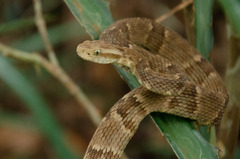
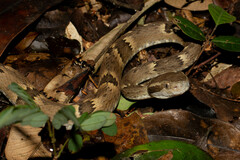
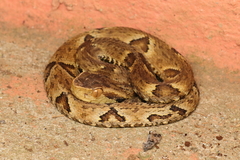
Bothrops jararaca—known as the jararaca or yarara—is a highly venomous pit viper species endemic to South America in southern Brazil, Paraguay, and northern Argentina. The specific name, jararaca, is derived from Old Tupi îararaka. Within its geographic range, it is often abundant and is an important cause of snakebite. No subspecies are currently recognized.

The drugs known as angiotensin converting enzyme (ACE) inhibitors, used for the treatment of hypertension and some types of congestive heart failure, were developed from a peptide found in the venom of this species. This is a slender and terrestrial species that grows to a maximum total length of 160 cm (63 in), although the average total length is much less.

The head scalation includes 5–12 intersupraoculars that are weakly keeled, 7–9 supralabials (usually 8) of which the second is fused with the prelacunal to form a lacunolabial, and 9–13 sublabials (usually 10–12). The midbody has 20–27 rows of dorsal scales (usually 23–25). The ventrals number 170–216 (rarely 218) and the 51–71 subcaudals are mostly paired.

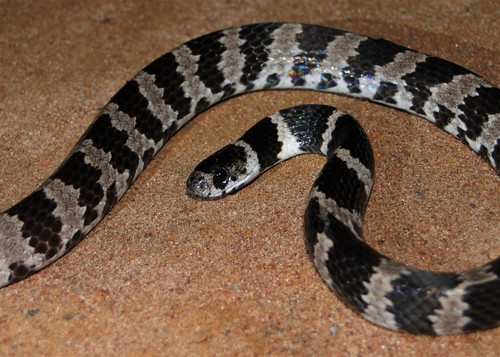
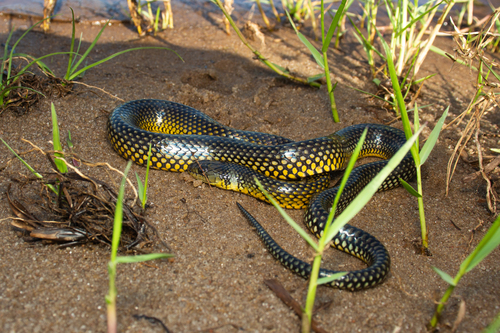
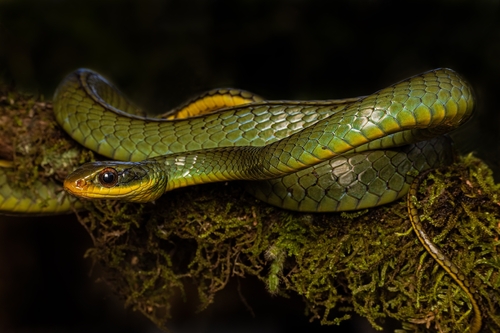
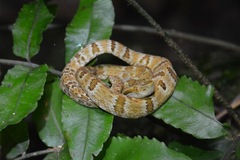
The color pattern is extremely variable, consisting of a dorsal ground color that may be tan, brown... Wikipedia →

Sounds

Recording0:11

Brazil · 2025

© Unidade de Conservação Ambiental Desterro-UFSC · iNaturalist · CC BY-NC 4.0

Global Distribution

Parks Where Found

# Park Country Daily sighting probability
1 Serra dos Órgãos National Park 🇧🇷 Brazil
~30%
2 Itatiaia National Park 🇧🇷 Brazil
~20%
3 Tijuca National Park 🇧🇷 Brazil
~10%

Cities Where Found

# City Country Daily sighting probability
1 Porto Alegre 🇧🇷 Brazil
~10%
2 Rio de Janeiro 🇧🇷 Brazil
~10%
3 São Paulo 🇧🇷 Brazil
~10%

Zoos & Centres Where Found

# Zoo / Centre Country
1 São Paulo Zoo 🇧🇷 Brazil In captivity
2 Fort Worth Zoo 🇺🇸 United States In captivity

Closest Relatives at São Paulo

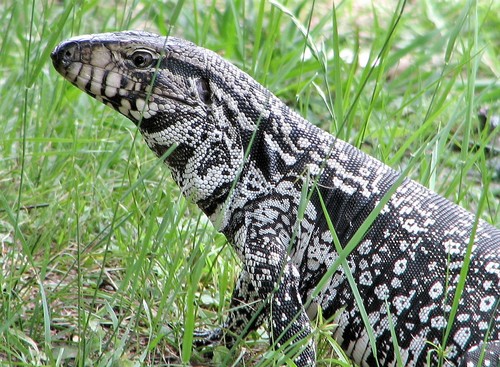
No species of the same family or order lives in São Paulo, so these are its closest relatives here: other reptiles.

Before you go

What are the chances of seeing a Yarará Lancehead in São Paulo?

With luck

About 10% of wildlife watchers report a Yarará Lancehead sighting in São Paulo on a given day, based on 32 verified sightings from GBIF citizen-science data. It is the 6th most-seen of the 23 reptiles we can rate there. Over three days the chance rises to about 20%, and over a week to about 40%, if each day is a fresh chance.

When is the best time to see a Yarará Lancehead in São Paulo?

September and November–May

In those months about 10% of wildlife watchers report a Yarará Lancehead in São Paulo on a given day, against under 5% in June–August and October, the lowest months.

What time of day is best to see a Yarará Lancehead?

Between 9 am and noon

Across all the parks we cover, that three-hour window holds the most Yarará Lancehead sightings with a recorded time, and about 7 in 10 of them come between 6 am and 6 pm: it is a daytime animal.

Is São Paulo the best place to see a Yarará Lancehead?

Among the best

Of the 3 cities where we can rate Yarará Lancehead sightings, São Paulo ranks 3rd at about 10%, level with the leaders once rounded. The best odds are in Porto Alegre (Brazil, about 10%) and Rio de Janeiro (Brazil, about 10%).

Where does the Yarará Lancehead sighting chance come from?

GBIF citizen-science records

It is estimated from how often the Yarará Lancehead is recorded against all the reptiles logged in São Paulo (32 verified sightings), calibrated against known sighting rates. Figures are rounded to the nearest 10% because citizen-science data supports honest approximations, not decimals, and months with records from fewer than five people show "—". How it works.

← Back to São Paulo