Oriental Cuckoo

Oriental Cuckoo

Cuculus optatus

Silhouette: Nicolas Huet le Jeune and Jean-Gabriel Prêtre (vectorized by T. Michael Keesey) · PhyloPic

LCLeast ConcernNTVUENCR
Daily sighting probability <5% · Rare
at Sapporo

In 3 days ~10%

6 Verified sightings at Sapporo
385 In all 4 parks From 2019 to 2026
August Best month
☀️ Diurnal When it's spotted

About the Oriental Cuckoo

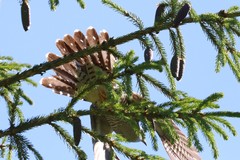
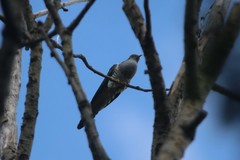
The Oriental cuckoo or Horsfield's cuckoo (Cuculus optatus) is a bird belonging to the genus Cuculus in the cuckoo family Cuculidae. It was formerly classified as a subspecies of the Himalayan cuckoo (C. saturatus), with the name 'Oriental cuckoo' used for the combined species. Differences in voice and size suggest that it should be treated as a separate species. The binomial name Cuculus horsfieldi has often been used instead of Cuculus optatus, but is now usually considered to be a junior synonym.

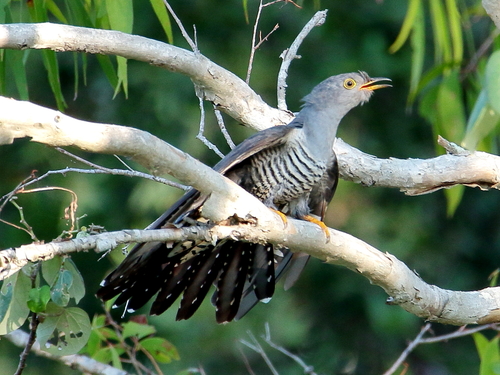
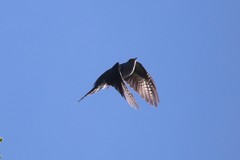
It is 30–32 centimetres long with a wingspan of 51–57 centimetres and a weight of 73–156 grams. The adult male has a grey head, breast and upperparts. The belly is creamy-white with dark bars. The vent is frequently buff with few markings. The legs and feet are orange-yellow and there is a bare yellow ring around the eye. Adult females and juveniles occur in two morphs. The grey morph is similar to the male but has a brownish wash on the breast. The rufous morph is reddish-brown above, paler on the underparts and with strong dark bands all over including the rump.

The common cuckoo (C. canorus) is very similar in appearance but is slightly bulkier with longer wings and... Wikipedia →

Sounds

Song0:58

China · 2026

© Peter Boesman · XC1147426 · CC BY-NC-ND 4.0

Call0:10

Russian Federation · 2020

© Swetlana Meshcheryagina · XC624316 · CC BY-NC-SA 4.0

Song0:50

Mongolia · 2025

© Richard E. Webster · XC1024431 · CC BY-NC-SA 4.0

Global Distribution

Parks Where Found

# Park Country Daily sighting probability
1 Taroko National Park 🇹🇼 Taiwan
~10%
2 Nikko National Park 🇯🇵 Japan
~10%
3 Raja Ampat 🇮🇩 Indonesia
<5%
4 Daintree National Park 🇦🇺 Australia
<5%

Cities Where Found

# City Country Daily sighting probability
1 Sapporo 🇯🇵 Japan
<5%
2 Taichung 🇹🇼 Taiwan
<5%
3 Kaohsiung 🇹🇼 Taiwan
<5%
4 Taipei 🇹🇼 Taiwan
<5%
5 Tokyo 🇯🇵 Japan
<5%
6 Brisbane 🇦🇺 Australia
<5%
7 Seoul 🇰🇷 South Korea
<5%
8 Nagoya 🇯🇵 Japan
<5%
9 Osaka 🇯🇵 Japan
<5%

Before you go

What are the chances of seeing an Oriental Cuckoo in Sapporo?

Rare

Under 5% of wildlife watchers report an Oriental Cuckoo sighting in Sapporo on a given day, based on 6 verified sightings from GBIF citizen-science data. It is the 63rd most-seen of the 72 birds we can rate there. Over three days the chance rises to about 10%, if each day is a fresh chance.

When is the best time to see an Oriental Cuckoo in Sapporo?

June and August

In those months about 10% of wildlife watchers report an Oriental Cuckoo in Sapporo on a given day, against under 5% in July and September–May, the lowest months.

What time of day is best to see an Oriental Cuckoo?

Between 7 and 10 am

Across all the parks we cover, that three-hour window holds the most Oriental Cuckoo sightings with a recorded time, and about 7 in 10 of them come between 6 am and 6 pm: it is a daytime animal.

Is Sapporo the best place to see an Oriental Cuckoo?

Yes

Of the 9 cities where we can rate Oriental Cuckoo sightings, Sapporo has the highest daily chance: under 5%. Next come Taichung (Taiwan, under 5%) and Kaohsiung (Taiwan, under 5%).

Where does the Oriental Cuckoo sighting chance come from?

GBIF citizen-science records

It is estimated from how often the Oriental Cuckoo is recorded against all the birds logged in Sapporo (6 verified sightings), calibrated against known sighting rates. Figures are rounded to the nearest 10% because citizen-science data supports honest approximations, not decimals, and months with records from fewer than five people show "—". How it works.
← Back to Sapporo