Great Spotted Woodpecker

Great Spotted Woodpecker

Dendrocopos major

Silhouette: Steven Traver · PhyloPic

LCLeast ConcernNTVUENCR
Daily sighting probability ~50% · Likely
at Sapporo

In 3 days ~90% in a week >90%

264 Verified sightings at Sapporo
9,791 In all 29 parks From 2019 to 2026
February Best month
☀️ Diurnal When it's spotted

About the Great Spotted Woodpecker

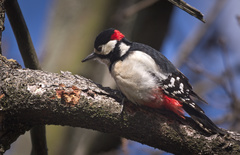
The great spotted woodpecker (Dendrocopos major) is a medium-sized woodpecker with pied black and white plumage and a red patch on the lower belly. Males and young birds also have red markings on the neck or head. This species is found across the Palearctic including parts of North Africa. Across most of its range it is resident, but in the north some will migrate if the conifer cone crop fails. Some individuals have a tendency to wander, leading to the recolonisation of Ireland in the first decade of the 21st century and to vagrancy to North America. Great spotted woodpeckers chisel into trees to find food or excavate nest holes, and also drum for contact and territorial advertisement; like other woodpeckers, they have anatomical adaptations to manage the physical stresses from the hammering action.

This woodpecker occurs in all types of woodlands and eats a variety of foods, being capable of extracting seeds from pine cones, insect larvae from inside trees or eggs and chicks of other birds from their nests. It breeds in holes excavated in living or dead trees, unlined apart from wood chips. The typical clutch is four to six glossy white eggs. Both parents incubate the eggs, feed the chicks, and keep the nest clean. When the young fledge they are fed by the adults for about ten days, each parent taking responsibility for feeding part of the brood.

The species is closely related to some other members of its genus. It has a number of subspecies, some of which are distinctive enough to be potential new species. It has a huge range and large population, with no widespread threats, so it is classed as a species of least concern by the International Union for Conservation of Nature (IUCN). Wikipedia →

Sounds

Call0:42

Poland · 2026

© Romuald Mikusek · XC1180312 · CC BY-NC-SA 4.0

Drumming0:51

Denmark · 2026

© Christian Bøggild · XC1098819 · CC BY-NC-SA 4.0

Alarm call0:48

France · 2025

© AUDEVARD Aurélien · XC1098622 · CC BY-NC-SA 4.0

Global Distribution

Parks Where Found

# Park Country Daily sighting probability
1 Białowieża National Park 🇵🇱 Poland
~70%
2 Nikko National Park 🇯🇵 Japan
~60%
3 Bavarian Forest National Park 🇩🇪 Germany
~50%
4 Cairngorms National Park 🇬🇧 United Kingdom
~40%
5 Aigüestortes National Park 🇪🇸 Spain
~40%
6 Tatra National Park 🇸🇰 Slovakia
~40%
7 Biebrza National Park 🇵🇱 Poland
~40%
8 Triglav National Park 🇸🇮 Slovenia
~30%
9 Plitvice Lakes National Park 🇭🇷 Croatia
~30%
10 Sierra de Guadarrama National Park 🇪🇸 Spain
~30%
11 Sierra Nevada National Park 🇪🇸 Spain
~30%
12 Gauja National Park 🇱🇻 Latvia
~30%
13 Kiskunság National Park 🇭🇺 Hungary
~30%
14 Hohe Tauern National Park 🇦🇹 Austria
~30%
15 Fertő-Hanság National Park 🇭🇺 Hungary
~30%
16 Hortobágy National Park 🇭🇺 Hungary
~30%
17 Pyrénées National Park 🇫🇷 France
~20%
18 Snowdonia National Park 🇬🇧 United Kingdom
~20%
19 Ecrins National Park 🇫🇷 France
~20%
20 Cévennes National Park 🇫🇷 France
~20%
21 Vanoise National Park 🇫🇷 France
~20%
22 Ordesa y Monte Perdido National Park 🇪🇸 Spain
~20%
23 Picos de Europa National Park 🇪🇸 Spain
~20%
24 Wadden Sea National Park 🇩🇪 Germany
~10%
25 Monfragüe National Park 🇪🇸 Spain
~10%
26 Mercantour National Park 🇫🇷 France
~10%
27 Jiuzhaigou National Park 🇨🇳 China
~10%
28 Doñana National Park 🇪🇸 Spain
<5%
29 Camargue 🇫🇷 France
<5%

Cities Where Found

# City Country Daily sighting probability
1 Munich 🇩🇪 Germany
~70%
2 Vienna 🇦🇹 Austria
~70%
3 Kharkiv 🇺🇦 Ukraine
~60%
4 Beijing 🇨🇳 China
~60%
5 Milan 🇮🇹 Italy
~60%
6 Budapest 🇭🇺 Hungary
~60%
7 Cologne 🇩🇪 Germany
~60%
8 Berlin 🇩🇪 Germany
~50%
9 Sapporo 🇯🇵 Japan
~50%
10 Sofia 🇧🇬 Bulgaria
~50%

Zoos & Centres Where Found

# Zoo / Centre Country
1 Asahiyama Zoo 🇯🇵 Japan In captivity
2 Leningrad Zoo 🇷🇺 Russia In captivity

Before you go

What are the chances of seeing a Great Spotted Woodpecker in Sapporo?

Likely

About 50% of wildlife watchers report a Great Spotted Woodpecker sighting in Sapporo on a given day, based on 264 verified sightings from GBIF citizen-science data. It is the 10th most-seen of the 72 birds we can rate there. Over three days the chance rises to about 90%, and over a week to over 90%, if each day is a fresh chance.

When is the best time to see a Great Spotted Woodpecker in Sapporo?

February and December

In those months about 70% of wildlife watchers report a Great Spotted Woodpecker in Sapporo on a given day, against about 30% in June, the lowest month.

What time of day is best to see a Great Spotted Woodpecker?

Between 8 and 11 am

Across all the parks we cover, that three-hour window holds the most Great Spotted Woodpecker sightings with a recorded time, and about 8 in 10 of them come between 6 am and 6 pm: it is a daytime animal.

Is Sapporo the best place to see a Great Spotted Woodpecker?

9th of 76

Of the 76 cities where we can rate Great Spotted Woodpecker sightings, Sapporo ranks 9th at about 50%. The best odds are in Munich (Germany, about 70%), Vienna (Austria, about 70%) and Kharkiv (Ukraine, about 60%).

Where does the Great Spotted Woodpecker sighting chance come from?

GBIF citizen-science records

It is estimated from how often the Great Spotted Woodpecker is recorded against all the birds logged in Sapporo (264 verified sightings), calibrated against known sighting rates. Figures are rounded to the nearest 10% because citizen-science data supports honest approximations, not decimals, and months with records from fewer than five people show "—". How it works.

← Back to Sapporo

