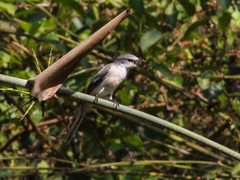
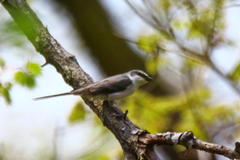
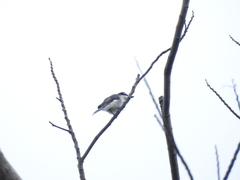
Ashy Minivet

Ashy Minivet

Pericrocotus divaricatus

Silhouette: PhyloPic

LCLeast ConcernNTVUENCR
Daily sighting probability ~10% · With luck
at Singapore

In 3 days ~10% in a week ~30%

673 Verified sightings at Singapore
985 In all 10 parks From 2019 to 2026
November Best month
☀️ Diurnal When it's spotted

About the Ashy Minivet

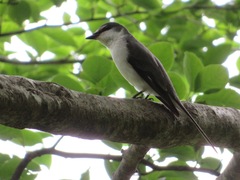
The ashy minivet (Pericrocotus divaricatus) is a passerine bird of eastern Asia belonging to the minivet genus Pericrocotus in the cuckooshrike family Campephagidae. While most of the minivets have shades of yellow, orange and red in their plumage, this species has only greys, whites and blacks. The male is distinctive with a white face and black nape although females can be confused with the female of the brown-rumped minivet. They forage in the canopy, often along with other minivets and join mixed-species foraging flocks.

It is 18.5–20 cm long. The male is grey above and whitish below. It has a black cap with a white forehead and there is a white band across the flight-feathers. The outer tail feathers are white. The bill and feet are black. The female's cap is grey apart from a black band between the bill and eye and a narrow white band above it. The call is a high-pitched, metallic trill. It is considered as closely related to Pericrocotus roseus and Pericrocotus cantonensis but differs in moult pattern. It is one of the few passerine birds that moult their primaries twice in a year and is the longest distance migrant among the minivets.

It breeds in south-east... Wikipedia →

Sounds

Call0:34

China · 2026

© Peter Boesman · XC1147664 · CC BY-NC-ND 4.0

Nocturnal flight call1:13

China · 2024

© 小菜鸟 · XC897439 · CC BY-NC-SA 4.0

Song0:30

Thailand · 2023

© Peter Ericsson · XC842169 · CC BY-NC-SA 4.0

Global Distribution

Parks Where Found

# Park Country Daily sighting probability
1 Cat Tien National Park 🇻🇳 Vietnam
~10%
2 Khao Yai National Park 🇹🇭 Thailand
~10%
3 Nikko National Park 🇯🇵 Japan
~10%
4 Kaeng Krachan National Park 🇹🇭 Thailand
~10%
5 Khao Luang National Park 🇹🇭 Thailand
~10%
6 Gunung Leuser National Park 🇮🇩 Indonesia
<5%
7 Taman Negara National Park 🇲🇾 Malaysia
<5%
8 Khao Sok National Park 🇹🇭 Thailand
<5%
9 Cuc Phuong National Park 🇻🇳 Vietnam
<5%
10 Doi Inthanon National Park 🇹🇭 Thailand
<5%

Cities Where Found

# City Country Daily sighting probability
1 Ho Chi Minh City 🇻🇳 Vietnam
~10%
2 Busan 🇰🇷 South Korea
~10%
3 Singapore 🇸🇬 Singapore
~10%
4 Manila 🇵🇭 Philippines
~10%
5 Sendai 🇯🇵 Japan
~10%
6 Xiamen City 🇨🇳 China
<5%
7 Phnom Penh 🇰🇭 Cambodia
<5%
8 Wenzhou 🇨🇳 China
<5%
9 Kuala Lumpur 🇲🇾 Malaysia
<5%
10 Hanoi 🇻🇳 Vietnam
<5%

Before you go

What are the chances of seeing an Ashy Minivet in Singapore?

With luck

About 10% of wildlife watchers report an Ashy Minivet sighting in Singapore on a given day, based on 673 verified sightings from GBIF citizen-science data. It is the 87th most-seen of the 298 birds we can rate there. Over three days the chance rises to about 10%, and over a week to about 30%, if each day is a fresh chance.

When is the best time to see an Ashy Minivet in Singapore?

November

In that month about 20% of wildlife watchers report an Ashy Minivet in Singapore on a given day, against under 5% in February and April–October, the lowest months. That is one of Singapore's wettest months, with about 280 mm of rain against 100 mm in February.

What time of day is best to see an Ashy Minivet?

Between 8 and 11 am

Across all the parks we cover, that three-hour window holds the most Ashy Minivet sightings with a recorded time, and about 9 in 10 of them come between 6 am and 6 pm: it is a daytime animal.

Is Singapore the best place to see an Ashy Minivet?

Among the best

Of the 27 cities where we can rate Ashy Minivet sightings, Singapore ranks 3rd at about 10%, level with the leaders once rounded. The best odds are in Ho Chi Minh City (Vietnam, about 10%) and Busan (South Korea, about 10%).

Where does the Ashy Minivet sighting chance come from?

GBIF citizen-science records

It is estimated from how often the Ashy Minivet is recorded against all the birds logged in Singapore (673 verified sightings), calibrated against known sighting rates. Figures are rounded to the nearest 10% because citizen-science data supports honest approximations, not decimals, and months with records from fewer than five people show "—". How it works.

← Back to Singapore