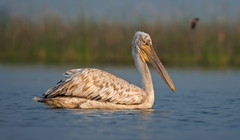
Dalmatian Pelican

Dalmatian Pelican

Pelecanus crispus

Silhouette: Oscar G. Miranda · PhyloPic

LCNTNear ThreatenedVUENCR
Daily sighting probability <5% · Rare
at Taipei

In 3 days <5% in a week ~10%

310 Verified sightings at Taipei
221 In all 2 parks From 2019 to 2026
January Best month

About the Dalmatian Pelican

The Dalmatian pelican (Pelecanus crispus), also known as the curly-headed pelican, is the largest member of the pelican family and among the heaviest flying birds in the world. With a wingspan typically ranging between 2.7 and 3.2 metres (8 ft 10 in and 10 ft 6 in), it ranks among the largest soaring birds. These pelicans are known for their graceful flight and often travel in synchronised flocks. With a range spanning across much of Central Eurasia, from the eastern Mediterranean in the west to the Taiwan Strait in the east, and from the Persian Gulf in the south to Siberia in the north, it is a short-to-medium-distance migrant between breeding and overwintering areas.

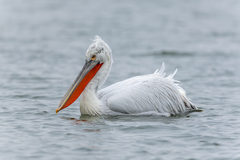
As with other pelicans, its diet is mainly fish, and the males are larger than the females. Its curly nape feathers, grey legs and silvery-white plumage are distinguishing features, and the wings appear solid grey in flight. The adults acquire a drabber plumage in winter, however, making them look more similar to the great white pelican. Its harsh vocalizations become more pronounced during the mating season. It breeds across the Palearctic from southeastern Europe to Russia, India and China in swamps and shallow lakes. It usually returns to traditional breeding sites, where it is less social than other pelican species. Its nests are crude heaps of vegetation, which are placed on islands or dense mats of vegetation.

The species' numbers dramatically declined during the 20th century, partly due to land use, disturbance and poaching activities. The core population survives in Russia, but in its Mongolian range, it is critically endangered. Removal of power lines to prevent bird strike or electrocution and constructing nesting platforms or rafts have reversed declines locally. Wikipedia →

Sounds

Alarm call0:08

Romania · 2014

© Marco Dragonetti · XC331137 · CC BY-NC-ND 4.0

Global Distribution

Parks Where Found

# Park Country Daily sighting probability
1 Keoladeo National Park 🇮🇳 India
~10%
2 Ranthambore National Park 🇮🇳 India
<5%

Cities Where Found

# City Country Daily sighting probability
1 Izmir 🇹🇷 Turkey
~30%
2 Rajkot 🇮🇳 India
~20%
3 Karachi 🇵🇰 Pakistan
~10%
4 Jaipur 🇮🇳 India
~10%
5 Jodhpur 🇮🇳 India
<5%
6 Taipei 🇹🇼 Taiwan
<5%
7 Beijing 🇨🇳 China
<5%

Zoos & Centres Where Found

# Zoo / Centre Country
1 Moscow Zoo 🇷🇺 Russia In captivity
2 Copenhagen Zoo 🇩🇰 Denmark In captivity
3 Tierpark Berlin 🇩🇪 Germany In captivity
4 Planckendael Zoo 🇧🇪 Belgium In captivity
5 Islamabad Zoo 🇵🇰 Pakistan In captivity
6 Le Pal 🇫🇷 France In captivity
7 Dvůr Králové Zoo 🇨🇿 Czechia In captivity
8 Chomutov Zoo 🇨🇿 Czechia In captivity
9 Walsrode World Bird Park 🇩🇪 Germany In captivity
10 Parc des oiseaux 🇫🇷 France In captivity
11 Yekaterinburg Zoo 🇷🇺 Russia In captivity
12 Zoo de Maubeuge 🇫🇷 France In captivity
13 Kaliningrad Zoo 🇷🇺 Russia In captivity
14 Karagandy Zoo 🇰🇿 Kazakhstan In captivity
15 San Diego Zoo Safari Park 🇺🇸 United States In captivity
16 Beijing Wildlife Park 🇨🇳 China In captivity
17 Taipei Zoo 🇹🇼 Taiwan In captivity
18 Shanghai Wild Animal Park 🇨🇳 China In captivity
19 Bronx Zoo 🇺🇸 United States In captivity
20 Haute Touche Zoological Park 🇫🇷 France In captivity
21 Parc animalier de Sainte-Croix 🇫🇷 France In captivity
22 Beijing Zoo 🇨🇳 China In captivity
23 Shanghai Zoo 🇨🇳 China In captivity
24 Zoo de Pescheray 🇫🇷 France In captivity
25 Suzhou Shangfangshan Forest Zoo 🇨🇳 China In captivity
26 Phoenix Zoo 🇺🇸 United States In captivity
27 Louisville Zoo 🇺🇸 United States In captivity
28 Yaroslavl Zoo 🇷🇺 Russia In captivity
29 La Torbiera 🇮🇹 Italy In captivity
30 Novosibirsk Zoo 🇷🇺 Russia In captivity
31 Kyiv Zoo 🇺🇦 Ukraine In captivity
32 Calgary Zoo 🇨🇦 Canada In captivity
33 Diergaarde Blijdorp 🇳🇱 Netherlands In captivity
34 Tierwelt Herberstein 🇦🇹 Austria In captivity
35 DierenPark Amersfoort 🇳🇱 Netherlands In captivity
36 Parc Zoologique et Botanique de Mulhouse 🇫🇷 France In captivity
37 Almaty Zoo 🇰🇿 Kazakhstan In captivity
38 Schönbrunn Zoo 🇦🇹 Austria In captivity
39 Zoo d'Amnéville 🇫🇷 France In captivity
40 Zoom di Cumiana 🇮🇹 Italy In captivity
41 Tierpark Bern 🇨🇭 Switzerland In captivity
42 Cleres Zoological Park 🇫🇷 France In captivity
43 Plaswijckpark 🇳🇱 Netherlands In captivity
44 Aquazoo Friesland 🇳🇱 Netherlands In captivity
45 Biotropica 🇫🇷 France In captivity
46 Vogelpark Avifauna 🇳🇱 Netherlands In captivity
47 Zoo Sibiu 🇷🇴 Romania In captivity
48 Tbilisi Zoo 🇬🇪 Georgia In captivity
49 Kazan Zoo & Botanical Garden 🇷🇺 Russia In captivity
50 Oasi Naturalistica di Sant'Alessio 🇮🇹 Italy In captivity

Before you go

What are the chances of seeing a Dalmatian Pelican in Taipei?

Rare

Under 5% of wildlife watchers report a Dalmatian Pelican sighting in Taipei on a given day, based on 310 verified sightings from GBIF citizen-science data. It is the 123rd most-seen of the 266 birds we can rate there. Over three days the chance rises to under 5%, and over a week to about 10%, if each day is a fresh chance.

When is the best time to see a Dalmatian Pelican in Taipei?

January

In that month about 10% of wildlife watchers report a Dalmatian Pelican in Taipei on a given day, against under 5% in February to December, the lowest months. That is one of Taipei's driest months, with about 95 mm of rain against 270 mm in June.

Is Taipei the best place to see a Dalmatian Pelican?

6th of 7

Of the 7 cities where we can rate Dalmatian Pelican sightings, Taipei ranks 6th at under 5%. The best odds are in Izmir (Turkey, about 30%), Rajkot (India, about 20%) and Karachi (Pakistan, about 10%).

Which relatives of the Dalmatian Pelican live in Taipei?

Same order: Pelecaniformes

The closest relatives of the Dalmatian Pelican that you can see in Taipei (order Pelecaniformes, Pelicans, Herons, Ibises, and Allies) are Little Egret (about 50%), Black-crowned Night Heron (about 50%) and Malayan Night Heron (about 40%), with each one's daily chance of a sighting.

Where does the Dalmatian Pelican sighting chance come from?

GBIF citizen-science records

It is estimated from how often the Dalmatian Pelican is recorded against all the birds logged in Taipei (310 verified sightings), calibrated against known sighting rates. Figures are rounded to the nearest 10% because citizen-science data supports honest approximations, not decimals, and months with records from fewer than five people show "—". How it works.

← Back to Taipei