Tundra Bean Goose

Tundra Bean Goose

Anser serrirostris

Silhouette: Rebecca Groom · PhyloPic

Daily sighting probability <5% · Rare
at Taipei

In 3 days <5%

18 Verified sightings at Taipei
636 In all 7 parks From 2019 to 2026
November Best month
☀️ Diurnal When it's spotted

About the Tundra Bean Goose

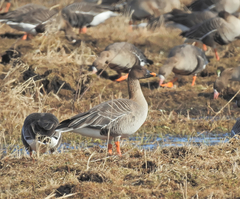
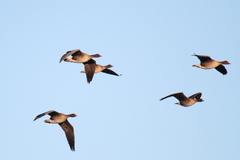
The tundra bean goose (Anser serrirostris) is a goose that breeds in northern Siberia. This and the taiga bean goose are recognised as separate species by the American Ornithological Society and International Ornithologists' Union, but are considered a single species by other authorities (collectively called bean goose). It is migratory and winters further south in Asia. The taiga and tundra bean goose diverged about 2.5 million years ago and established secondary contact ca. 60,000 years ago, resulting in extensive gene flow.

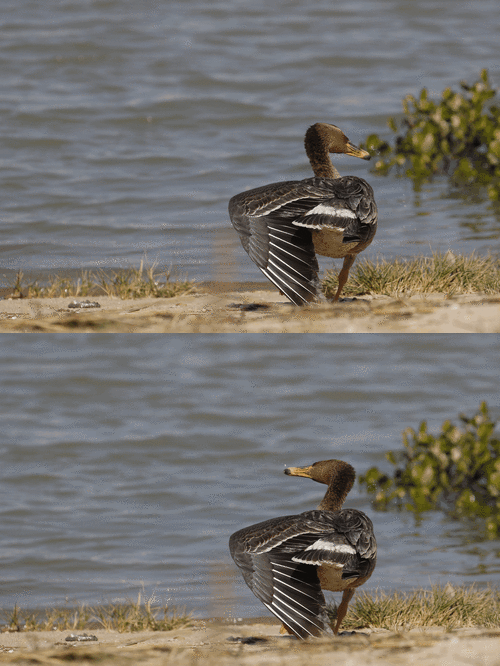
The length ranges from 68 to 90 cm (27–35 in), wingspan from 140 to 174 cm (55–69 in) and weight from 1.7–4 kg (3.7–8.8 lb). In the nominate subspecies, males average 3.2 kg (7.1 lb) and females average 2.84 kg (6.3 lb). The bill is black at the base and tip, with an orange band across the middle; the legs and feet are also bright orange.

The upper wing-coverts are dark brown, as in the white-fronted goose (Anser albifrons) and the lesser white-fronted goose (A. erythropus), but differing from these in having narrow white fringes to the feathers. The voice is a loud honking, higher pitched in the smaller subspecies.

The closely related pink-footed... Wikipedia →
Sounds

Flight call0:14

Poland · 2025

© Romuald Mikusek · XC1062362 · CC BY-NC-SA 4.0

Call1:15

China · 2025

© Peter Boesman · XC988387 · CC BY-NC-ND 4.0

Nocturnal flight call0:23

Netherlands · 2025

© Fred Prak · XC976767 · CC BY-NC-SA 4.0

Global Distribution

Parks Where Found

# Park Country Daily sighting probability
1 Biebrza National Park 🇵🇱 Poland
~10%
2 Gauja National Park 🇱🇻 Latvia
~10%
3 Białowieża National Park 🇵🇱 Poland
<5%
4 Wadden Sea National Park 🇩🇪 Germany
<5%
5 Hortobágy National Park 🇭🇺 Hungary
<5%
6 Kiskunság National Park 🇭🇺 Hungary
<5%
7 Bavarian Forest National Park 🇩🇪 Germany
<5%

Cities Where Found

# City Country Daily sighting probability
1 Seoul 🇰🇷 South Korea
~10%
2 Daegu 🇰🇷 South Korea
~10%
3 Philadelphia 🇺🇸 United States
~10%
4 Beijing 🇨🇳 China
<5%
5 Berlin 🇩🇪 Germany
<5%
6 Warsaw 🇵🇱 Poland
<5%
7 Helsinki 🇫🇮 Finland
<5%
8 Kaohsiung 🇹🇼 Taiwan
<5%
9 Hangzhou 🇨🇳 China
<5%
10 Hamburg 🇩🇪 Germany
<5%

Zoos & Centres Where Found

# Zoo / Centre Country
1 Moscow Zoo 🇷🇺 Russia In captivity
2 Beijing Zoo 🇨🇳 China In captivity
3 Kunming Zoo 🇨🇳 China In captivity

Before you go

What are the chances of seeing a Tundra Bean Goose in Taipei?

Rare

Under 5% of wildlife watchers report a Tundra Bean Goose sighting in Taipei on a given day, based on 18 verified sightings from GBIF citizen-science data. It is the 213th most-seen of the 266 birds we can rate there. Over three days the chance rises to under 5%, if each day is a fresh chance.

When is the best time to see a Tundra Bean Goose in Taipei?

Any time of year

In every month with enough records, under 5% of wildlife watchers report a Tundra Bean Goose in Taipei on a given day, so our monthly data shows no clear season.

What time of day is best to see a Tundra Bean Goose?

Between 9 am and noon

Across all the parks we cover, that three-hour window holds the most Tundra Bean Goose sightings with a recorded time, and about 8 in 10 of them come between 6 am and 6 pm: it is a daytime animal.

Is Taipei the best place to see a Tundra Bean Goose?

14th of 14

Of the 14 cities where we can rate Tundra Bean Goose sightings, Taipei ranks 14th at under 5%. The best odds are in Seoul (South Korea, about 10%), Daegu (South Korea, about 10%) and Philadelphia (United States, about 10%).

Where does the Tundra Bean Goose sighting chance come from?

GBIF citizen-science records

It is estimated from how often the Tundra Bean Goose is recorded against all the birds logged in Taipei (18 verified sightings), calibrated against known sighting rates. Figures are rounded to the nearest 10% because citizen-science data supports honest approximations, not decimals, and months with records from fewer than five people show "—". How it works.

← Back to Taipei