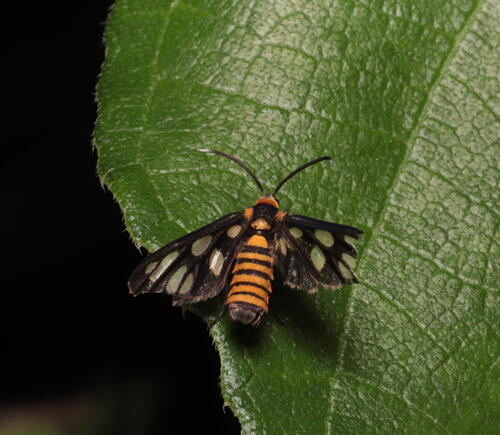
Lesser Banded Hornet
Daily sighting probability ~10% · With luck
at Tasikmalaya

In 3 days ~30% in a week ~60%

6 Verified sightings at Tasikmalaya
11 In all 2 parks From 2019 to 2026
December Best month
☀️ Diurnal When it's spotted

About the Lesser Banded Hornet

Vespa affinis, the lesser banded hornet, is a common hornet in tropical and subtropical Asia. The lesser banded hornet is a small to medium-sized hornet, with queens reaching up to 30 mm, males 26 mm and workers averaging 22 to 25 mm.

The head is brownish red or black, pubescent, with some red markings on frons and vertex, black temple; compound eyes and ocelli black; dark brown antennae and usually pale brown underneath; black clypeus, coarsely punctate, posterior side of clypeus with broadly rounded lobes; mandibles and tooth black. Thorax black with many punctures and some erected hairs, propodeum black. Legs dark brown. Wings dark fuscous brown, tegulae dark brown. Gaster with some fine punctures, dark brown segments except first and second segments yellowish orange. In some specimens, the yellowish orange on the first tergite may be reduced to two transverse spots and a narrow apical band.

There are many color variants across the range of the species, originally considered subspecies but no longer recognized; while there is a history of recognizing subspecies within many of the Vespa hornets, the most recent taxonomic revision of the genus treats all subspecific... Wikipedia →

Global Distribution

Parks Where Found

# Park Country Daily sighting probability
1 Yala National Park 🇱🇰 Sri Lanka
~20%
2 Minneriya National Park 🇱🇰 Sri Lanka
~10%

Cities Where Found

# City Country Daily sighting probability
1 Yogyakarta 🇮🇩 Indonesia
~30%
2 Jamshedpur 🇮🇳 India
~30%
3 Phnom Penh 🇰🇭 Cambodia
~20%
4 Xiuying District 🇨🇳 China
~20%
5 Taichung 🇹🇼 Taiwan
~20%
6 Surakarta 🇮🇩 Indonesia
~20%
7 Ho Chi Minh City 🇻🇳 Vietnam
~20%
8 Jakarta 🇮🇩 Indonesia
~20%
9 Tuen Mun 🇨🇳 China
~10%
10 Dhaka 🇧🇩 Bangladesh
~10%

Before you go

What are the chances of seeing a Lesser Banded Hornet in Tasikmalaya?

With luck

About 10% of wildlife watchers report a Lesser Banded Hornet sighting in Tasikmalaya on a given day, based on 6 verified sightings from GBIF citizen-science data. It is the 65th most-seen of the 76 insects we can rate there. Over three days the chance rises to about 30%, and over a week to about 60%, if each day is a fresh chance.

When is the best time to see a Lesser Banded Hornet in Tasikmalaya?

November and December

In those months about 20% of wildlife watchers report a Lesser Banded Hornet in Tasikmalaya on a given day, against under 5% in January to September, the lowest months. Those are among Tasikmalaya's wettest months, with about 370 mm of rain a month against 50 mm in August.

What time of day is best to see a Lesser Banded Hornet?

Between 6 and 9 am

Across all the parks we cover, that three-hour window holds the most Lesser Banded Hornet sightings with a recorded time, and about 9 in 10 of them come between 6 am and 6 pm: it is a daytime animal.

Is Tasikmalaya the best place to see a Lesser Banded Hornet?

15th of 24

Of the 24 cities where we can rate Lesser Banded Hornet sightings, Tasikmalaya ranks 15th at about 10%. The best odds are in Yogyakarta (Indonesia, about 30%), Jamshedpur (India, about 30%) and Phnom Penh (Cambodia, about 20%).

Which relatives of the Lesser Banded Hornet live in Tasikmalaya?

Same order: Hymenoptera

The closest relatives of the Lesser Banded Hornet that you can see in Tasikmalaya (order Hymenoptera, Ants, Bees, Wasps, and Sawflies) are Asian Weaver Ant (about 40%), Yellow Crazy Ant (about 20%) and Yellow-And-Black Potter Wasp (about 20%), with each one's daily chance of a sighting.

Where does the Lesser Banded Hornet sighting chance come from?

GBIF citizen-science records

It is estimated from how often the Lesser Banded Hornet is recorded against all the insects logged in Tasikmalaya (6 verified sightings), calibrated against known sighting rates. Figures are rounded to the nearest 10% because citizen-science data supports honest approximations, not decimals, and months with records from fewer than five people show "—". How it works.

← Back to Tasikmalaya