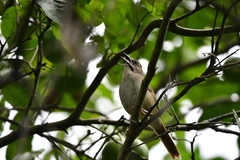
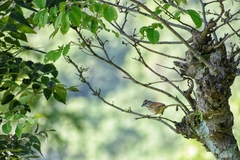

Rusty Sparrow

Rusty Sparrow

Aimophila rufescens

Silhouette: L. Shyamal · PhyloPic

LCLeast ConcernNTVUENCR
Daily sighting probability <5% · Rare
at Tegucigalpa

In 3 days <5% in a week ~10%

21 Verified sightings at Tegucigalpa
401 In all 8 parks From 2019 to 2026
October Best month
☀️ Diurnal When it's spotted

About the Rusty Sparrow

The rusty sparrow (Aimophila rufescens) is a species of bird in the family Passerellidae, the New World sparrows. It is found from Mexico to Costa Rica. The rusty sparrow was formally described by William Swainson in 1827 with the binomial Pipilo rufescens, placing it among the towhees. In 1840 it was reassigned to its present genus Aimophila that Swainson had erected in 1837; the now A. rufescens was designated the genus' type species.

The rusty sparrow has these seven subspecies: The rusty sparrow is 16.5 to 20 cm (6.5 to 7.9 in) long and weighs 34 to 48 g (1.2 to 1.7 oz). The sexes have the same plumage. Adults of the nominate subspecies A. r. rufescens have a chestnut crown with black streaks and a thin olive gray or buffy stripe in its middle. They have dark brown lores, a whitish streak above the lores, a white eye-ring, and a dusky stripe behind the eye on an otherwise olive grayish face. Their back and scapulars are brown with wide black streaks. Their wings are mostly brown with chestnut secondaries and inner greater coverts. Their tail is chestnut brown. Their chin, throat, and belly are grayish buff with a blackish stripe on... Wikipedia →

Sounds

Interaction calls0:44

Mexico · 2026

© Richard E. Webster · XC1183487 · CC BY-NC-SA 4.0

Song1:01

Guatemala · 2023

© Max Noack · XC791719 · CC BY-NC-SA 4.0

Call0:27

Belize · 2016

© Jacob R. Saucier · XC318974 · CC BY-NC-SA 4.0

Global Distribution

Parks Where Found

# Park Country Daily sighting probability
1 Cusuco National Park 🇭🇳 Honduras
~20%
2 Celaque National Park 🇭🇳 Honduras
~20%
3 La Tigra National Park 🇭🇳 Honduras
~10%
4 Cañón del Sumidero National Park 🇲🇽 Mexico
~10%
5 El Triunfo 🇲🇽 Mexico
<5%
6 Cerro Azul Meámbar National Park 🇭🇳 Honduras
<5%
7 Rincón de la Vieja National Park 🇨🇷 Costa Rica
<5%
8 Lago de Yojoa 🇭🇳 Honduras
<5%

Cities Where Found

# City Country Daily sighting probability
1 Guatemala City 🇬🇹 Guatemala
<5%
2 Tegucigalpa 🇭🇳 Honduras
<5%

Before you go

What are the chances of seeing a Rusty Sparrow in Tegucigalpa?

Rare

Under 5% of wildlife watchers report a Rusty Sparrow sighting in Tegucigalpa on a given day, based on 21 verified sightings from GBIF citizen-science data. It is the 93rd most-seen of the 142 birds we can rate there. Over three days the chance rises to under 5%, and over a week to about 10%, if each day is a fresh chance.

When is the best time to see a Rusty Sparrow in Tegucigalpa?

October

In that month about 10% of wildlife watchers report a Rusty Sparrow in Tegucigalpa on a given day, against under 5% in November to September, the lowest months. That is one of Tegucigalpa's wettest months, with about 180 mm of rain against 10 mm in January.

What time of day is best to see a Rusty Sparrow?

Between 7 and 10 am

Across all the parks we cover, that three-hour window holds the most Rusty Sparrow sightings with a recorded time, and about 9 in 10 of them come between 6 am and 6 pm: it is a daytime animal.

Is Tegucigalpa the best place to see a Rusty Sparrow?

Among the best

Of the 2 cities where we can rate Rusty Sparrow sightings, Tegucigalpa ranks 2nd at under 5%, level with the leaders once rounded. The best odds are in Guatemala City (Guatemala, under 5%).

Where does the Rusty Sparrow sighting chance come from?

GBIF citizen-science records

It is estimated from how often the Rusty Sparrow is recorded against all the birds logged in Tegucigalpa (21 verified sightings), calibrated against known sighting rates. Figures are rounded to the nearest 10% because citizen-science data supports honest approximations, not decimals, and months with records from fewer than five people show "—". How it works.

← Back to Tegucigalpa