About the Japanese Beetle
The Japanese beetle (Popillia japonica) is a species of scarab beetle. Due to the presence of natural predators, the Japanese beetle is not considered a pest in its native Japan. In North America and some regions of Europe, it is a noted pest to roughly 300 species of plants. Some of these plants include roses, grapes, hops, canna, crape myrtles, birch trees, linden trees, and others.
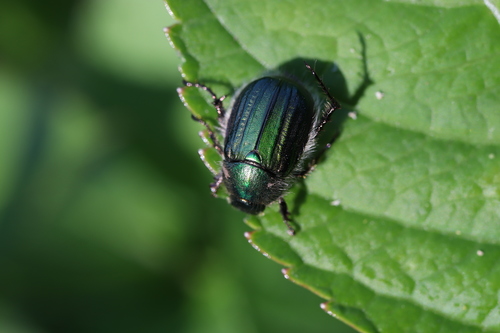
The adult beetles damage plants by skeletonizing the foliage (i.e., consuming only the material between a leaf's veins), as well as, at times, feeding on a plant's fruit. The subterranean larvae feed on the roots of grasses.
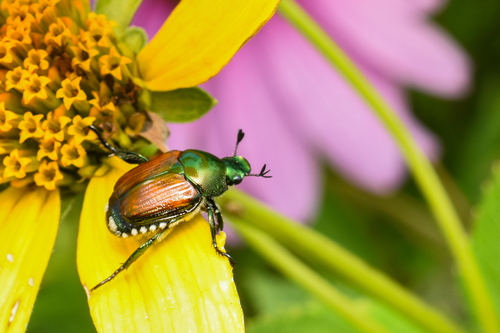
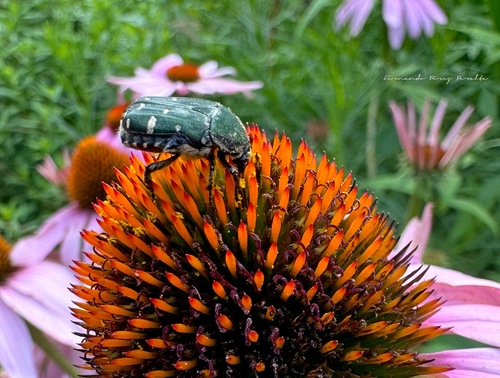
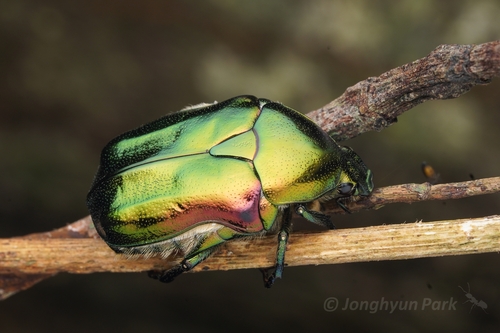
English entomologist Edward Newman described the Japanese beetle in 1841. Adults of P. japonica measure 15 mm (0.6 in) in length and 10 mm (0.4 in) in width, with iridescent, copper-colored elytra and a green thorax and head. A row of white tufts (spots) of hair projects from under the wing covers on each side of the body. Males are slightly smaller than females. Grubs are white and lie in curled positions. A mature grub is roughly 1 in (2.5 cm) long.
Popillia japonica is native to Japan, and is an invasive species in North America... Wikipedia →