Eastern Newt

Eastern Newt

Notophthalmus viridescens

Silhouette: Beth Reinke · PhyloPic

LCLeast ConcernNTVUENCR
Daily sighting probability <5% · Rare
at Toronto

In 3 days ~10% in a week ~20%

14 Verified sightings at Toronto
537 In all 6 parks From 2019 to 2026
April Best month
☀️ Diurnal When it's spotted

About the Eastern Newt

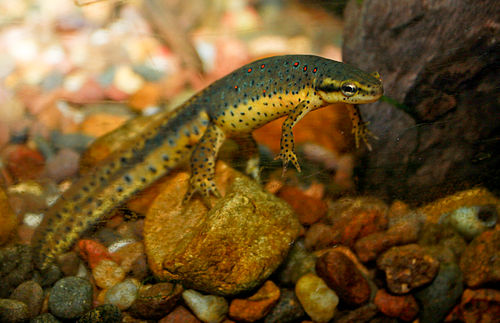
The eastern newt (Notophthalmus viridescens) is a common newt of eastern North America. It frequents small lakes, ponds, vernal ponds and streams or nearby wooded areas. The eastern newt produces tetrodotoxin, which makes the species unpalatable to predatory fish and crayfish. It has a lifespan of 12 to 15 years in the wild, and it may grow to 5 in (13 cm) in length. These animals are common aquarium pets, being either collected from the wild or sold commercially. The striking bright orange juvenile stage, which is land-dwelling, is known as a red eft. Some sources blend the general name of the species and that of the red-spotted newt subspecies into the eastern red-spotted newt (although there is no "western" one).

The eastern newt includes these four subspecies: Red-spotted newt (Notophthalmus viridescens viridescens); Broken-striped newt (Notophthalmus viridescens dorsalis); Central newt (Notophthalmus viridescens louisianensis) - Central newts measure from 2.5 in (6.4 cm) to 4 in (10 cm) in length. They are brown or green, with fine black dots all over the body. There may be a row of red spots on each side of the body. The belly is yellow or orange and is noticeably... Wikipedia →
Sounds

Recording0:21

Canada · 2024

© schw0099 · iNaturalist · CC BY-NC 4.0

Global Distribution

Parks Where Found

# Park Country Daily sighting probability
1 Shenandoah National Park 🇺🇸 United States
~50%
2 Acadia National Park 🇺🇸 United States
~30%
3 Great Smoky Mountains National Park 🇺🇸 United States
~30%
4 Isle Royale National Park 🇺🇸 United States
~20%
5 Cape Breton Highlands National Park 🇨🇦 Canada
~20%
6 Big Cypress National Preserve 🇺🇸 United States
~10%

Cities Where Found

# City Country Daily sighting probability
1 Toronto 🇨🇦 Canada
<5%
2 New York City 🇺🇸 United States
<5%

Zoos & Centres Where Found

# Zoo / Centre Country
1 National Zoological Park 🇺🇸 United States In captivity
2 Cincinnati Zoo and Botanical Garden 🇺🇸 United States In captivity
3 Ostrava Zoo 🇨🇿 Czechia In captivity
4 Ecomuseum Zoo 🇨🇦 Canada In captivity
5 Toronto Zoo 🇨🇦 Canada In captivity
6 The Maryland Zoo 🇺🇸 United States In captivity
7 ZooTampa 🇺🇸 United States In captivity
8 Krakow Zoo 🇵🇱 Poland In captivity
9 Western North Carolina Nature Center 🇺🇸 United States In captivity
10 Aquarium du Québec 🇨🇦 Canada In captivity
11 North Carolina Aquarium at Fort Fisher 🇺🇸 United States In captivity
12 Reptile Gardens 🇺🇸 United States In captivity
13 Oklahoma Aquarium 🇺🇸 United States In captivity
14 North Carolina Aquarium at Pine Knoll Shores 🇺🇸 United States In captivity
15 Huntsman Fundy Discovery Aquarium 🇨🇦 Canada In captivity

Before you go

What are the chances of seeing an Eastern Newt in Toronto?

Rare

Under 5% of wildlife watchers report an Eastern Newt sighting in Toronto on a given day, based on 14 verified sightings from GBIF citizen-science data. It is the 9th most-seen of the 12 amphibians we can rate there. Over three days the chance rises to about 10%, and over a week to about 20%, if each day is a fresh chance.

When is the best time to see an Eastern Newt in Toronto?

Any time of year

In every month with enough records, under 5% of wildlife watchers report an Eastern Newt in Toronto on a given day, so our monthly data shows no clear season.

What time of day is best to see an Eastern Newt?

Between 9 am and noon

Across all the parks we cover, that three-hour window holds the most Eastern Newt sightings with a recorded time, and about 9 in 10 of them come between 6 am and 6 pm: it is a daytime animal.

Is Toronto the best place to see an Eastern Newt?

Yes

Of the 2 cities where we can rate Eastern Newt sightings, Toronto has the highest daily chance: under 5%. Next come New York City (United States, under 5%).

Where does the Eastern Newt sighting chance come from?

GBIF citizen-science records

It is estimated from how often the Eastern Newt is recorded against all the amphibians logged in Toronto (14 verified sightings), calibrated against known sighting rates. Figures are rounded to the nearest 10% because citizen-science data supports honest approximations, not decimals, and months with records from fewer than five people show "—". How it works.

← Back to Toronto