Peacock Pansy
Daily sighting probability ~20% · Possible
at Vasai-Virar

In 3 days ~60% in a week ~80%

5 Verified sightings at Vasai-Virar
125 In all 10 parks From 2019 to 2026
July Best month
☀️ Diurnal When it's spotted

About the Peacock Pansy

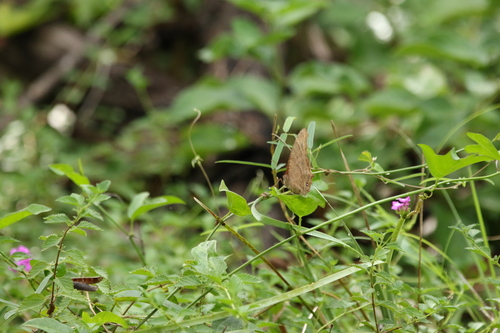
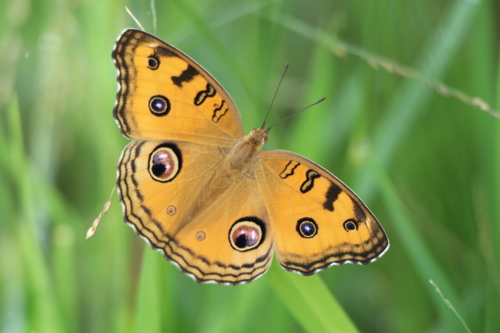
Junonia almana, the peacock pansy, is a species of nymphalid butterfly found in Cambodia and South Asia. It exists in two distinct adult forms, which differ chiefly in the patterns on the underside of the wings; the dry-season form has few markings, while the wet-season form has additional eyespots and lines. It is listed as Least Concern in the IUCN Red List.

The adult butterfly has a wingspan of 54–62 mm (2.1–2.4 in), and exhibits seasonal polyphenism. "Upperside rich orange-yellow. Fore wing with a pale dusky and a much darker short transverse bar with lateral jet-black marginal lines across cell, another somewhat similar bar defining the discocellulars; costal margin, an inner and an outer subterminal line, and a terminal line dusky black; a large minutely white-centred ocellus with an inner slender and outer black ring on disc in interspace 2; two similar but smaller geminate subapical ocelli with an obscure pale spot above them and a short oblique bar connecting them to the black on the costa. Hind wing: a small minutely white-centred and very slenderly black-ringed discal ocellus in interspace 2, with a very much larger pale yellow and... Wikipedia →

Global Distribution

Parks Where Found

# Park Country Daily sighting probability
1 Keoladeo National Park 🇮🇳 India
~30%
2 Royal Bardia National Park 🇳🇵 Nepal
~30%
3 Chitwan National Park 🇳🇵 Nepal
~30%
4 Cuc Phuong National Park 🇻🇳 Vietnam
~30%
5 Gunung Leuser National Park 🇮🇩 Indonesia
~30%
6 Kanha National Park 🇮🇳 India
~10%
7 Minneriya National Park 🇱🇰 Sri Lanka
~10%
8 Khao Sok National Park 🇹🇭 Thailand
~10%
9 Khao Yai National Park 🇹🇭 Thailand
~10%
10 Kaeng Krachan National Park 🇹🇭 Thailand
~10%

Cities Where Found

# City Country Daily sighting probability
1 Prayagraj 🇮🇳 India
~50%
2 Raipur 🇮🇳 India
~40%
3 Yogyakarta 🇮🇩 Indonesia
~40%
4 Dhaka 🇧🇩 Bangladesh
~40%
5 Jamshedpur 🇮🇳 India
~40%
6 Phnom Penh 🇰🇭 Cambodia
~30%
7 Guwahati 🇮🇳 India
~30%
8 Salem 🇮🇳 India
~30%
9 Kuala Lumpur 🇲🇾 Malaysia
~30%
10 Yangon 🇲🇲 Myanmar
~30%

Before you go

What are the chances of seeing a Peacock Pansy in Vasai-Virar?

Possible

About 20% of wildlife watchers report a Peacock Pansy sighting in Vasai-Virar on a given day, based on 5 verified sightings from GBIF citizen-science data. It is the 17th most-seen of the 20 insects we can rate there. Over three days the chance rises to about 60%, and over a week to about 80%, if each day is a fresh chance.

When is the best time to see a Peacock Pansy in Vasai-Virar?

February and July

In those months about 40% of wildlife watchers report a Peacock Pansy in Vasai-Virar on a given day, against under 5% in March–April, June and October–December, the lowest months. Those are among Vasai-Virar's wettest months, with about 420 mm of rain a month against almost none in January.

What time of day is best to see a Peacock Pansy?

Between 11 am and 2 pm

Across all the parks we cover, that three-hour window holds the most Peacock Pansy sightings with a recorded time, and about 8 in 10 of them come between 6 am and 6 pm: it is a daytime animal.

Is Vasai-Virar the best place to see a Peacock Pansy?

19th of 55

Of the 55 cities where we can rate Peacock Pansy sightings, Vasai-Virar ranks 19th at about 20%. The best odds are in Prayagraj (India, about 50%), Raipur (India, about 40%) and Yogyakarta (Indonesia, about 40%).

Which relatives of the Peacock Pansy live in Vasai-Virar?

Same family: Nymphalidae

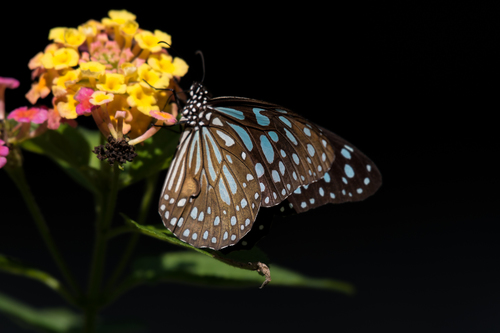
The closest relatives of the Peacock Pansy that you can see in Vasai-Virar (family Nymphalidae, Brush-footed Butterflies) are Plain Tiger Butterfly (about 30%), Common Evening Brown (about 30%) and Blue Tiger (about 30%), with each one's daily chance of a sighting.

Where does the Peacock Pansy sighting chance come from?

GBIF citizen-science records

It is estimated from how often the Peacock Pansy is recorded against all the insects logged in Vasai-Virar (5 verified sightings), calibrated against known sighting rates. Figures are rounded to the nearest 10% because citizen-science data supports honest approximations, not decimals, and months with records from fewer than five people show "—". How it works.
← Back to Vasai-Virar