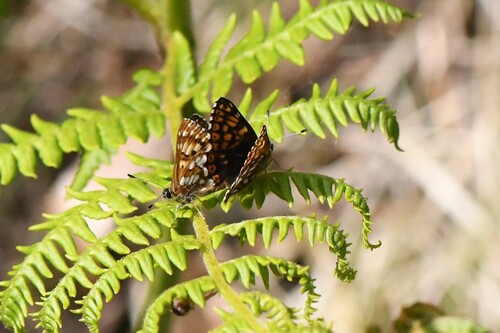
Duke Of Burgundy

Duke Of Burgundy

Hamearis lucina

Daily sighting probability <5% · Rare
at Vienna

In 3 days ~10% in a week ~20%

6 Verified sightings at Vienna
159 In all 6 parks From 2019 to 2026
May Best month
☀️ Diurnal When it's spotted

About the Duke Of Burgundy

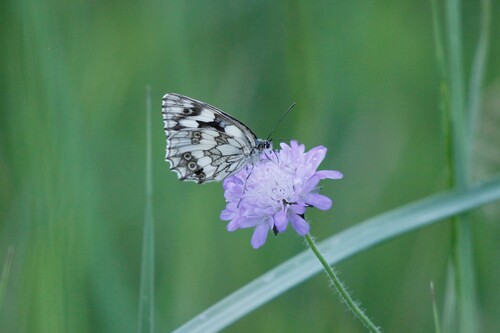
Hamearis lucina, the Duke of Burgundy, the only member of the genus Hamearis, is a European butterfly in the family Riodinidae. For many years, it was known as the "Duke of Burgundy fritillary", because the adult's chequered pattern is strongly reminiscent of "true" fritillaries of the family Nymphalidae.

Riodinidae is currently treated as a distinct family within the superfamily Papilionoidea, but in the past they were held to be the subfamily Riodininae of the Lycaenidae. Earlier, they were considered to be part of the now defunct family "Erycinidae", whose species are divided between this family and the subfamily Libytheinae.

The genus Hamearis, described by Jacob Hübner in 1819 is a monotypic genus of uncertain position (incertae sedis). Here it is considered part of subfamily Nemeobiinae, tribe Zemerini, within the metalmark butterfly family (Riodinidae).

The origin of the common name is not known and the species was once called Mr Vernon's small fritillary. The male has a wingspan of 29–31 millimetres (1.1–1.2 in), and the female 31–34 mm (1.2–1.3 in). The upperside of the wings are marked in a checquered pattern strongly reminiscent... Wikipedia →

Global Distribution

Parks Where Found

# Park Country Daily sighting probability
1 Triglav National Park 🇸🇮 Slovenia
~30%
2 Mercantour National Park 🇫🇷 France
~20%
3 Ordesa y Monte Perdido National Park 🇪🇸 Spain
~10%
4 Ecrins National Park 🇫🇷 France
~10%
5 Pyrénées National Park 🇫🇷 France
~10%
6 Cévennes National Park 🇫🇷 France
~10%

Cities Where Found

# City Country Daily sighting probability
1 Kharkiv 🇺🇦 Ukraine
~10%
2 Budapest 🇭🇺 Hungary
~10%
3 Kyiv 🇺🇦 Ukraine
<5%
4 Vienna 🇦🇹 Austria
<5%

Before you go

What are the chances of seeing a Duke Of Burgundy in Vienna?

Rare

Under 5% of wildlife watchers report a Duke Of Burgundy sighting in Vienna on a given day, based on 6 verified sightings from GBIF citizen-science data. It is the 1178th most-seen of the 1406 insects we can rate there. Over three days the chance rises to about 10%, and over a week to about 20%, if each day is a fresh chance.

When is the best time to see a Duke Of Burgundy in Vienna?

Any time of year

In every month with enough records, under 5% of wildlife watchers report a Duke Of Burgundy in Vienna on a given day, so our monthly data shows no clear season.

What time of day is best to see a Duke Of Burgundy?

Between 11 am and 2 pm

Across all the parks we cover, that three-hour window holds the most Duke Of Burgundy sightings with a recorded time, and about 9 in 10 of them come between 6 am and 6 pm: it is a daytime animal.

Is Vienna the best place to see a Duke Of Burgundy?

4th of 4

Of the 4 cities where we can rate Duke Of Burgundy sightings, Vienna ranks 4th at under 5%. The best odds are in Kharkiv (Ukraine, about 10%), Budapest (Hungary, about 10%) and Kyiv (Ukraine, under 5%).

Which relatives of the Duke Of Burgundy live in Vienna?

Same order: Lepidoptera

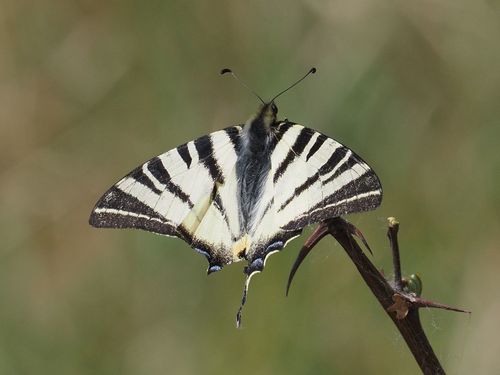
The closest relatives of the Duke Of Burgundy that you can see in Vienna (order Lepidoptera, Butterflies and Moths) are Common Blue (about 20%), Scarce Swallowtail (about 20%) and Meadow Brown (about 20%), with each one's daily chance of a sighting.

Where does the Duke Of Burgundy sighting chance come from?

GBIF citizen-science records

It is estimated from how often the Duke Of Burgundy is recorded against all the insects logged in Vienna (6 verified sightings), calibrated against known sighting rates. Figures are rounded to the nearest 10% because citizen-science data supports honest approximations, not decimals, and months with records from fewer than five people show "—". How it works.

← Back to Vienna