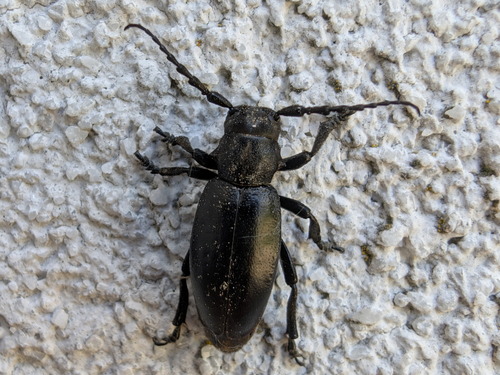
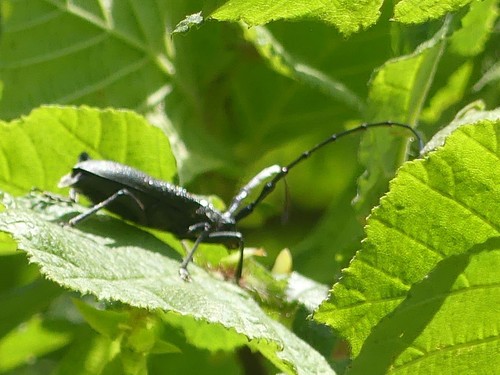
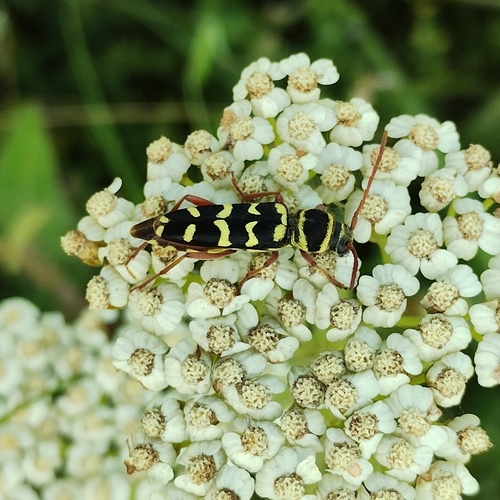
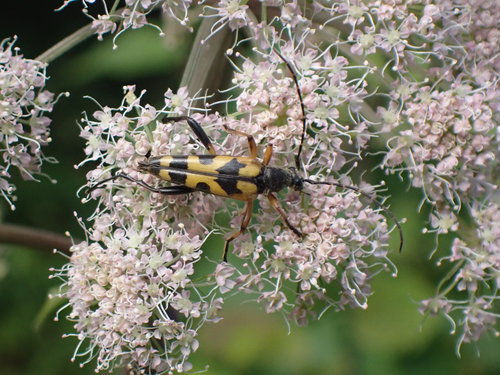
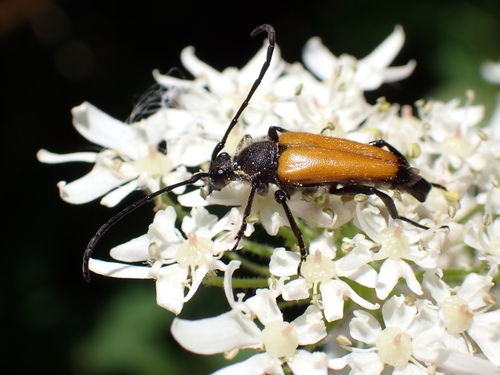
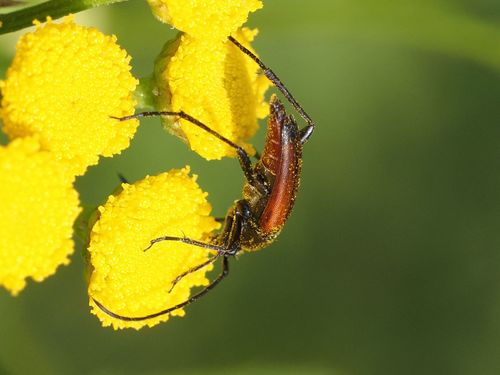
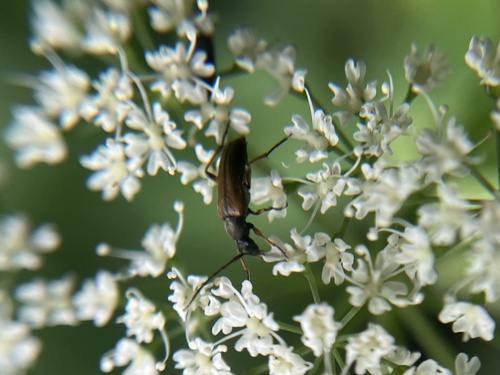
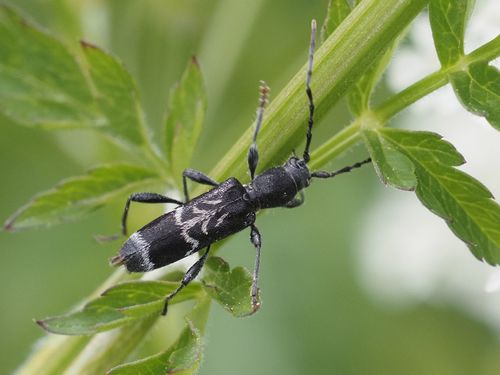
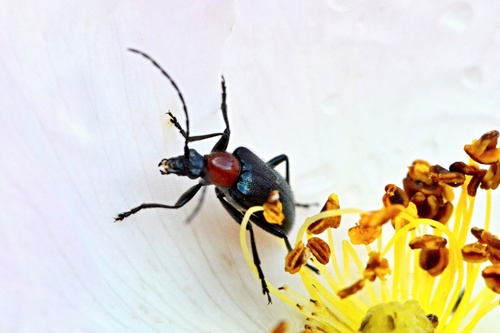
Speckled Longhorn Beetle

Speckled Longhorn Beetle

Pachytodes cerambyciformis

Daily sighting probability <5% · Rare
at Vienna

In 3 days ~10% in a week ~20%

20 Verified sightings at Vienna
224 In all 12 parks From 2019 to 2026
June Best month
☀️ Diurnal When it's spotted

About the Speckled Longhorn Beetle

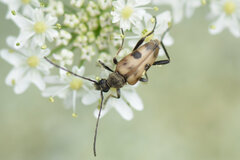
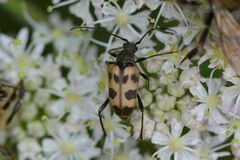
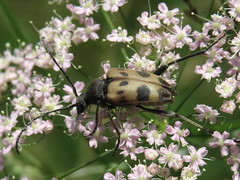
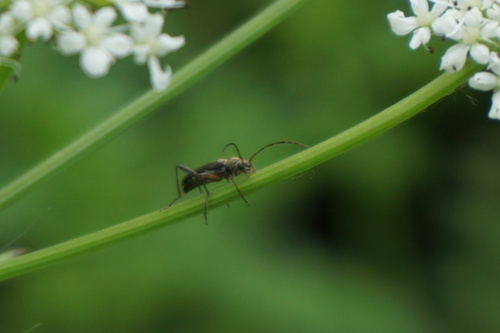
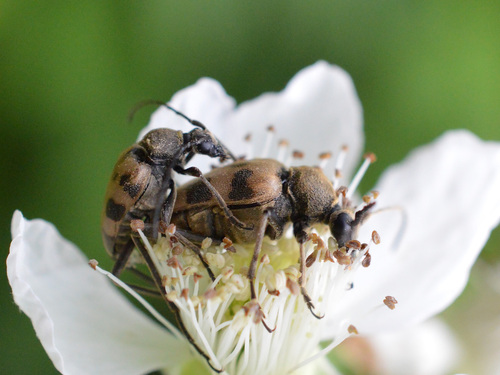
Pachytodes cerambyciformis is a species of beetle belonging to the family Cerambycidae, subfamily Lepturinae (flower longhorns). Pachytodes cerambyciformis can reach a length of 7–12 mm. These beetles have a quite compact body. Elytra are only about twice as long as broad, and clearly narrower towards the end. Head, pronotum and legs are black. Elitra are matt, light brownish-yellow, with black markings, which are very variable and sometimes absent. Usually they show two transversal black bands and a black apex. The first band usually is not continuous, while the second black band is narrower in the center. The suture is normally light brownish-yellow.

This species is very similar to Pachytodes erraticus. The differences are listed in the below table. This beetle can be found in most of Europe and in western Asia. It is missing in the North Europe, while in Central Europe it is one of the most common species. In particular it is present in Albania, Austria, Belarus, Belgium, Bosnia and Herzegovina, Bulgaria, Croatia, Czech Republic, Denmark, France, Germany, Hungary, Italy, Latvia, Lithuania, Luxembourg, Moldova, Netherlands, North... Wikipedia →
Global Distribution

Parks Where Found

# Park Country Daily sighting probability
1 Tatra National Park 🇸🇰 Slovakia
~20%
2 Aigüestortes National Park 🇪🇸 Spain
~20%
3 Ecrins National Park 🇫🇷 France
~20%
4 Vanoise National Park 🇫🇷 France
~20%
5 Bavarian Forest National Park 🇩🇪 Germany
~10%
6 Hohe Tauern National Park 🇦🇹 Austria
~10%
7 Ordesa y Monte Perdido National Park 🇪🇸 Spain
~10%
8 Triglav National Park 🇸🇮 Slovenia
~10%
9 Pyrénées National Park 🇫🇷 France
~10%
10 Mercantour National Park 🇫🇷 France
~10%
11 Snowdonia National Park 🇬🇧 United Kingdom
~10%
12 Cévennes National Park 🇫🇷 France
<5%

Cities Where Found

# City Country Daily sighting probability
1 Essen 🇩🇪 Germany
<5%
2 Vienna 🇦🇹 Austria
<5%

Before you go

What are the chances of seeing a Speckled Longhorn Beetle in Vienna?

Rare

Under 5% of wildlife watchers report a Speckled Longhorn Beetle sighting in Vienna on a given day, based on 20 verified sightings from GBIF citizen-science data. It is the 643rd most-seen of the 1406 insects we can rate there. Over three days the chance rises to about 10%, and over a week to about 20%, if each day is a fresh chance.

When is the best time to see a Speckled Longhorn Beetle in Vienna?

June

In that month about 10% of wildlife watchers report a Speckled Longhorn Beetle in Vienna on a given day, against under 5% in July to May, the lowest months. That is one of Vienna's wettest months, with about 90 mm of rain against 40 mm in February.

What time of day is best to see a Speckled Longhorn Beetle?

Between 10 am and 1 pm

Across all the parks we cover, that three-hour window holds the most Speckled Longhorn Beetle sightings with a recorded time, and about 9 in 10 of them come between 6 am and 6 pm: it is a daytime animal.

Is Vienna the best place to see a Speckled Longhorn Beetle?

Among the best

Of the 2 cities where we can rate Speckled Longhorn Beetle sightings, Vienna ranks 2nd at under 5%, level with the leaders once rounded. The best odds are in Essen (Germany, under 5%).

Which relatives of the Speckled Longhorn Beetle live in Vienna?

Same family: Cerambycidae

The closest relatives of the Speckled Longhorn Beetle that you can see in Vienna (family Cerambycidae, Longhorn Beetles) are Alpine Longhorn Rosalia (about 10%), Common Grammoptera (about 10%) and Dorcadion aethiops (about 10%), with each one's daily chance of a sighting.

Where does the Speckled Longhorn Beetle sighting chance come from?

GBIF citizen-science records

It is estimated from how often the Speckled Longhorn Beetle is recorded against all the insects logged in Vienna (20 verified sightings), calibrated against known sighting rates. Figures are rounded to the nearest 10% because citizen-science data supports honest approximations, not decimals, and months with records from fewer than five people show "—". How it works.

← Back to Vienna