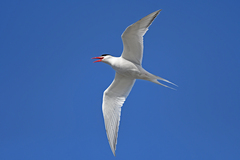


South American Tern

South American Tern

Sterna hirundinacea

Silhouette: Sharon Wegner-Larsen · PhyloPic

LCLeast ConcernNTVUENCR
Daily sighting probability <5% · Rare
at Vitória

In 3 days ~10% in a week ~30%

28 Verified sightings at Vitória
608 In all 4 parks From 2019 to 2026
June Best month
☀️ Diurnal When it's spotted

About the South American Tern

The South American tern (Sterna hirundinacea) is a species of tern found in coastal regions of southern South America, including the Falkland Islands, ranging north to Peru (Pacific coast) and Brazil (Atlantic coast). It is generally the most common tern in its range. The smaller, highly migratory common tern closely resembles it. The specific epithet refers to the "swallow-like" forked tail feathering.

With adult South American terns reaching a length of 40 to 44 centimetres (16 to 17 in), they are larger than either common terns (Sterna hirundo) or Arctic terns (Sterna paradisaea). Otherwise they closely resemble these species in plumage at all times of year. The beak is larger and is red in adults, and they do not have a dark-coloured bar on the carpus of the wing. The black cap extends below the eye, usually separated from it by a white crescent, and the rear edge of the cap is neatly defined. Juveniles have boldly-barred, dusky, upper parts, and retain their barred tertials into their immature plumage, which differentiates them from common and Arctic tern immatures.

This tern is found around the coasts of the southern half of South America... Wikipedia →

Sounds

Call0:20

Brazil · 2024

© JAYRSON ARAUJO DE OLIVEIRA · XC927125 · CC BY-NC-SA 4.0

Song0:10

Uruguay · 2013

© Pedro Rinaldi · XC818917 · CC BY-NC-SA 4.0

Alarm call0:18

Brazil · 2015

© Alexandre Bianco · XC247560 · CC BY-NC-SA 4.0

Global Distribution

Parks Where Found

# Park Country Daily sighting probability
1 Península Valdés 🇦🇷 Argentina
~40%
2 Tierra del Fuego National Park 🇦🇷 Argentina
~30%
3 Torres del Paine National Park 🇨🇱 Chile
~10%
4 Tijuca National Park 🇧🇷 Brazil
<5%

Cities Where Found

# City Country Daily sighting probability
1 Vitória 🇧🇷 Brazil
<5%
2 Montevideo 🇺🇾 Uruguay
<5%
3 Rio de Janeiro 🇧🇷 Brazil
<5%
4 Lima 🇵🇪 Peru
<5%

Before you go

What are the chances of seeing a South American Tern in Vitória?

Rare

Under 5% of wildlife watchers report a South American Tern sighting in Vitória on a given day, based on 28 verified sightings from GBIF citizen-science data. It is the 89th most-seen of the 126 birds we can rate there. Over three days the chance rises to about 10%, and over a week to about 30%, if each day is a fresh chance.

When is the best time to see a South American Tern in Vitória?

June to October

In those months about 10% of wildlife watchers report a South American Tern in Vitória on a given day, against under 5% in November to May, the lowest months. Those are among Vitória's driest months, with about 60 mm of rain a month against 200 mm in November.

What time of day is best to see a South American Tern?

Between 10 am and 1 pm

Across all the parks we cover, that three-hour window holds the most South American Tern sightings with a recorded time, and about 9 in 10 of them come between 6 am and 6 pm: it is a daytime animal.

Is Vitória the best place to see a South American Tern?

Yes

Of the 4 cities where we can rate South American Tern sightings, Vitória has the highest daily chance: under 5%. Next come Montevideo (Uruguay, under 5%) and Rio de Janeiro (Brazil, under 5%).

Which relatives of the South American Tern live in Vitória?

Same family: Laridae

The closest relatives of the South American Tern that you can see in Vitória (family Laridae, Gulls, Terns, and Skimmers) are Sandwich Tern (about 10%), Grey-hooded Gull (about 10%) and Dominican Gull (about 10%), with each one's daily chance of a sighting.

Where does the South American Tern sighting chance come from?

GBIF citizen-science records

It is estimated from how often the South American Tern is recorded against all the birds logged in Vitória (28 verified sightings), calibrated against known sighting rates. Figures are rounded to the nearest 10% because citizen-science data supports honest approximations, not decimals, and months with records from fewer than five people show "—". How it works.

← Back to Vitória