

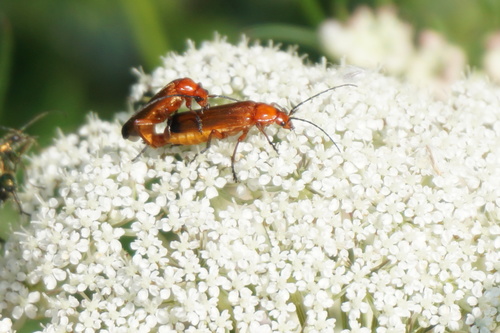
European Red-Bellied Clerid

European Red-Bellied Clerid

Thanasimus formicarius

Daily sighting probability <5% · Rare
at Warsaw

In 3 days ~10% in a week ~20%

5 Verified sightings at Warsaw
38 In all 5 parks From 2019 to 2026
March Best month
☀️ Diurnal When it's spotted

About the European Red-Bellied Clerid

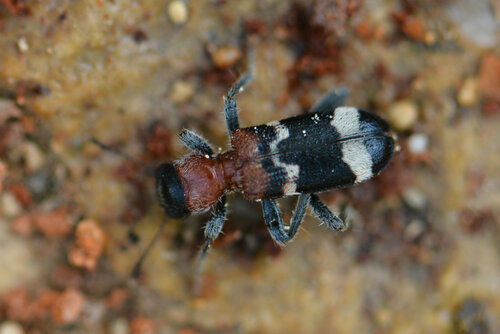
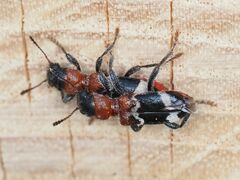
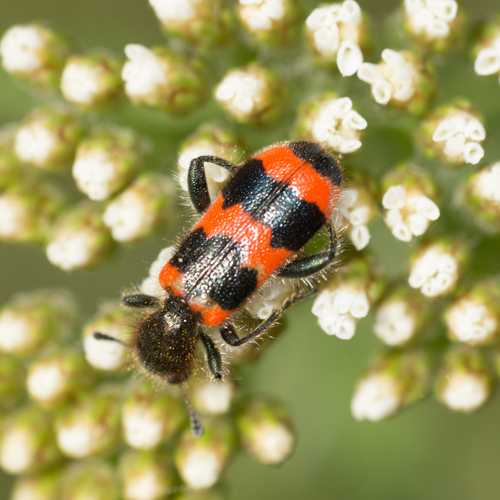
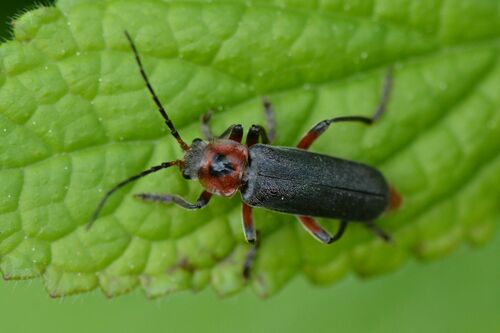
Thanasimus formicarius, the ant beetle or European red-bellied clerid, is a medium size insect, rather soft-bodied, with strong mandibles that can tear between the hard sclerotized integument of bark beetles. Larvae and adults are common predators of bark beetles in Europe.

The adults overwinter at the base of conifers, rarely of deciduous trees. They emerge in the spring and fly to lower parts of trees to hunt bark beetles. Their common prey are pine bark beetles Tomicus piniperda and T. minor, and the European spruce bark beetle, Ips typographus. Often they are seen waiting for their prey on the bark of fallen pine or spruce trees. Both ant beetles and bark beetles are attracted to monoterpenes from the damaged areas of the fallen trees. Stacked wood is especially attractive due to the monoterpene volatiles. The ant beetles are also attracted to specific pheromone components of bark beetles therefore they often fall into bark beetle pheromone traps. The larvae enter the scolytid galleries and feed on the immature stages of the bark beetles. The larvae grow very slowly, spending two years in the larval stage, and pupate in the fall in niches in the outer bark. Adults... Wikipedia →

Global Distribution

Parks Where Found

# Park Country Daily sighting probability
1 Białowieża National Park 🇵🇱 Poland
~10%
2 Bavarian Forest National Park 🇩🇪 Germany
~10%
3 Cairngorms National Park 🇬🇧 United Kingdom
~10%
4 Sierra de Guadarrama National Park 🇪🇸 Spain
<5%
5 Pyrénées National Park 🇫🇷 France
<5%

Cities Where Found

# City Country Daily sighting probability
1 Vienna 🇦🇹 Austria
<5%
2 Warsaw 🇵🇱 Poland
<5%
3 Hamburg 🇩🇪 Germany
<5%
4 Prague 🇨🇿 Czechia
<5%

Before you go

What are the chances of seeing a European Red-Bellied Clerid in Warsaw?

Rare

Under 5% of wildlife watchers report a European Red-Bellied Clerid sighting in Warsaw on a given day, based on 5 verified sightings from GBIF citizen-science data. It is the 501st most-seen of the 580 insects we can rate there. Over three days the chance rises to about 10%, and over a week to about 20%, if each day is a fresh chance.

When is the best time to see a European Red-Bellied Clerid in Warsaw?

March

In that month about 10% of wildlife watchers report a European Red-Bellied Clerid in Warsaw on a given day, against under 5% in April to February, the lowest months.

What time of day is best to see a European Red-Bellied Clerid?

Between noon and 3 pm

Across all the parks we cover, that three-hour window holds the most European Red-Bellied Clerid sightings with a recorded time, and about 9 in 10 of them come between 6 am and 6 pm: it is a daytime animal.

Is Warsaw the best place to see a European Red-Bellied Clerid?

Among the best

Of the 4 cities where we can rate European Red-Bellied Clerid sightings, Warsaw ranks 2nd at under 5%, level with the leaders once rounded. The best odds are in Vienna (Austria, under 5%).

Where does the European Red-Bellied Clerid sighting chance come from?

GBIF citizen-science records

It is estimated from how often the European Red-Bellied Clerid is recorded against all the insects logged in Warsaw (5 verified sightings), calibrated against known sighting rates. Figures are rounded to the nearest 10% because citizen-science data supports honest approximations, not decimals, and months with records from fewer than five people show "—". How it works.

← Back to Warsaw