Broad-Handed Carpenter Bee

Broad-Handed Carpenter Bee

Xylocopa latipes

Daily sighting probability ~20% · Possible
at Yogyakarta

In 3 days ~40% in a week ~70%

11 Verified sightings at Yogyakarta
153 In all 10 parks From 2019 to 2026
July Best month
☀️ Diurnal When it's spotted

About the Broad-Handed Carpenter Bee

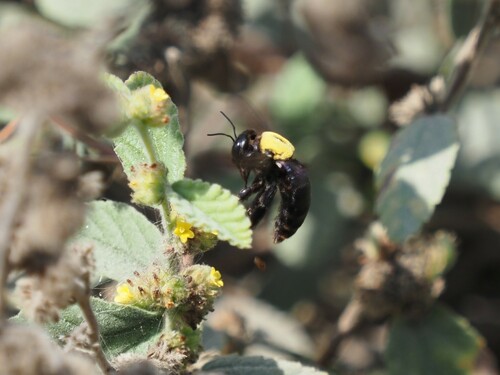
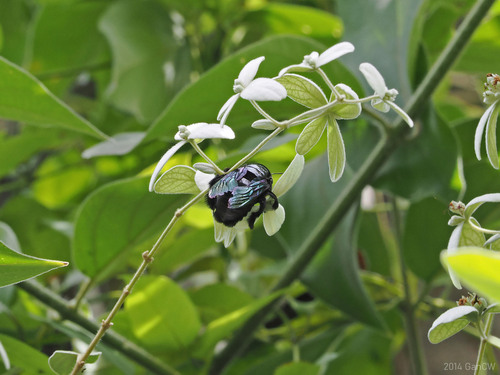
Xylocopa latipes, the broad-handed carpenter bee, is a species of carpenter bee widely dispersed throughout Southeast Asia. This bee inhabits forests and constructs nests by burrowing into wood. It often makes long deep tunnels in wooden rafters, fallen trees, telephone poles, etc., but is not found in living trees.

It was first described by the English entomologist, Dru Drury in 1773, and is a member of the group of carpenter bees (Family Apidae). The broad-handed carpenter bee is a very large, robust, solitary bee. It is shiny, fully black in colour with fuscous metallic blue-green or purple wings in sunlight. The broad-handed carpenter bee is among the largest Xylocopa known and among the largest bees of the world (though it is not the world's largest, that title belongs to another Southeast Asian bee, the Indonesian Megachile pluto). It has a loud and distinctive, low-pitched buzzing that can be heard as it flies between flowers or perches. In urban areas, these bees can become attached to certain perches, returning to them day after day, even after several generations.

Carpenter bees mate on-the-wing. Males grasp the females in flight and place their front or middle... Wikipedia →
Global Distribution

Parks Where Found

# Park Country Daily sighting probability
1 Bako National Park 🇲🇾 Malaysia
~30%
2 Danum Valley Conservation Area 🇲🇾 Malaysia
~30%
3 Gunung Leuser National Park 🇮🇩 Indonesia
~30%
4 Kinabalu Park 🇲🇾 Malaysia
~20%
5 Kinabatangan Wildlife Sanctuary 🇲🇾 Malaysia
~20%
6 Taman Negara National Park 🇲🇾 Malaysia
~20%
7 Khao Sok National Park 🇹🇭 Thailand
~20%
8 Sepilok 🇲🇾 Malaysia
~10%
9 Kaeng Krachan National Park 🇹🇭 Thailand
~10%
10 Khao Yai National Park 🇹🇭 Thailand
~10%

Cities Where Found

# City Country Daily sighting probability
1 Kuching 🇲🇾 Malaysia
~30%
2 Kuala Lumpur 🇲🇾 Malaysia
~20%
3 Surakarta 🇮🇩 Indonesia
~20%
4 Singapore 🇸🇬 Singapore
~20%
5 Denpasar 🇮🇩 Indonesia
~20%
6 Yogyakarta 🇮🇩 Indonesia
~20%
7 Johor Bahru 🇲🇾 Malaysia
~20%
8 Jakarta 🇮🇩 Indonesia
~10%
9 Bandung 🇮🇩 Indonesia
~10%

Before you go

What are the chances of seeing a Broad-Handed Carpenter Bee in Yogyakarta?

Possible

About 20% of wildlife watchers report a Broad-Handed Carpenter Bee sighting in Yogyakarta on a given day, based on 11 verified sightings from GBIF citizen-science data. It is the 74th most-seen of the 141 insects we can rate there. Over three days the chance rises to about 40%, and over a week to about 70%, if each day is a fresh chance.

When is the best time to see a Broad-Handed Carpenter Bee in Yogyakarta?

March and June–July

In those months about 30% of wildlife watchers report a Broad-Handed Carpenter Bee in Yogyakarta on a given day, against under 5% in January–February, April–May and October, the lowest months.

What time of day is best to see a Broad-Handed Carpenter Bee?

Between 8 and 11 am

Across all the parks we cover, that three-hour window holds the most Broad-Handed Carpenter Bee sightings with a recorded time, and about 8 in 10 of them come between 6 am and 6 pm: it is a daytime animal.

Is Yogyakarta the best place to see a Broad-Handed Carpenter Bee?

6th of 9

Of the 9 cities where we can rate Broad-Handed Carpenter Bee sightings, Yogyakarta ranks 6th at about 20%. The best odds are in Kuching (Malaysia, about 30%), Kuala Lumpur (Malaysia, about 20%) and Surakarta (Indonesia, about 20%).

Where does the Broad-Handed Carpenter Bee sighting chance come from?

GBIF citizen-science records

It is estimated from how often the Broad-Handed Carpenter Bee is recorded against all the insects logged in Yogyakarta (11 verified sightings), calibrated against known sighting rates. Figures are rounded to the nearest 10% because citizen-science data supports honest approximations, not decimals, and months with records from fewer than five people show "—". How it works.

← Back to Yogyakarta