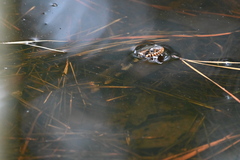
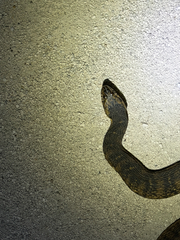
Banded Water Snake

Banded Water Snake

Nerodia fasciata

Silhouette: Beth Reinke · PhyloPic

LCLeast ConcernNTVUENCR Endemic
Daily sighting probability ~50% · Likely
at Congaree National Park

In 3 days ~90% in a week >90%

120 Verified sightings at Congaree National Park From 2019 to 2026
1,017 In all 4 parks
June Best month
☀️🌙 Day & Night When it's spotted

About the Banded Water Snake

The banded water snake or southern water snake (Nerodia fasciata) is a species of mostly aquatic, nonvenomous, colubrid snakes most commonly found in the Midwest, Southeastern United States. Nerodia fasciata is natively found from southern Illinois, south to Louisiana, and east to North Carolina and Florida. Introduced populations exist in Texas and California; other sources include eastern Texas in its natural range. In 1992, its congener Nerodia sipedon (northern or common water snake) and it were found in three sites in California by the US Fish and Wildlife Service (USFWS). Further trapping did indeed catch large numbers of them, indicating that a thriving invasive population exists in that area.

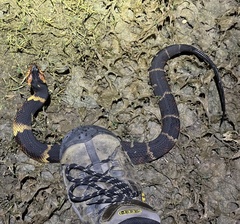
Adults of the banded water snake typically range from 56 to 107 cm (22 to 42 in) in total length, with a record size (in the Florida subspecies) of 159 cm (62.5 in) in total length. It is typically gray, greenish-gray, or brown in color, with... Wikipedia →

Global Distribution

Parks Where Found

# Park Country Daily sighting probability
1 Big Cypress National Preserve 🇺🇸 United States
~60%
2 Congaree National Park 🇺🇸 United States
~50%
3 Everglades National Park 🇺🇸 United States
~30%
4 Merritt Island National Wildlife Refuge 🇺🇸 United States
~20%

Cities Where Found

# City Country Daily sighting probability
1 Houston 🇺🇸 United States
~20%
2 Orlando 🇺🇸 United States
~20%
3 Miami 🇺🇸 United States
~10%

Zoos & Centres Where Found

# Zoo / Centre Country
1 Ecomuseum Zoo 🇨🇦 Canada In captivity
2 Cameron Park Zoo 🇺🇸 United States In captivity
3 Philadelphia Zoo 🇺🇸 United States In captivity
4 Oklahoma Aquarium 🇺🇸 United States In captivity

Before you go

What are the chances of seeing a Banded Water Snake in Congaree National Park?

Likely

About 50% of wildlife watchers report a Banded Water Snake sighting in Congaree National Park on a given day, based on 120 verified sightings from GBIF citizen-science data from 2019 to 2026. It is the 6th most-seen of the 22 reptiles we can rate there. Over three days the chance rises to about 90%, and over a week to over 90%, if each day is a fresh chance.

When is the best time to see a Banded Water Snake in Congaree National Park?

May and June

In those months about 70% of wildlife watchers report a Banded Water Snake in Congaree National Park on a given day, against under 5% in January, the lowest month.

What time of day is best to see a Banded Water Snake?

Between 8 and 11 pm

Across all the parks we cover, that three-hour window holds the most Banded Water Snake sightings with a recorded time, and about 6 in 10 of them come between 6 pm and 6 am: it is seen both by day and at night.

Is Congaree National Park the best place to see a Banded Water Snake?

2nd of 4

Of the 4 parks where we can rate Banded Water Snake sightings, Congaree National Park ranks 2nd at about 50%. The best odds are in Big Cypress National Preserve (United States, about 60%). All parks ranked.

Which relatives of the Banded Water Snake live in Congaree National Park?

Same genus: Nerodia

The closest relatives of the Banded Water Snake that you can see in Congaree National Park (genus Nerodia, Watersnakes) are Plain-bellied Water Snake (about 60%) and Brown Watersnake (about 60%), with each one's daily chance of a sighting.

Where does the Banded Water Snake sighting chance come from?

GBIF citizen-science records

It is estimated from how often the Banded Water Snake is recorded against all the reptiles logged in Congaree National Park (120 verified sightings from 2019 to 2026), calibrated against known sighting rates. Figures are rounded to the nearest 10% because citizen-science data supports honest approximations, not decimals, and months with records from fewer than five people show "—". How it works.

← Back to Congaree National Park