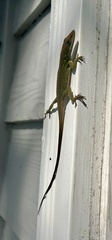
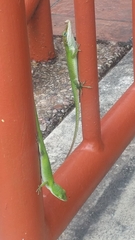
Green Anole

Green Anole

Anolis carolinensis

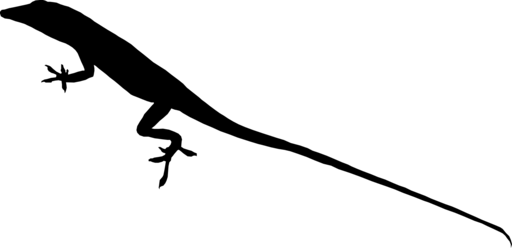
Silhouette: Sarah Werning · PhyloPic

LCLeast ConcernNTVUENCR
Daily sighting probability ~60% · Likely
at Congaree National Park

In 3 days >90%

186 Verified sightings at Congaree National Park From 2019 to 2026
927 In all 6 parks
November Best month
☀️ Diurnal When it's spotted

About the Green Anole

Anolis carolinensis or green anole (US: ) (among other names below) is a tree-dwelling species of anole lizard native to the southeastern United States and introduced to islands in the Pacific and Caribbean. A small to medium-sized lizard, the green anole is a trunk-crown ecomorph and can change its color to several shades from brown to green.

Other names include the Carolina anole, Carolina green anole, American anole, American green anole, North American green anole and red-throated anole. It is commonly called chameleon in the southeastern United States and sometimes referred to as the American chameleon (typically in the pet trade) due to its color-changing ability; however, it is not a true chameleon.

Anolis carolinensis is a species of the large lizard genus Anolis within the family Dactyloidae (anole lizards). This species was named by Friedrich Siegmund Voigt (1781-1850) in 1832. Phylogenetic evidence indicates that the Carolina anole belongs to the Anolis carolinensis anole series, a wider clade of Caribbean Anolis which are all also known as "green anoles". This group is composed of mid-sized trunk-crown anoles with large, conspicuously elongated heads and... Wikipedia →

Sounds

Recording0:19

United States · 2026

© critterstalker · iNaturalist · CC BY-NC 4.0

Global Distribution

Parks Where Found

# Park Country Daily sighting probability
1 Congaree National Park 🇺🇸 United States
~60%
2 Everglades National Park 🇺🇸 United States
~40%
3 Merritt Island National Wildlife Refuge 🇺🇸 United States
~30%
4 Big Cypress National Preserve 🇺🇸 United States
~20%
5 Great Smoky Mountains National Park 🇺🇸 United States
~20%
6 Big Bend National Park 🇺🇸 United States
~10%

Cities Where Found

# City Country Daily sighting probability
1 Austin 🇺🇸 United States
~50%
2 San Antonio 🇺🇸 United States
~50%
3 Dallas 🇺🇸 United States
~40%
4 Houston 🇺🇸 United States
~40%
5 Miami 🇺🇸 United States
~40%
6 Naha 🇯🇵 Japan
~40%
7 Orlando 🇺🇸 United States
~30%
8 San Diego 🇺🇸 United States
~20%
9 Los Angeles 🇺🇸 United States
<5%

Zoos & Centres Where Found

# Zoo / Centre Country
1 San Diego Zoo 🇺🇸 United States In captivity
2 Pairi Daiza 🇧🇪 Belgium In captivity
3 California Academy of Sciences 🇺🇸 United States In captivity
4 San Diego Zoo Safari Park 🇺🇸 United States In captivity
5 Oakland Zoo 🇺🇸 United States In captivity
6 Assiniboine Park Zoo 🇨🇦 Canada In captivity
7 Wilhelma 🇩🇪 Germany In captivity
8 Western North Carolina Nature Center 🇺🇸 United States In captivity
9 Reptile Gardens 🇺🇸 United States In captivity
10 Dallas World Aquarium 🇺🇸 United States In captivity
11 Aquarium and Natural History Museum in Kraków 🇵🇱 Poland In captivity
12 Medicine Park Aquarium & Natural Sciences Center 🇺🇸 United States In captivity

Closest Relatives at Congaree National Park

No species of the same family or order lives in Congaree National Park, so these are its closest relatives here: other reptiles.

Before you go

What are the chances of seeing a Green Anole in Congaree National Park?

Likely

About 60% of wildlife watchers report a Green Anole sighting in Congaree National Park on a given day, based on 186 verified sightings from GBIF citizen-science data from 2019 to 2026. It is the 2nd most-seen of the 22 reptiles we can rate there. Over three days the chance rises to over 90%, if each day is a fresh chance.

When is the best time to see a Green Anole in Congaree National Park?

October and November

In those months about 80% of wildlife watchers report a Green Anole in Congaree National Park on a given day, against about 40% in January, the lowest month.

What time of day is best to see a Green Anole?

Between 9 am and noon

Across all the parks we cover, that three-hour window holds the most Green Anole sightings with a recorded time, and about 8 in 10 of them come between 6 am and 6 pm: it is a daytime animal.

Where does the Green Anole sighting chance come from?

GBIF citizen-science records

It is estimated from how often the Green Anole is recorded against all the reptiles logged in Congaree National Park (186 verified sightings from 2019 to 2026), calibrated against known sighting rates. Figures are rounded to the nearest 10% because citizen-science data supports honest approximations, not decimals, and months with records from fewer than five people show "—". How it works.

← Back to Congaree National Park