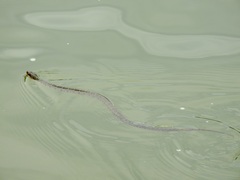
Plain-bellied Water Snake

Plain-bellied Water Snake

Nerodia erythrogaster

Silhouette: Beth Reinke · PhyloPic

LCLeast ConcernNTVUENCR
Daily sighting probability ~60% · Likely
at Congaree National Park

In 3 days >90%

206 Verified sightings at Congaree National Park From 2019 to 2026
236 In all 2 parks
May Best month
☀️🌙 Day & Night When it's spotted

About the Plain-bellied Water Snake

Nerodia erythrogaster, also known as the plain-bellied water snake or plainbelly water snake, is a common species of semi-aquatic, non-venomous colubrid snake endemic to the United States. The plain-bellied water snake is a large, thick-bodied, mostly patternless snake, with a generally beige underside. Some snakes display a thin, white line between the pale belly and their darker top scales. Subspecies can range from dark brown, gray, and olive-green to greenish-gray or blackish in color. Some lighter-colored individuals have dark dorsal patterns. Plain-bellied water snakes can be distinguished from other water snakes by their "plain", patternless undersides, which vary in color from light reddish hues to beige; this is where they get the common name "plain-bellied", as they typically have no notable markings on their bellies. There used to be recognized subspecies of the plain-bellied water snake, although scientists often had a hard time differentiating between them. This has led to these subspecies no longer being recognized.

The scientific name erythrogaster comes from the Greek word "erythros" (meaning 'red') and "gaster" (meaning 'belly'). This species exhibits... Wikipedia →

Global Distribution

Parks Where Found

# Park Country Daily sighting probability
1 Congaree National Park 🇺🇸 United States
~60%
2 Big Bend National Park 🇺🇸 United States
~10%

Cities Where Found

# City Country Daily sighting probability
1 Austin 🇺🇸 United States
~30%
2 Dallas 🇺🇸 United States
~20%
3 Houston 🇺🇸 United States
~10%
4 San Antonio 🇺🇸 United States
~10%

Zoos & Centres Where Found

# Zoo / Centre Country
1 Cameron Park Zoo 🇺🇸 United States In captivity
2 London Zoo 🇬🇧 United Kingdom In captivity
3 Museum of Life and Science 🇺🇸 United States In captivity

Before you go

What are the chances of seeing a Plain-bellied Water Snake in Congaree National Park?

Likely

About 60% of wildlife watchers report a Plain-bellied Water Snake sighting in Congaree National Park on a given day, based on 206 verified sightings from GBIF citizen-science data from 2019 to 2026. It is the most-seen of the 22 reptiles we can rate there. Over three days the chance rises to over 90%, if each day is a fresh chance.

When is the best time to see a Plain-bellied Water Snake in Congaree National Park?

May

In that month about 80% of wildlife watchers report a Plain-bellied Water Snake in Congaree National Park on a given day, against about 30% in November to January, the lowest months.

What time of day is best to see a Plain-bellied Water Snake?

Between 8 and 11 pm

Across all the parks we cover, that three-hour window holds the most Plain-bellied Water Snake sightings with a recorded time, and about 6 in 10 of them come between 6 am and 6 pm: it is seen both by day and at night.

Is Congaree National Park the best place to see a Plain-bellied Water Snake?

Yes

Of the 2 parks where we can rate Plain-bellied Water Snake sightings, Congaree National Park has the highest daily chance: about 60%. Next come Big Bend National Park (United States, about 10%).

Which relatives of the Plain-bellied Water Snake live in Congaree National Park?

Same genus: Nerodia

The closest relatives of the Plain-bellied Water Snake that you can see in Congaree National Park (genus Nerodia, Watersnakes) are Brown Watersnake (about 60%) and Banded Water Snake (about 50%), with each one's daily chance of a sighting.

Where does the Plain-bellied Water Snake sighting chance come from?

GBIF citizen-science records

It is estimated from how often the Plain-bellied Water Snake is recorded against all the reptiles logged in Congaree National Park (206 verified sightings from 2019 to 2026), calibrated against known sighting rates. Figures are rounded to the nearest 10% because citizen-science data supports honest approximations, not decimals, and months with records from fewer than five people show "—". How it works.

← Back to Congaree National Park